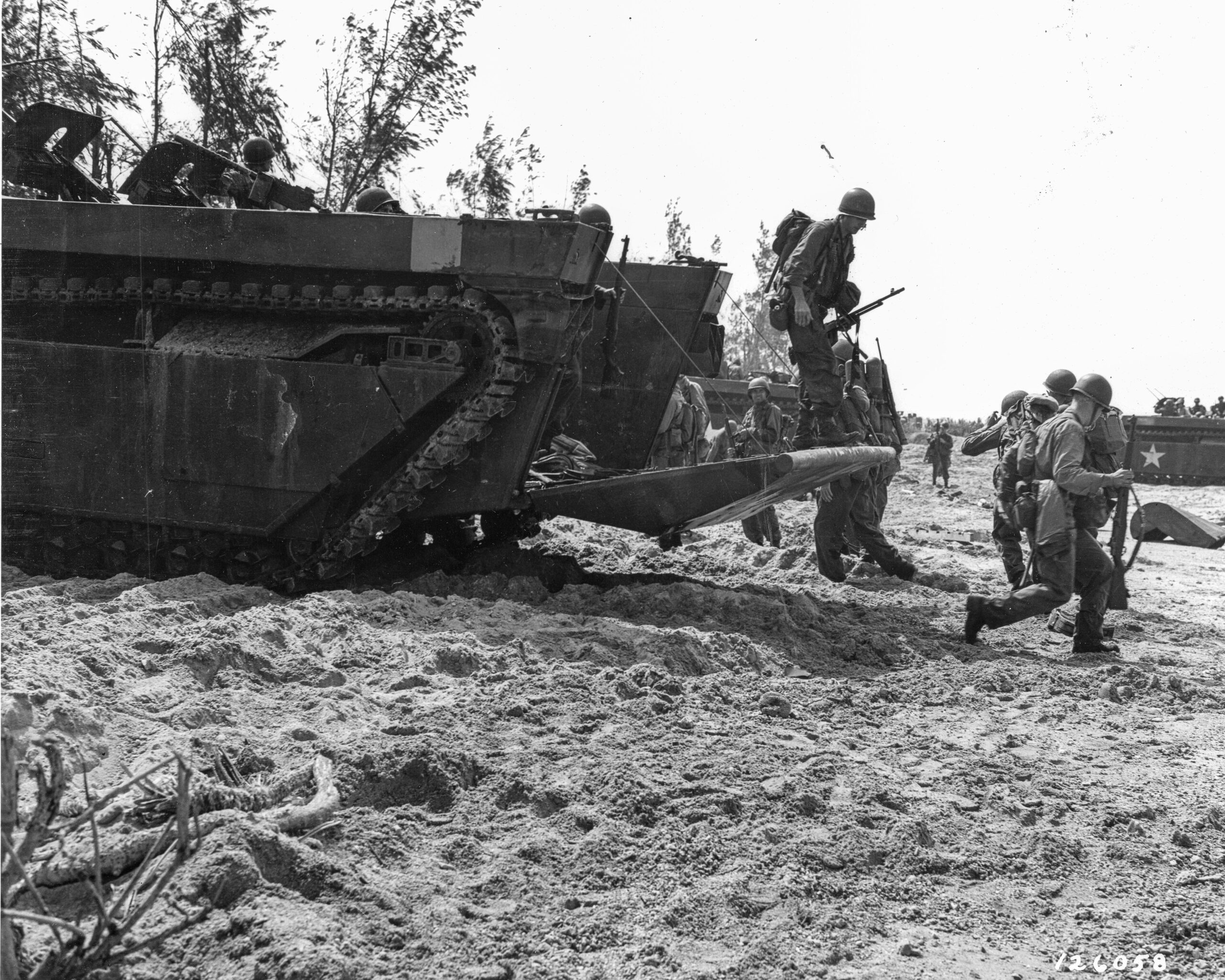
| 1 April 1945 · 08:30 local | Tenth Army Lands Across the Hagushi Beaches | Hagushi beaches, central Okinawa | On the morning of 1 April, American Army and Marine divisions landed on the west-central Hagushi beaches under naval gunfire and air cover. Their first waves found relatively light opposition and pushed inland toward Kadena and Yontan airfields. By evening the landing force had gained a substantial beachhead and was moving across the island’s waist. Sources 1, 2, 3, 4 |
| 6 April 1945 · First major Kikusui wave | Kikusui Attacks Strike the Fleet Screen | Radar-picket stations off Okinawa | On 6 April Japanese naval and army aircraft began the first major Kikusui series of mass attacks against ships around Okinawa. Suicide aircraft, conventional bombers and escorts approached from bases to the north and west, and outlying destroyers often encountered them before they reached the invasion anchorage. Multiple American ships were sunk or damaged during the attacks of 6–7 April. Sources 3, 5, 15 |
| 7 April 1945 · Afternoon | Carrier Aircraft Sink Yamato in Operation Ten-Gō | East China Sea, south of Kyushu | On 7 April American carrier aircraft intercepted the Japanese battleship Yamato, the cruiser Yahagi and their destroyer escorts in the East China Sea. Successive bomb and torpedo attacks destroyed both large ships and four destroyers before the force could reach Okinawa. The Japanese surface sortie failed to disrupt the invasion fleet or the troops established ashore. Sources 3, 4, 5 |
| 9 April 1945 · Morning attack | The American Advance Meets the Kakazu Defenses | Kakazu Ridge, south of the beachhead | By 9 April the American XXIV Corps was pressing against the Kakazu ridgeline, part of the Japanese defensive approaches to Shuri. Infantry attacks had to climb exposed slopes while surviving defenders fired from concealed caves and flanking positions. Local gains were difficult to hold under fire from adjacent strongpoints, and the easy pace of the first landing days ended. Sources 1, 2 |
| 16 April 1945 · Morning | The 77th Division Lands on Ie Shima | Ie Shima, west of northern Okinawa | On 16 April the U.S. 77th Infantry Division landed on Ie Shima, an island northwest of Okinawa, to seize its airfield and remove a Japanese strongpoint from the wider operating area. Japanese resistance developed from concealed positions after the landing and required several days of infantry fighting. The attack expanded the network of airfields supporting the Okinawa operation. Sources 1, 9, 16 |
| 16 April 1945 · Radar-picket battle | Repeated Air Strikes Cripple USS Laffey | Radar Picket Station No. 1 | On 16 April Japanese aircraft attacked U.S. radar-picket ships northeast of Okinawa. The destroyer USS Laffey endured repeated bomb and suicide-aircraft strikes but remained afloat, while other destroyers, including Pringle, were sunk during the wider day’s attacks. The action showed how the exposed picket line absorbed losses as it warned the fleet of incoming aircraft. Sources 5, 15, 16 |
| 19 April 1945 · Major coordinated attack | XXIV Corps Launches a Major Attack on the Shuri Line | Approaches to Shuri | On 19 April the American XXIV Corps renewed its offensive against the Japanese defenses north and east of Shuri after an intensive artillery preparation. Infantry and tanks moved toward ridges defended by the 62nd Division and other Thirty-Second Army elements. Several assaults gained ground locally, but fortified caves, concealed guns and reverse-slope fire limited the intended penetration. Sources 1, 2, 12 |
| 4 May 1945 · Before dawn and daytime | Thirty-Second Army Counterattacks and Loses Strength | Shuri front and east coast | On 4 May Japanese forces attacked outward from the Shuri defensive belt, supported by attempted coastal landings along American-held sectors. Infantry formations of the Thirty-Second Army advanced into concentrated American artillery and small-arms fire. The attack failed to recover the initiative and inflicted substantial losses on units the Japanese command needed to defend the remaining ridges. Sources 1, 2, 12 |
| 11 May 1945 · Morning | Two Suicide Aircraft Devastate USS Bunker Hill | Fifth Fleet operating area off Okinawa | On 11 May two Japanese suicide aircraft struck USS Bunker Hill in quick succession while she operated with the American fast-carrier force off Okinawa. Fires and explosions spread through the carrier, killing and wounding large numbers of crew and air personnel. Damage-control teams saved the ship, but she withdrew for major repairs, and Vice Admiral Marc Mitscher had to move his flag. Sources 3, 5, 15 |
| 18 May 1945 · After a week of fighting | 29th Marines Secure Sugar Loaf Hill | Sugar Loaf Hill, north of Naha | On 18 May elements of the 29th Marines, 6th Marine Division, secured Sugar Loaf Hill after days of repeated attacks and counterattacks. The small rise was part of a larger Japanese defensive complex that covered approaches to Naha and the western side of Shuri. The fight had exhausted assault units and cost tanks and infantrymen as the Marines sought a position from which to keep Japanese defenders from returning to the crest. Sources 1, 2, 11, 12 |
| 29 May 1945 · Morning | Marines Enter Shuri as the Japanese Army Withdraws | Shuri Castle | On 29 May troops of the U.S. 1st Marine Division entered Shuri Castle, the historic fortress commanding the central Japanese defensive position. The site had been heavily damaged by bombardment and weeks of fighting. The Japanese Thirty-Second Army had already begun withdrawing toward the southern end of Okinawa, leaving Shuri to the advancing Americans. Sources 1, 2, 12 |
| 4 June 1945 · Amphibious assault | Sixth Marine Division Lands on Oroku Peninsula | Oroku Peninsula, Naha harbor | On 4 June elements of the 6th Marine Division crossed Naha harbor and landed on Oroku Peninsula to isolate and defeat the Japanese naval force commanded by Rear Admiral Minoru Ōta. Fighting developed around defended ridges, built-up positions and underground naval headquarters. The landing gave the Marines an approach behind the coastal positions that guarded the western part of Naha. Sources 1, 2, 6, 8 |
| 13 June 1945 · Collapse of naval headquarters | Organized Japanese Naval Resistance Ends on Oroku | Oroku naval headquarters | By 13 June American Marines had overcome the principal Japanese naval positions on Oroku Peninsula. Rear Admiral Minoru Ōta died by suicide in the underground naval headquarters with members of his staff. Surviving defenders were dispersed or isolated, and the organized naval defense of the peninsula ended. Sources 1, 2, 6, 8, 7 |
| 18 June 1945 · Afternoon | Japanese Artillery Kills General Buckner | Southern Okinawa, near the Marine front | On 18 June a Japanese artillery burst killed Lieutenant General Simon Bolivar Buckner Jr. while he observed Marine operations near the southern Okinawa front. Buckner had commanded the U.S. Tenth Army from the landing through the prolonged battle for Shuri and the drive to the final Japanese positions. Major General Roy S. Geiger, the Marine III Amphibious Corps commander, temporarily assumed command of the army. Sources 1, 2, 6 |
| 22 June 1945 · Official campaign-end ceremony at 10:00 | Tenth Army Marks the End of the Okinawa Campaign | Mabuni and the southern Okinawa highlands | At 10:00 on 22 June, the U.S. Tenth Army held a formal flag-raising ceremony at its headquarters to mark the end of the Okinawa campaign. General Roy Geiger had reported the island secured on 21 June as Japanese resistance fragmented around Mabuni. Lieutenant General Mitsuru Ushijima and Chief of Staff Isamu Chō died by suicide in their southern headquarters area, while American troops continued searches and received surrenders in the days that followed. Sources 1, 2, 6, 7, 10, 12 |