Skip to content
WW2 Theatres Theatres of the Second World War
Home / The Western Front / The Liberation of Paris
Tanks and half-tracks of the French 2e Division Blindée pass the Arc de Triomphe through crowds on the Champs-Élysées, 26 August 1944.

The Liberation of Paris

19 to 26 August 1944 · Paris, France · Insurrection, armoured entry and surrender

Paris was meant to be bypassed. The rising that began on 19 August made that plan politically and militarily untenable; a week later the city had passed from insurrection to French armoured entry, German surrender and de Gaulle's victory procession.

Jack Downey, US Office of War Information · Library of Congress · Public domain · Source

This event sits inside Operation Overlord, where it appears as a single entry. This page carries it in full.

BACK TO OPERATION OVERLORD
INSURRECTION BEGAN
19 Aug 1944Police seize the Préfecture; open fighting spreads across Paris
BARRICADES
Nearly 600Paris and its suburbs by 24 August, according to the Musée de la Libération
FIRST REGULAR TROOPS IN
24 Aug, 21:22Dronne and La Nueve reach the Hôtel de Ville
SURRENDER
25 Aug 1944Choltitz signs; Leclerc receives the capitulation and Rol-Tanguy countersigns
VICTORY PROCESSION
26 Aug 1944De Gaulle walks from the Arc de Triomphe toward Notre-Dame
Marker affiliation Allied Axis Other / contested
Map layers

01 / 34

The City

Strongpoints, streets and a front that could not be drawn as one line

Paris was a city the Allied armies had intended to bypass. Feeding it would immediately draw thousands of tons a day from an already stretched supply system, while a deliberate assault risked turning a political prize into an urban battle. German strength is reported differently according to what is counted: the Supreme Commander's wartime report described a Paris garrison of about 10,000, while broader Greater Paris totals include additional security, administrative and rear-area troops.

The Germans held a chain of strongpoints rather than a continuous front: command buildings, barracks, government sites and road junctions that could be reinforced by armoured vehicles. Between them lay twenty arrondissements, bridges, railway stations and public buildings that the Resistance could seize faster than the garrison could occupy every street.

That is why the map treats control as schematic. From 19 August the FFI and striking police held pockets, buildings and neighbourhood routes rather than a clean territorial line. By 24 August the Musée de la Libération records nearly 600 barricades in Paris and the suburbs, slowing movement and multiplying the number of places the garrison had to contest.

Command & Decision

An uprising inside Paris changed an Allied plan made outside it

Three contests ran at once. Rol-Tanguy and the FFI were trying to turn strikes and occupied buildings into a general uprising. Nordling was trying to keep channels open between the insurgents and the German command, using negotiations to limit fighting and secure prisoners. De Gaulle and his delegates were trying to ensure that liberation restored French state authority rather than leaving the political outcome to whichever armed group controlled the Hôtel de Ville.

The decisive operational choice was made outside the map. Eisenhower had planned to bypass Paris, but pressure from de Gaulle and reports carried out from the city forced a reconsideration. The relief force was authorised, with Leclerc's 2e Division Blindée chosen to spearhead the entry and the US 4th Infantry Division advancing on another axis. Those headquarters decisions are kept in this narrative instead of dragging the rail-scroll camera hundreds of kilometres away from Paris.

Inside the city, Choltitz faced orders that threatened destruction while his position was already collapsing. The Supreme Commander's report recorded that he made no attempt to destroy the bridges or other major installations. His later memoir turned that outcome into a story of personal refusal; the page keeps the result separate from the postwar claim about motive.

De Gaulle then made the political meaning visible. He went first to the Ministry of War, the office he had left in 1940, and only afterwards to the Hôtel de Ville. On 26 August he walked down the Champs-Élysées at the head of a victory procession. The sequence asserted continuity of the French Republic as clearly as any speech.

Raoul Nordling
Consul-General, Sweden

Raoul Nordling

Swedish Consulate-General, Paris

A neutral businessman born in Paris who put himself between the garrison and the rising, negotiated the truce that bought the city five days, and used it to take several thousand political prisoners out of German custody before they could be deported.

Swedish National Archives · Source
Philippe Leclerc de Hauteclocque
Général de division, France

Philippe Leclerc de Hauteclocque

Commanding, 2e Division Blindée

Sent a detachment towards Paris without orders on 21 August, then took the division in on the 24th. He had sworn at Kufra in 1941 that he would not stop until the French flag flew over Strasbourg.

French national collection · Public domain · Source
Henri Rol-Tanguy
Colonel, France

Henri Rol-Tanguy

Commanding, FFI Île-de-France

Ordered general mobilisation on 18 August without waiting for Free French agreement, rejected the truce three days later, and commanded the rising from a tunnel beneath Denfert-Rochereau. His signature is on the surrender beside Leclerc's.

Musée de la Libération de Paris · Source
Charles de Gaulle
President, Provisional Government of the French Republic

Charles de Gaulle

Free France

Insisted that a French division enter first and that he go to the Ministry of War before the Hôtel de Ville. Refused to proclaim the Republic on the grounds that it had never ceased to exist.

US Office of War Information · Public domain · Source
Dwight D. Eisenhower
General, United States

Dwight D. Eisenhower

Supreme Commander, Allied Expeditionary Force

Had planned to bypass Paris while the armies pursued the retreating Germans. Pressure from de Gaulle and information carried from the uprising changed the calculation; Eisenhower authorised a relief force, with the 2e Division Blindée selected to spearhead the move into the capital.

US Army · NARA 778813 · Public domain · Source
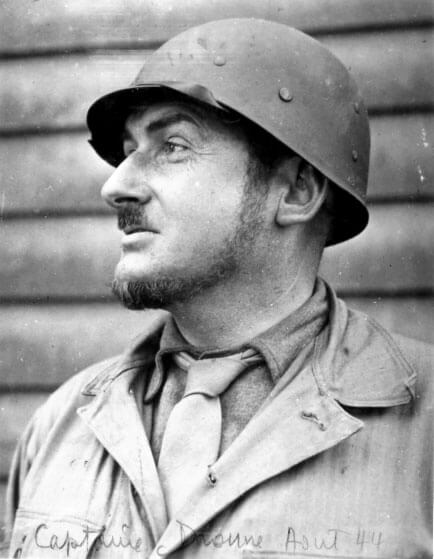
Raymond Dronne
Capitaine, France

Raymond Dronne

9th Company, Régiment de marche du Tchad

Given a direct order to reach the centre of Paris that night by any route available. Took three tanks and a handful of half-tracks through the Porte d'Italie and halted in front of the Hôtel de Ville at 21:22 on 24 August.

Service historique de la Défense · Source
Alexandre Parodi
Delegate General, France

Alexandre Parodi

Provisional Government delegation in Paris

The senior representative of de Gaulle's government inside the city. Arrested at a German checkpoint on 20 August carrying the papers naming the new administration, and released the same day through Nordling's intervention.

French national collection · Source
Jacques Chaban-Delmas
Général de brigade, France

Jacques Chaban-Delmas

National Military Delegate

At 29 the youngest general officer in the French forces, moving between London, Algiers and Paris. Argued against launching the rising before the Allies were close enough to support it, and was overruled by events.

French national collection · Source
Dietrich von Choltitz
General der Infanterie, Germany

Dietrich von Choltitz

Commander, Greater Paris

Received the order to leave Paris as a field of ruins and did not carry it out. His postwar account presented this as a soldier's refusal to destroy a European capital. Historians note he lacked the means to do it properly, held ground he could not defend, and had reason to leave the city intact for the men about to capture him.

French national collection · Public domain · Source
Walter Model
Generalfeldmarschall, Germany

Walter Model

Commander-in-Chief West from 17 August

Took over the western command in the middle of the Falaise catastrophe, with the whole German position in France collapsing. Paris was one problem among several and he had no reserves to send to it.

Bundesarchiv · CC BY-SA 3.0 DE · Source

Arms & Machines

The machines that carried the 2e DB into an uprising already under way

The Resistance fought with an uneven collection of small arms, including Sten submachine guns and weapons taken from German troops. The regular force that arrived behind it was an American-equipped French armoured division: Shermans, M3 half-tracks, M8 reconnaissance vehicles and M10 tank destroyers gave Leclerc the mobile firepower the insurgents lacked.

German armour in Paris included reused French vehicles as well as other armoured and self-propelled weapons held at strongpoints and roadblocks. A surviving frame from the clandestinely filmed battle shows a German-used Hotchkiss H35 moving through central Paris on 19 August. In narrow streets even obsolete armour could dominate a junction until regular Allied weapons arrived.

M4A2 Sherman
The 2e DB Sherman Ile-de-France of the 12e Régiment de Chasseurs d'Afrique landing at Utah Beach on 2 August 1944, before the drive to Paris.
US Army · Public domain · Source

M4A2 Sherman

Medium tank · 75 mm gun · US-built · principal battle tank of the 2e DB

Shermans gave Leclerc's division the protected firepower the Paris insurgents did not possess. The 2e DB landed in Normandy with American equipment and brought its Shermans through the southern approaches and into the city on 25 August.

M3 half-track
A 2e DB half-track, identified in the Commons description as Kichi-Kichi, in the Champs-Élysées procession on 26 August 1944.
Jack Downey, US Office of War Information · Library of Congress · Public domain · Source

M3 half-track

Armoured personnel carrier · .50-cal and .30-cal machine-gun mounts · used throughout the 2e DB

Half-tracks carried infantry and command groups at the same speed as the division's tanks. La Nueve's vehicles became the most recognisable examples because many bore names from the Spanish Civil War and some reached the Hôtel de Ville with Dronne on 24 August.

M10 3-inch Gun Motor Carriage
An M10 tank destroyer photographed in the United States in 1943; representative of the M10s used by the 2e DB in Paris.
US Office of War Information / Library of Congress · Public domain · Source

M10 3-inch Gun Motor Carriage

Tank destroyer · 3-inch gun · open turret · RBFM, 2e Division Blindée

The Régiment blindé de fusiliers marins operated M10 tank destroyers inside the 2e DB. ECPAD's Paris liberation records specifically identify M10s of the division in the capital, where their high-velocity guns gave French columns a weapon for German armour and defended strongpoints.

M8 Greyhound
An M8 Greyhound passes beneath the Arc de Triomphe after the liberation of Paris, photographed on 29 August 1944.
US Office of War Information / NARA · Public domain · Source

M8 Greyhound

6×6 armoured reconnaissance car · 37 mm gun · high road speed

Light armoured cars performed reconnaissance and liaison work around fast-moving columns. An M8 was photographed under the Arc de Triomphe after the liberation; its exact unit is difficult to prove because wartime censorship removed identifying numbers.

M8 75 mm Howitzer Motor Carriage
An M8 Howitzer Motor Carriage pilot vehicle at Aberdeen Proving Ground on 22 September 1942, a wartime representative image.
US Government · Public domain · Source

M8 75 mm Howitzer Motor Carriage

Self-propelled howitzer · 75 mm M2/M3 · Stuart-derived chassis

The 2e DB's American equipment included M8 self-propelled howitzers for close artillery support. They paired an armoured, mobile chassis with a 75 mm howitzer suited to supporting rapidly changing armoured columns.

Sten Mk II submachine gun
A French partisan with a Sten crouches beside an American officer during street fighting in an unidentified French city in 1944; a representative Resistance weapon photograph, not a Paris-specific image.
US Army Signal Corps · NARA 531322 · Public domain · Source

Sten Mk II submachine gun

9×19 mm · blowback submachine gun · compact weapon supplied to French resistance groups

Stens were among the compact automatic weapons supplied to French resistance networks. Paris fighters had far fewer firearms than men willing to fight, so dropped, hidden and captured weapons were concentrated where they could protect barricades and seized buildings.

Hotchkiss H35 in German service
A German-used Hotchkiss H35 moving through central Paris on 19 August 1944, from the clandestinely produced liberation film.
Comité de Libération du Cinéma Français film frame · Public domain on Commons · Source

Hotchkiss H35 in German service

Captured French light tank · 37 mm gun · reused by German occupation forces

Occupation and security units made use of captured French armour. A frame from the Resistance film La Libération de Paris shows a German-used Hotchkiss H35 moving through central Paris on 19 August, an obsolete tank that was still dangerous in narrow streets against lightly armed insurgents.

Browning M1919A4
A Browning M1919 crew in Aachen on 15 October 1944; a wartime representative image of the weapon rather than a Paris photograph.
Ellett, US Army · Public domain · Source

Browning M1919A4

.30-calibre machine gun · belt-fed · infantry and vehicle weapon

US-equipped French formations used Browning machine guns on vehicles and in dismounted roles. In a city fight the M1919 gave regular troops sustained fire unavailable to most FFI groups and could be moved from a vehicle mount to a street position.

The Cost

Paris and the Paris region, using the French official commemorative accounting

French Ministry of the Armed Forces material gives about 1,000 FFI dead, 580 civilians killed and 156 soldiers of the 2e Division Blindée killed in Paris and the Paris region. The same official narrative gives about 3,200 German dead and 12,800 prisoners. Other works use different boundaries and counting methods, so these figures should be read as one defined official accounting rather than exact totals for every fight inside the city.

The cost also sits beside the occupation that had just ended. Deportations, imprisonment and executions continued into the final days before the uprising. The liberation therefore belongs in the same August chronology as the last departures from Paris prisons and deportation sites.

About 1,000

FFI killed

French official commemorative material gives about 1,000 FFI dead in Paris and the Paris region during the liberation.

Proposed by French Ministry of the Armed Forces, Chemins de mémoire, La Libération de Paris - Août 1944

580

Civilians killed

Official French accounting gives 580 civilian dead in Paris and the Paris region during the liberation.

Proposed by French Ministry of the Armed Forces, Chemins de mémoire, La Libération de Paris - Août 1944

156

2e Division Blindée killed

The same official French accounting gives 156 dead from Leclerc's division in Paris and the Paris region.

Proposed by French Ministry of the Armed Forces, Chemins de mémoire, La Libération de Paris - Août 1944

About 3,200 / 12,800

German killed / prisoners

French official commemorative material gives about 3,200 German dead and 12,800 prisoners for the liberation of Paris and its region; different works use different geographic boundaries.

Proposed by French Ministry of the Armed Forces, Chemins de mémoire

Books & Relics

The authenticity of the relics is not verified by WW2 Theatres.

This collection is curated by WW2 Theatres and not affiliated with our website, with all site photographs licensed to their respective owners.

Sources & Archives

US Army Center of Military History · Musée de la Libération de Paris · Archives de Paris

The Musée de la Libération de Paris, built above Rol-Tanguy's command post beneath the Place Denfert-Rochereau, holds the largest single collection on the rising. Alongside it sit the Archives de Paris, the Mémorial de la Shoah for the deportations, and the US Army official history for the Allied side of the decision to change the plan.

Times before 24 August are approximate, drawn from Resistance reports written after the fact and from the Prefecture logs. District control shown on the map is generalised and shows the pattern of the rising rather than street-level positions.

  1. Breakout and Pursuit, the American official history of the decision to enter Paris, Martin Blumenson, 1961US Army Center of Military History
  2. Collections of the Paris insurrection, in Rol-Tanguy's command post beneath Denfert-RochereauMusée de la Libération de Paris, Musée du Général Leclerc, Musée Jean Moulin
  3. Prefecture of Police records and municipal registers for August 1944Archives de Paris
  4. Deportation records for France, including the convoys from DrancyMémorial de la Shoah
  5. Film and photographic record of the Liberation of ParisECPAD, Établissement de communication et de production audiovisuelle de la Défense
  6. Liberation of Paris, photographic categoryWikimedia Commons
  7. Papers and reports of the Swedish Consulate-General in Paris, 1944Riksarkivet, Swedish National Archives
  8. Records of the 2e Division Blindée and the Régiment de marche du TchadService historique de la Défense, Vincennes
  9. La Nueve and the Spanish Republicans of the 9th CompanyMinisterio de Cultura, Spain, and municipal commemorations in Paris
  10. Free French records and the addresses of General de Gaulle, August 1944Fondation Charles de Gaulle
  11. La Libération de Paris - Août 1944Chemins de mémoire, French Ministry of the Armed Forces
  12. Report by the Supreme Commander to the Combined Chiefs of Staff on the Operations in Europe, Dwight D. Eisenhower, 1946US Army Center of Military History
Operation chronologyDates, locations and sourced event summaries
DateEventLocationSummary
Tuesday 8 August · MiddayCholtitz arrives at the Hôtel MeuriceHôtel Meurice, rue de Rivoli

Dietrich von Choltitz had been appointed military governor of Paris on 7 August and reached the capital the following day, establishing his headquarters in the Hôtel Meurice on the rue de Rivoli.

Sources 1, 2, 12
Thursday 10 August · 06:00The railwaymen strikeGare du Nord and the depots

Railway workers across the Paris region stopped work. The strike closed the network the German army needed to move troops and supplies through the city, and it was the first open act of the rising that followed.

Sources 2, 3
Tuesday 15 August · 05:00The police strikePréfecture de Police, Île de la Cité

Around 20,000 Paris policemen stopped work rather than be disarmed by the Germans, who had begun seizing weapons from precincts they no longer trusted. The Métro stopped the same day and the postal workers followed.

Sources 2, 3
Tuesday 15 August · 09:00The last train leaves PantinPantin station

Around 2,200 prisoners were taken from Fresnes, Romainville and the Cherche-Midi and loaded onto a train at Pantin bound for Buchenwald and Ravensbrück. It was the last mass deportation train to leave Paris.

Sources 4
Thursday 17 August · 10:00Vichy and the German administration leaveCentral Paris

Pierre Laval was removed to Belfort and the Vichy apparatus in Paris dissolved. German civil administration began burning files and loading lorries, and the Gestapo offices on the avenue Foch emptied.

Sources 1, 2
Friday 18 August · 18:00Rol-Tanguy orders general mobilisationDenfert-Rochereau

Colonel Henri Rol-Tanguy, commanding the FFI in the Île-de-France, had posters printed calling every Parisian capable of bearing arms to mobilise. His command post was in a disused tunnel beneath the Place Denfert-Rochereau, connected to the surface by the city telephone system the Germans never cut.

Sources 2, 3
Saturday 19 August · 07:00The police seize the PréfecturePréfecture de Police

Around two thousand striking policemen occupied their own headquarters on the Île de la Cité at first light and raised the tricolour over it for the first time since June 1940. La Marseillaise was sung in the courtyard.

Sources 2, 3
Saturday 19 August · 08:30Luizet installed as Prefect of PolicePréfecture de Police

Charles Luizet, appointed by the Provisional Government, took possession of the Prefecture as its lawful head. Alexandre Parodi, de Gaulle's delegate general, and Jacques Chaban-Delmas, his military delegate, were both in the city.

Sources 2, 10
Saturday 19 August · 10:00The rising spreadsAcross the city

Town halls in the eastern arrondissements were taken one after another. Fighting broke out at the Place de la République, on the boulevards and around the German strongpoints. Weapons were taken from the men who had been carrying them.

Sources 2, 3
Saturday 19 August · 14:00German armour shells the PréfectureQuai des Orfèvres

Tanks and self-propelled guns came onto the quais and shelled the Prefecture across the river, setting fires in the courtyard. The defenders had rifles, a few automatic weapons and petrol bombs made in the building.

Sources 2, 3
Saturday 19 August · 19:00Nordling opens negotiationsSwedish Consulate-General

Raoul Nordling, the Swedish consul-general, born in Paris and running a business there, put himself between the garrison and the rising. He proposed a truce to both sides on the argument that neither could win quickly and both would lose the city.

Sources 2, 7
Sunday 20 August · 09:00The truce is declaredHôtel de Ville

A ceasefire was announced by loudspeaker car through the streets: the Germans would not attack occupied buildings, the Resistance would not attack German columns leaving the city.

Sources 2, 3, 7
Sunday 20 August · 13:00Parodi is arrested, and releasedRue de Bourgogne

Alexandre Parodi, the senior representative of the Provisional Government in Paris, was stopped at a German checkpoint carrying documents naming the Free French administration for the city.

Sources 2, 7, 10
Sunday 20 August · 17:00Nordling secures the prisonersFresnes and the Paris prisons

Using the truce, Nordling negotiated the transfer of political prisoners from German custody to the Red Cross and the Swedish consulate. Several thousand people were taken off the deportation lists in the days that followed.

Sources 2, 4, 7
Monday 21 August · 10:00Rol-Tanguy rejects the truceDenfert-Rochereau

The FFI command and the Paris committee of liberation repudiated the ceasefire and ordered the fighting resumed. Rol-Tanguy's position was that a rising that stops is a rising that has surrendered its claim.

Sources 2, 3
Tuesday 22 August · 08:00The barricades go upThe whole city

Fighting resumed and Paris began building. Paving stones came up by hand, trees came down across boulevards, and lorries, buses and furniture filled the gaps. The Musée de la Libération records nearly 600 barricades in Paris and the suburbs by 24 August.

Sources 2, 3
Wednesday 23 August · 09:00Hitler threatens Paris with destructionHôtel Meurice

Orders reaching the Paris command demanded that the capital should not be surrendered intact and threatened bridges and key installations if the city had to be abandoned.

Sources 1, 12
Wednesday 23 August · 16:00The Grand Palais burnsGrand Palais

German forces set the Grand Palais on fire during fighting on 23 August after clashes involving police and FFI nearby. Smoke from the huge glass-roofed building became one of the most visible signs that the struggle for the city was still active.

Sources 2, 3, 11
Thursday 24 August · 09:00The advance is held at the southern approachesAntony and the southern approaches

The 2e Division Blindée met determined German resistance on the roads through Antony, Fresnes and the southern approaches. Progress was slower than Leclerc wanted while columns searched for routes through roadblocks and defended junctions.

Sources 1, 8
Thursday 24 August · 19:00Leclerc orders a detachment in by any routeSouth of Paris

With the main columns still delayed on the approaches, Leclerc ordered Captain Raymond Dronne to take a small detachment by back routes and reach the centre of Paris that night.

Sources 1, 8, 9
Thursday 24 August · 20:00La Nueve enters the cityPorte d'Italie

Dronne's column came through the Porte d'Italie and drove north through streets held or screened by the Resistance, with civilians helping point out routes around German positions.

Sources 8, 9
Thursday 24 August · 21:22The first troops reach the Hôtel de VilleHôtel de Ville

La Nueve halted on the square in front of the Hôtel de Ville. The first regular Allied soldiers to reach the centre of Paris were Spanish exiles in American vehicles wearing French uniforms.

Sources 2, 8, 9
Thursday 24 August · 22:22The bellsNotre-Dame

The great bell of Notre-Dame began to ring and church bells across Paris followed. The sound carried through a city that was still divided by German strongpoints and Resistance-held streets.

Sources 2, 3, 5
Friday 25 August · 07:00The main force entersPorte d'Orléans

The main body of the 2e Division Blindée entered through the southern gates on 25 August, while the US 4th Infantry Division advanced into Paris on another axis.

Sources 1, 8
Friday 25 August · 10:00German strongpoints fall across the cityLuxembourg Palace

French and American troops, often accompanied by FFI, reduced the remaining German strongpoints around sites including the Luxembourg Palace, the École Militaire, government buildings and military headquarters.

Sources 1, 2, 5, 8
Friday 25 August · 13:30Choltitz is taken at the MeuriceHôtel Meurice

French troops reached the Hôtel Meurice and captured Choltitz at his headquarters. He was taken first to the Préfecture de Police and then to Leclerc at Montparnasse.

Sources 1, 2, 8
Friday 25 August · 15:30The surrender is signedGare Montparnasse

Choltitz signed the capitulation of the Paris garrison on 25 August. The written convention was received by Leclerc and countersigned by Henri Rol-Tanguy for the FFI.

Sources 1, 2, 8
Friday 25 August · 16:00Rol-Tanguy's signature fixes the Resistance into the surrenderGare Montparnasse

Henri Rol-Tanguy's countersignature placed the FFI command on the written capitulation beside the regular French military authority represented by Leclerc.

Sources 2, 8, 10
Friday 25 August · 17:00De Gaulle goes to the Ministry of War firstMinistry of War, rue Saint-Dominique

De Gaulle entered Paris and went not to the Hôtel de Ville, where the Resistance was waiting, but to the Ministry of War, into the office he had left in June 1940. He found the furniture where he had last seen it.

Sources 10
Friday 25 August · 19:00The speech at the Hôtel de VilleHôtel de Ville

De Gaulle went to the Hôtel de Ville and addressed the crowd, presenting the liberation as the recovery of a French state that had continued through the war.

Sources 2, 10
Saturday 26 August · 15:00The march down the Champs-ÉlyséesArc de Triomphe to Notre-Dame

De Gaulle laid a wreath at the Arc de Triomphe and then moved down the Champs-Élysées through an immense crowd, accompanied by figures from the provisional government, the Resistance and the armed forces.

Sources 5, 8, 10
Saturday 26 August · 15:45Gunfire scatters the victory crowdPlace de la Concorde

As the victory procession crossed central Paris, gunfire sent people on the Place de la Concorde flat onto the pavement and scrambling for cover. A US Army photographer caught the moment.

Sources 2, 5, 10
Saturday 26 August · 23:00The last raidEastern arrondissements

German aircraft bombed Paris during the night of 26 to 27 August, striking eastern districts after two days of liberation celebrations.

Sources 2, 3, 11
After · —Liberation gives way to reckoningParis

The bridges and major installations had survived, and the new authorities now had to feed, police and govern a capital emerging from occupation while the Allied armies continued east.

Sources 1, 2, 3, 10

Image rights. US federal government photographs are public domain. Paris Musées images marked CC0 are used under the CC0 dedication. Bundesarchiv portraits are credited under their stated Creative Commons licences. Other files retain the licence and attribution stated on their individual Wikimedia Commons File pages.