Skip to content
WW2 Theatres Theatres of the Second World War
Home / The Battle of the Atlantic / The Opening Convoy War
A young survivor of Athenia being passed ashore from the Norwegian rescue vessel Knute Nelson at Galway following the liner’s sinking on 3 September 1939.

The Opening Convoy War

3 September 1939 to 25 June 1940 · Western Approaches, North Atlantic and British coastal waters · Ten months

Britain restored convoy within days of the declaration of war. Germany's U-boat arm could still sink ships and deliver spectacular blows, but it began the campaign with too few ocean-going boats to maintain a blockade. The opening months became a contest over concentration, escort, mines, air reconnaissance and unreliable torpedoes before the fall of France changed the geography of the Atlantic war.

Press Agency photographer · Imperial War Museums HU 51014 · IWM Non-Commercial Licence

ATLANTIC U-BOATS
18Available for Atlantic operations on 7 September 1939; Germany had 57 U-boats in total
CONVOY RETURNS
6–7 SeptemberCoastal convoys began on 6 September; outward ocean convoys followed the next day
FIRST HX CONVOY
16 September 1939Eighteen merchant ships sailed from Halifax, escorted by the Canadian destroyers Saguenay and St. Laurent
ROYAL OAK DEAD
835Killed when U-47 penetrated Scapa Flow on 14 October 1939
TORPEDO CRISIS
8 failed shotsU-47 attacked transports at Vaagsfjord twice on 16 April 1940 without a hit
Marker affiliation Allied Axis Other / contested
Map layers

01 / 12

Convoys Return to the North Atlantic

The First World War had already shown that grouping merchant ships could reduce the submarine's opportunities

The convoy principle had been established in the First World War, and the Admiralty reintroduced it within days of the declaration of war. Regular east-coast convoys began on 6 September 1939 and outward ocean convoys on 7 September. The first Halifax convoy, HX 1, sailed on 16 September. The early arrangements were still incomplete. Escorts were scarce, ocean coverage was limited and many ships continued independently on routes that could not yet be protected continuously.

Convoy worked before the escorts became technically dominant because it changed the submarine's search problem. A U-boat could patrol an ocean route for days without seeing anything. Grouping dozens of ships into one moving formation reduced the number of targets at sea and allowed the available destroyers, sloops and armed vessels to protect several cargoes at once. The escort's task was to make the convoy harder to find, force the attacker to approach a defended formation and keep losses low enough that the cargo flow continued. By the end of 1939 the Royal Navy had escorted almost 5,800 merchant ships in convoy and lost twelve of them. In the same months 102 ships sailing independently were sunk.

The first months differ from the great North Atlantic convoy battles of 1941 to 1943. Germany had too few boats to maintain wide patrol lines for long. British escorts were often thin. Aircraft were better at finding submarines than destroying them, and much of the shipping loss occurred outside convoy. The machinery that later fought the decisive convoy battles was being assembled while the first campaign was already underway.

Dönitz and the Shortage of Ocean-going U-boats

A developed tactical idea met a force too small for continuous Atlantic concentration

Karl Dönitz wanted U-boats to find convoys in patrol lines, report contact and concentrate other boats for a coordinated attack. The force available in September 1939 was not large enough to apply that method continuously. A British postwar study of German records counts 57 U-boats in existence at the outbreak and 49 ready for operational duties on 29 August. Only 18 were available for Atlantic operations on 7 September. Coastal boats, training requirements, maintenance and the long passage from German bases further reduced the number that could remain in the Western Approaches.

The attack of 17–18 October showed what Dönitz was trying to build. U-37, U-46 and U-48 were brought against convoy HG 3, sailing from Gibraltar to Liverpool, under central tactical direction. German records described it as the first attack of that type. The three boats sank three ships. It was evidence that concentration could work, but also evidence of the arithmetic problem. Werner Hartmann's group had started with six boats. One struck a mine on 13 October and two more were sunk in earlier attacks, so only three reached HG 3.

The force was then pulled in several directions. U-boats laid mines, attacked independent shipping and supported operations in the North Sea. In March 1940 they were withdrawn from the Western Approaches for the invasion of Norway. The Norwegian deployment produced many firing opportunities but exposed serious torpedo defects. When the boats returned to the Atlantic, the fall of France was about to solve a different German problem by bringing bases hundreds of miles closer to the convoy routes.

Admiral Sir Martin Dunbar-Nasmith
Commander-in-Chief, Western Approaches · United Kingdom

Admiral Sir Martin Dunbar-Nasmith

Protection of shipping in the Western Approaches

Held responsibility for the Western Approaches from the outbreak of war while also serving as Commander-in-Chief, Plymouth. His command had to organise convoy protection with too few modern escorts, coordinate searches after submarine attacks and keep merchant traffic moving through the waters in which U-boats concentrated their early patrols.

Lt C. J. Ware / Admiralty official collection / IWM A 15047 · UK Government work · Source
Admiral of the Fleet Sir Dudley Pound
First Sea Lord · United Kingdom

Admiral of the Fleet Sir Dudley Pound

Naval policy and allocation of scarce escort forces

Became First Sea Lord shortly before the war. Pound had to divide destroyers and other escorts among trade protection, fleet screening, anti-submarine operations and later the Norwegian campaign. The opening convoy system therefore developed under an allocation problem as much as a technical one: every ship assigned to one task was unavailable for another.

Bassano · UK Crown Copyright expired · Source
Winston Churchill
First Lord of the Admiralty · United Kingdom

Winston Churchill

Political direction of the Royal Navy, September 1939 to May 1940

Returned to the Admiralty on the day Britain declared war. Churchill pressed for aggressive naval action while the service was simultaneously rebuilding convoy protection, countering mines and preparing operations in Scandinavia. His tenure spans the transition from the opening Atlantic defence to the Norwegian campaign, after which he became prime minister on 10 May 1940.

War Office official photographer, Keating · UK Government work · Source
Air Chief Marshal Sir Frederick Bowhill
Air Officer Commanding-in-Chief, Coastal Command · United Kingdom

Air Chief Marshal Sir Frederick Bowhill

Air reconnaissance and early anti-submarine cooperation

Commanded Coastal Command throughout this operation. His aircraft could search wide sea areas and force submarines to dive, but the command entered the war with limited specialised anti-submarine training and ineffective weapons. The 100-pound anti-submarine bomb proved useless against a diving U-boat. Coastal Command's role grew from reporting submarines to attacking them only gradually.

Royal Air Force official photographer / Imperial War Museums CH 14503 · UK Government work · Source
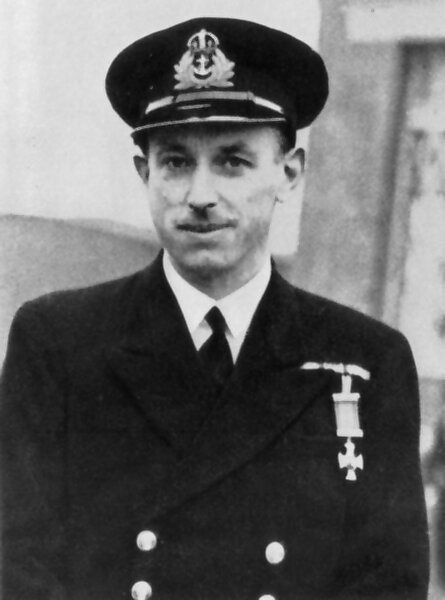
John Ouvry
Lieutenant Commander, Royal Navy · United Kingdom

John Ouvry

Recovery of the German magnetic mine at Shoeburyness

Led the HMS Vernon team that rendered safe the intact Type GA magnetic mine recovered at Shoeburyness on 23 November 1939. Examining its mechanism allowed British specialists to develop effective magnetic sweeping and ship-protection measures against a weapon that had been closing shipping lanes and damaging major warships.

HMS Vernon historical collection, reproduced via The Vernon Link · reuse status not stated · Source
Karl Dönitz
Rear Admiral, Führer der Unterseeboote · Germany

Karl Dönitz

Operational commander of the U-boat arm

Entered the war with a developed concept for concentrating submarines against convoys but without the numbers needed to maintain large Atlantic patrol lines. He used the October 1939 group attack as evidence for coordinated tactics, then had to divert boats to Norway. The repeated torpedo failures there convinced him that technical defects were wasting opportunities his small force could not afford.

Bundesarchiv Bild 101II-MW-5564-25 / Wächter · CC BY-SA 3.0 DE · Source
Erich Raeder
Grand Admiral, Commander-in-Chief of the Kriegsmarine · Germany

Erich Raeder

German naval strategy and the Norwegian diversion

Directed a navy that could not match the Royal Navy in surface strength and supported submarine war against British trade while also pursuing mines, surface raiders and the occupation of Norway. The Norwegian operation drew U-boats away from the Western Approaches in March 1940; the later occupation of the French Atlantic coast transformed the basing position Raeder's navy had lacked in September 1939.

Bundesarchiv Bild 146-1980-128-63 / Ernst Sandau Jr. · CC BY-SA 3.0 DE · Source
Fritz-Julius Lemp
Commander of U-30 · Germany

Fritz-Julius Lemp

Sinking of Athenia

Commanded U-30 when it torpedoed the passenger liner Athenia on 3 September 1939. He later said he had taken her for an armed merchant cruiser. He did not report the sinking by radio, and German authorities later concealed U-30's responsibility. The attack killed civilians on the first day of the Atlantic war and pushed the Admiralty toward immediate convoy protection.

National Digital Archives, Poland · photograph dated September 1940 · Source
Günther Prien
Kapitänleutnant, U-47 · Germany

Günther Prien

Scapa Flow and the April 1940 torpedo crisis

Penetrated Scapa Flow on 14 October 1939 and sank Royal Oak, giving the U-boat arm its most dramatic early success. Six months later the same commander fired eight torpedoes at British transports in Vaagsfjord without a hit. His report helped convince Dönitz that technical failures were crippling the Norwegian submarine operation.

Bundesarchiv Bild 183-2006-1130-500 / Annelise Schulze · CC BY-SA 3.0 DE · Source
Otto Kretschmer
Kapitänleutnant, U-23 · Germany

Otto Kretschmer

Attack on convoy HN 12 and the loss of HMS Daring

Commanded U-23 when it torpedoed HMS Daring during the night of 18 February 1940 while the destroyer was guarding convoy HN 12. Kretschmer used a favourable position inside the escort screen to strike a warship protecting merchant traffic, revealing a vulnerability that early convoy commanders had to address. He transferred to U-99 later in 1940.

Mannewitz / Bundesarchiv Bild 101II-MW-0951-24A · CC BY-SA 3.0 DE · Source

Escorts, ASDIC and the Magnetic Mine Threat

ASDIC, depth charges and aircraft existed in 1939, but none provided continuous detection and destruction

British destroyers and sloops entered the war with ASDIC, but the set was designed primarily to track a submerged submarine at relatively short range. A U-boat attacking on the surface at night could be difficult to detect. An escort that gained contact still had to manoeuvre over the target to deliver depth charges. The escort force itself was too small for the number of ocean, coastal and military commitments placed on it. Older destroyers therefore remained central to convoy defence while new Flower-class corvettes were only beginning to enter service in 1940.

Air patrols offered a way to search much larger areas. Coastal Command was assigned increasing responsibility for attacking U-boats as well as reporting them. The concept was ahead of the weapons. Crews had little specialised anti-submarine training. The 100-pound anti-submarine bomb proved useless against a diving U-boat, and in 1939 only the flying boats could carry the 450-pound depth charge. Aircraft could force a submarine under, break contact with a convoy and narrow the search, but the highly effective air-submarine combination belonged to a later stage of the campaign.

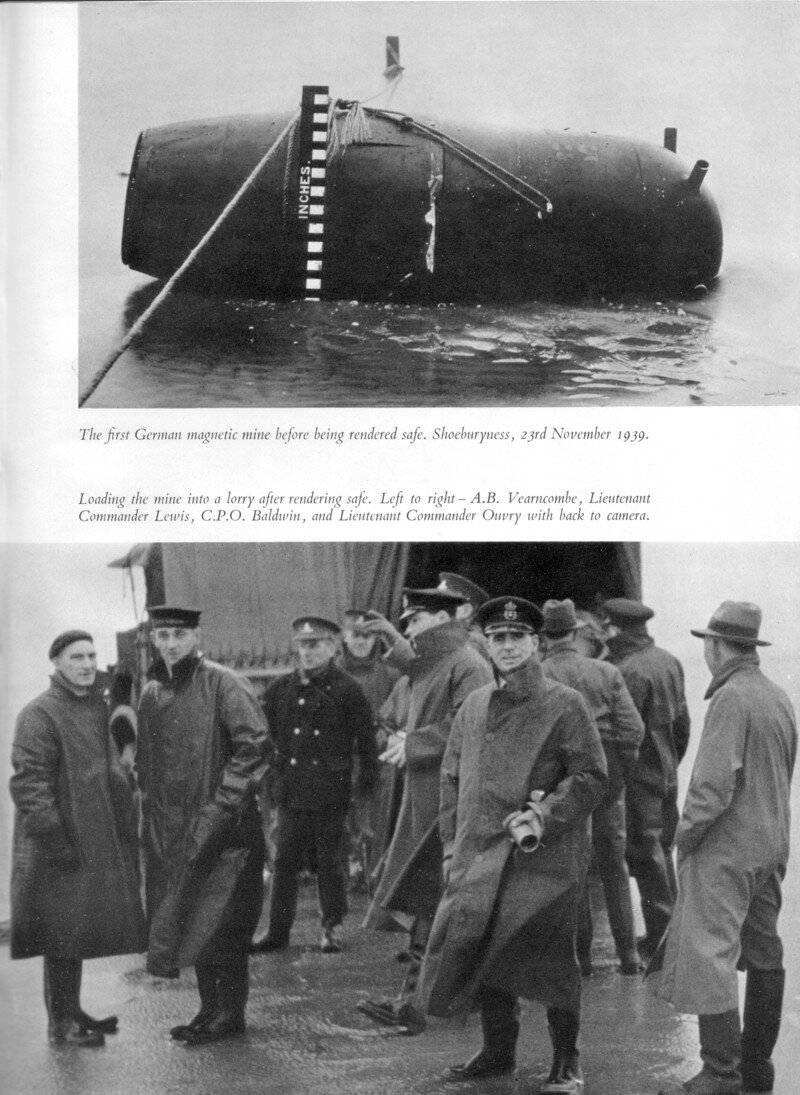
Mines created a separate threat to the same shipping system. German magnetic ground mines could block approaches without a submarine remaining in the area. On 21 November 1939 the cruiser HMS Belfast was mined in the Firth of Forth and put out of action for nearly three years. When a Type GA mine was recovered intact at Shoeburyness on 23 November, John Ouvry and the HMS Vernon team gave British scientists the firing mechanism they needed to design effective countermeasures. Degaussing and magnetic sweeps did not remove the mine threat at once, but they converted an unfamiliar weapon into a technical problem that could be attacked systematically.

Type VIIA/B U-boat
A Type VII submarine taking on torpedoes at Wilhelmshaven, 22 December 1939. Loading boats for the next patrol was part of the early fleet-capacity problem.
Dietrich / Bundesarchiv Bild 101II-MW-5536-03 · CC BY-SA 3.0 DE · Source

Type VIIA/B U-boat

Germany · ocean-going submarine · five torpedo tubes on Type VIIB · principal early Atlantic attack boat

The Type VII combined enough range for the Western Approaches with a hull small enough for rapid production. Its real limitation in 1939 was availability: the Atlantic force was too small to maintain the patrol lines needed for continuous group attacks.

Type IXA U-boat
Type IXA submarine U-37 returning to Wilhelmshaven on 18 April 1940; an example of the long-range U-boats used during the opening Atlantic campaign.
Tews / Bundesarchiv Bild 101II-MW-5613-03A · CC BY-SA 3.0 DE · Source

Type IXA U-boat

Germany · long-range submarine · six torpedo tubes · greater endurance than Type VII

Type IX boats could patrol farther into the Atlantic and remain at sea longer, making them valuable while Germany still operated from home ports. Their small numbers prevented the extra range from becoming a continuous ocean blockade in 1939–40.

V and W-class destroyer
HMS Wolverine (D78), a V- and W-class destroyer, photographed in 1939.
Royal Navy official photograph · UK Government work · Source

V and W-class destroyer

United Kingdom · First World War-era destroyer · convoy escort and anti-submarine work

Older destroyers carried much of the early escort burden because modern fleet destroyers were also needed with the Home Fleet. They had speed, ASDIC and depth charges, but endurance and the sheer number of convoy commitments limited how densely routes could be protected.

Flower-class corvette
Flower-class escort HMS Picotee, photographed July 1941 after the first corvettes had entered wartime service; illustrates the class ordered to meet the early escort shortage.
Royal Navy official photographer / IWM A 4594 · UK Government work · Source

Flower-class corvette

United Kingdom and Canada · small ocean escort · entering service from 1940

Flowers were ordered as inexpensive escorts that could be built in commercial yards. Only the first were entering service during this operation, but the class represented the answer to the escort-number problem that pre-war destroyer forces could not solve alone.

ASDIC active sonar display
Surviving ASDIC sonar display photographed at the German Museum of Technology, Berlin, in 2013; a later equipment-identification photograph.
ÄDA-DÄP · CC BY-SA 3.0 · photographed 2013 · Source

ASDIC active sonar display

United Kingdom · shipborne active echo-ranging apparatus · submerged submarine detection

ASDIC transmitted sound pulses and used their echoes to determine the bearing and range of a submerged submarine. It gave escorts a way to develop a depth-charge attack but offered little warning of a U-boat approaching on the surface at night. Contact could disappear during the last part of an attack as the escort passed over its target.

Depth charge
HMS Jaguar releasing depth charges during 1940, illustrating the anti-submarine attack method available to destroyer escorts.
Lt C. J. Ware / Royal Navy official photographer / IWM A 868 · UK Government work · Source

Depth charge

Allied anti-submarine explosive · hydrostatic depth setting · dropped from stern racks and throwers

Depth charges were the escort's main killing weapon once a submerged contact had been obtained. Early attacks required the escort to estimate the submarine's depth and movement, and many patterns forced a boat away without destroying it.

German Type GA magnetic mine
German magnetic Type GA mine on the Shoeburyness mudflats on 23 November 1939, photographed before disarming; the composite also shows the recovery party.
HMS Vernon historical collection, via The Vernon Link · reuse status not stated · Source

German Type GA magnetic mine

Germany · air-dropped magnetic ground mine · influence fuze

The GA mine detonated in response to a ship's magnetic field and lay on the seabed without a mooring wire. Standard contact-mine sweeps could not clear it, allowing a small number of mines to interrupt approaches until an intact specimen was recovered and studied.

Shipboard degaussing cable system
Workers installing hull degaussing cables on an American merchant vessel in April 1942; a later photograph of the same anti-mine system adopted during the opening convoy war.
U.S. Office of War Information, April 1942 / National Museum of the U.S. Navy · Public domain (U.S. federal government) · Source

Shipboard degaussing cable system

Allied merchantmen and warships · electrical cable coils fitted along the hull · magnetic-mine protection

Electrical cables around a ship’s hull carried current that reduced its magnetic signature, making German influence mines less likely to fire beneath it. Britain developed the method alongside magnetic sweeping after the Shoeburyness recovery. External coils remained visible on many vessels; the US wartime example pictured shows the physical cable installation and is distinct from the British Double-L sweep towed by minesweepers.

Shipping Losses, Convoy Survival and U-boat Attrition

The losses were real, and the convoy system kept a small submarine force from turning them into a blockade

Athenia, Courageous and Royal Oak made the opening months appear more disastrous than the convoy record alone suggests. A passenger liner was sunk on the first evening of the British war. A fleet carrier was lost while hunting submarines two weeks later. In October U-47 entered the Royal Navy's principal anchorage and sank a battleship. Each exposed a different vulnerability, and none of them broke Britain's Atlantic supply system.

Convoys were attacked and escorts were lost, but German boats found many of their easier targets outside the protected formations. At the same time the U-boat arm was paying a significant price. By the end of March 1940, between 17 and 19 German submarines had been lost, depending on whether accidents and losses in port are counted. Construction had not yet produced the large operational fleet Dönitz believed necessary for a sustained blockade.

By June 1940 both sides had shown what they could do. Britain had kept traffic moving with imperfect escorts. Germany had shown that submarines, mines and surprise attacks could impose serious losses. Norway interrupted the Atlantic offensive, and defective torpedoes wasted opportunities there. The defeat of France altered the strategic geography of the campaign. U-30 entered Lorient for refit on 7 July 1940, and the patrol route to the Atlantic was dramatically shortened.

117

Athenia dead

Passengers and crew killed after U-30 torpedoed the liner on the evening of 3 September 1939. Sources give totals from 112 to 128.

518

Courageous lost

The Admiralty War Diary recorded 518 of the carrier's complement lost when U-29 sank her on 17 September.

835

Royal Oak dead

Men and boys killed when U-47 torpedoed the battleship at anchor inside Scapa Flow on 14 October.

17–19

U-boats lost by end of March 1940

The count depends on whether accidents and losses in port are included. Either way, German submarine losses were consuming a force that had entered the war too small to maintain a continuous Atlantic blockade.

Admiralty Diaries, BdU War Logs and Coastal Command Records

Royal Navy official history · Admiralty war diaries · BdU war logs · Coastal Command records

The chronology is anchored in Stephen Roskill's official history and the Admiralty War Diaries for the British operational picture. The German side uses the translated BdU war logs and the postwar Admiralty history of German U-boat policy, which preserve the force numbers, convoy assessments and Dönitz's own reactions to the torpedo failures.

The Athenia and Royal Oak casualty figures are checked against Royal Navy and Imperial War Museums material. The magnetic-mine sequence uses the Admiralty history and the record of John Ouvry's recovery at Shoeburyness. Coastal Command's early limitations are taken from the RAF's official history and Bowhill's despatches. Sources give Athenia totals between 112 and 128, and the figure used here is 117. Counts of U-boat losses by March 1940 run from 17 to 19 according to the treatment of accidents and port losses.

  1. The War at Sea 1939–1945, Volume I: The Defensive, S. W. RoskillUnited Kingdom official history / Naval Historical Branch
  2. Admiralty War Diary, September 1939Naval Historical Branch, Royal Navy
  3. BdU War Log, 15 August to 15 September 1939, PG 30247German U-boat Command war diary, translated by US Naval Historical Center
  4. History of U-boat Policy, September 1939 to December 1940British Admiralty CB 4051, based on captured German records
  5. Arms, Men and Governments: The War Policies of Canada, 1939–1945Directorate of History and Heritage, Canada
  6. HMS Royal Oak and the loss at Scapa FlowRoyal Navy and Imperial War Museums records
  7. First controlled U-boat attack on a convoy, 17–18 October 1939BdU operational report, U-37/U-46/U-48
  8. Development of magnetic mines and British countermeasures, 1939Royal Navy official history and HMS Vernon records
  9. John Ouvry and the recovery of the German magnetic mine at ShoeburynessAustralian War Memorial
  10. Coastal Command operations, September 1939 to June 1941Royal Air Force Air Historical Branch
  11. U-23 war diary, patrol of February 1940German U-boat war diary, translated by U-boat Archive
  12. Admiralty War Diary, February 1940Naval Historical Branch, Royal Navy
  13. BdU War Log, April 1940, PG 30263German U-boat Command war diary, translated by US Naval Historical Center
  14. The Conduct of the War at Sea, Karl Dönitz, postwar essayNaval History and Heritage Command
  15. BdU War Log, July 1940, PG 30268German U-boat Command war diary
  16. Sinking of SS Athenia, September 1939, HU 51014Imperial War Museums
  17. The Norwegian Operation and the Torpedo Crisisuboat.net
  18. Sea mine, magnetic, Type GAImperial War Museums
  19. Sinking of HMS Courageous, September 1939Imperial War Museums
  20. U-boat losses during 1939uboat.net
  21. U-boat losses during 1940uboat.net
  22. The Naval Service of Canada: Its Official History, vol. 2, Activities on Shore During the Second World War, G. N. TuckerDepartment of National Defence, Canada
  23. HMS Courageous sinking, 17 September 1939, HU 45268Imperial War Museums / Royal Navy official photographer
  24. HMS Vernon — German Type GA mine at Shoeburyness and Lt Cdr John OuvryThe Vernon Link / Minewarfare and Clearance Diving Officers Association
  25. U-47 war diary, 5th war patrol, April 1940U-boat Archive, translated German Kriegstagebuch
  26. HMS Daring and U-23 patrol, 18 February 1940, Otto KretschmerU-23 Kriegstagebuch / U-boat Archive
Operation chronologyDates, locations and sourced event summaries
DateEventLocationSummary
Sunday 3 September 1939 · 19:40U-30 torpedoes AtheniaNorthwest of Ireland

Hours after Britain declares war, U-30 torpedoes the passenger liner Athenia northwest of Ireland. The ship is carrying 1,418 passengers and crew, including many civilians leaving Europe. Of these, 117 die. The attack contradicts the German restrictions then governing attacks on passenger ships and immediately creates the impression in Britain and the United States that unrestricted submarine warfare may already have begun.

Sources 1, 2, 3, 16
Wednesday 6 September 1939 · Convoy beginsThe convoy system is put back into operationBritish coastal and ocean approaches

Regular east-coast convoys begin on 6 September, and outward ocean convoys from the Thames and Liverpool follow on 7 September. The Admiralty is applying a system whose purpose is to reduce the number of isolated targets at sea and concentrate scarce escort ships around groups of merchantmen. The first arrangements do not provide continuous protection across the Atlantic, but they change the geometry of the submarine campaign immediately.

Sources 1, 2, 4
Saturday 16 September 1939 · HX 1 sailsThe first HX convoy leaves HalifaxHalifax, Nova Scotia

HX 1 sails from Halifax with eighteen merchant ships bound for Britain. The Canadian destroyers Saguenay and St. Laurent provide the local escort as the convoy clears the port, and the cruisers Berwick and York meet it in the Atlantic. The convoy reaches Liverpool without loss. The voyage establishes the eastbound HX series that will become one of the principal North Atlantic supply routes for the rest of the war.

Sources 4, 5, 22
Sunday 17 September 1939 · 20:20U-29 sinks HMS CourageousWestern Approaches, southwest of Ireland

HMS Courageous is torpedoed by U-29 while operating southwest of Ireland as part of a carrier-based anti-submarine hunting group. She sinks within twenty minutes, and the Admiralty War Diary records 518 of her complement lost. The Navy has sent large fleet carriers to search areas where U-boats are expected, but the operation exposes the carrier itself to the weapon it is trying to hunt.

Sources 1, 2, 10, 19, 23
Saturday 14 October 1939 · NightU-47 penetrates Scapa FlowScapa Flow, Orkney

Günther Prien takes U-47 through the incomplete blockship defences of Scapa Flow and attacks HMS Royal Oak at anchor. After an initial torpedo causes limited damage, a second attack produces catastrophic explosions. The battleship capsizes and sinks with 835 men and boys dead. The Home Fleet's principal wartime anchorage has been penetrated by a single submarine.

Sources 1, 6
17–18 October 1939 · First group attackThree U-boats make the first controlled convoy attackEastern Atlantic, west of the Iberian approaches

U-46 reports a northbound convoy, HG 3, on passage from Gibraltar to Liverpool. BdU brings U-37 and U-48 toward the contact, producing the first attack of the war in which several U-boats operate against one convoy under central tactical direction. German records credit the three boats with more than 25,000 gross tons sunk during 17 and 18 October, although torpedo failures and confusion limit the attack.

Sources 4, 7
Thursday 23 November 1939 · Mine recoveredAn intact German magnetic mine is rendered safeShoeburyness, Thames Estuary

Lieutenant Commander John Ouvry and the HMS Vernon mine team render safe a German Type GA magnetic ground mine exposed on the mud at Shoeburyness. British forces have already suffered serious losses and disruption from magnetic mines. They detonate in response to a ship's magnetic field, and the standard wire sweeps designed for moored contact mines cannot clear them. Two days earlier a magnetic mine disabled the cruiser HMS Belfast in the Firth of Forth.

Sources 1, 8, 9, 18, 24
Sunday 18 February 1940 · HN 12U-23 sinks HMS Daring beside convoy HN 12North Sea, on the Norway–Britain convoy route

Kapitänleutnant Otto Kretschmer brings U-23 toward convoy HN 12 during the night and fires at one of the destroyers covering the formation. HMS Daring is hit and breaks apart. The U-boat's own war diary describes a convoy of roughly twenty ships protected by destroyers and a submarine. An escort screen can itself present valuable targets to a boat that gets into a favourable firing position.

Sources 11, 12, 27
Sunday 25 February 1940 · HN 14The escort of HN 14 destroys U-63Southeast of the Shetland Islands

U-63 has already torpedoed the Swedish merchant ship Santos from convoy HN 14 when the British submarine Narwhal sights the U-boat on the surface the following morning. Narwhal signals the convoy escort. Destroyers Escort, Imogen and Inglefield attack with depth charges, forcing U-63 to the surface and destroying her. Twenty-four of the twenty-five German crew survive and are taken prisoner.

Sources 12
March 1940 · RedeploymentU-boats are pulled away from the Western ApproachesNorth Sea and Norwegian approaches

German U-boats begin withdrawing from the Western Approaches so that they can support the planned invasion of Norway. The decision interrupts the Atlantic merchant-shipping offensive. The winter campaign has shown that Britain can keep convoy traffic moving. It has also shown that Germany is struggling to replace submarine losses quickly enough to build a larger force.

Sources 1, 14
Tuesday 16 April 1940 · VaagsfjordEight torpedoes from U-47 fail to hitVaagsfjord, northern Norway

U-47 finds British transports at anchor in Vaagsfjord and attacks at close range. Four torpedoes fail to produce a hit. Prien attacks again and another four fail. Dönitz records the report with alarm: eight unsuccessful shots by one of his most experienced commanders make it increasingly difficult to explain the failures as bad firing solutions or isolated crew error.

Sources 13, 14, 17
22 to 25 June 1940 · French armisticeThe fall of France changes the U-boat warFrench Atlantic coast

France signs an armistice with Germany on 22 June, with hostilities ending on 25 June. The German occupation of the Atlantic coast gives the Kriegsmarine access to ports such as Lorient, Brest and Saint-Nazaire. The bases are not operational for U-boats on the day of the armistice. The strategic change is immediate. Boats will no longer have to begin every Atlantic patrol with the long passage from Germany around the British Isles.

Sources 14, 15, 26

Image rights follow their individual source records: Bundesarchiv material is credited CC BY-SA 3.0 DE, U.S. government material is public domain, and British official photographs retain their applicable source-stated status. The HMS Vernon historical photographs of Ouvry and the Shoeburyness mine have no explicit reusable licence stated on the source page and require confirmation before republishing. Later identification images in KIT are dated as such. The operational map routes are generalised rather than reconstructed individual ship tracks.