Skip to content
WW2 Theatres Theatres of the Second World War
Home / The Opening Campaigns / Battle of France 1940
German troops in northern France during the campaign of 1940.

Battle of France 1940

10 May to 25 June 1940 · France, Belgium, the Netherlands and Luxembourg · Forty-seven days

Follow the Battle of France from the German invasion of the Low Countries and the breakthrough across the Meuse to the evacuation at Dunkirk, the second German offensive and the armistices that ended organised fighting. The timeline explains why the Allied armies moved into Belgium, how German armour reached the Channel, what Operation Dynamo saved and why France was defeated despite determined resistance and substantial modern equipment.

Bundesarchiv Bild 101I-299-1808-10A · CC BY-SA 3.0 DE · Source

CAMPAIGN
47 days10 May to 25 June 1940
MEUSE BRIDGEHEADS
13 MaySedan, Dinant and Monthermé opened the central rupture
CHANNEL REACHED
20 MayGerman mobile forces reached the Somme estuary and divided the Allied front
DUNKIRK EVACUATION
338,226Allied personnel evacuated between 26 May and 4 June during Operation Dynamo
CIVILIAN EXODUS
About 8 millionPeople fled Belgium, northern and eastern France and the advancing front
Marker affiliation Allied Axis Other / contested
Map layers

01 / 36

The Ardennes, the Meuse and the Dyle Move

The opening plan placed the Allied mobile armies north of the sector where the main German armoured concentration would appear.

The Allied Dyle-Breda plan answered a political and military problem. Belgium contained the ground on which the main German advance was expected, and moving French and British armies forward offered a shorter line while protecting Belgian territory and the Channel ports. The French Seventh Army extended the manoeuvre toward Breda in the Netherlands, committing one of the coalition's most mobile formations far to the north.

Army Group A meanwhile concentrated seven panzer divisions opposite Luxembourg and the Ardennes. The forested region contained a limited road network and imposed severe congestion on German columns, yet the traffic continued west toward the Meuse. French planning expected enough warning to reinforce the river line before a large mechanised force could convert the Ardennes march into an assault crossing.

Sedan, Dinant and Monthermé became the hinge of the campaign. Once bridgeheads formed on 13 May, the ground west of the river opened toward Rethel, Saint-Quentin, the Somme and the Channel. The German operational objective shifted from crossing a defended river to maintaining movement faster than Allied headquarters could assemble a new continuous front.

From the Dyle Plan to a Broken Front

The decisive command problem was the speed with which information, reserves and orders had to move after the Meuse crossings.

French commander-in-chief Maurice Gamelin entered the campaign with the strongest Allied field armies committed to the movement into Belgium. The plan had logic inside the coalition's political and geographic constraints, yet it left the central reserve structure thin behind the Ardennes-Meuse sector. The German attack therefore created two simultaneous problems: a major battle in Belgium and a rapidly widening rupture farther south.

German panzer corps used radio networks and mission-oriented command to preserve tempo through congestion, crossings and unexpected resistance. Corps and division commanders redirected columns while engineers built bridges and Luftwaffe units concentrated against selected points. Allied commands possessed radios, aircraft and motorised formations of their own, but the coalition's reporting and decision cycle moved through more headquarters and often reached units after the local situation had changed.

The front broke cumulatively. Reserve placement, the collapse of Ninth Army sectors, delayed counterattacks, disrupted communications and the westward movement of German armour reinforced one another. Weygand inherited the command on 19 May with the northern armies almost severed from the main French front; his later defence on the Somme and Aisne began from a strategic position created during the first ten days.

Pierre Billotte
Captain, France

Pierre Billotte

41st Tank Battalion, at Stonne

Took his Char B1 bis into Stonne and destroyed thirteen German tanks in one action. His tank came out with about 140 hits on it, none of which had penetrated. It is the single clearest answer to the claim that France was beaten because its equipment was inadequate.

Moshe Pridan / Government Press Office of Israel, L14932-28 G16981 · Public domain in Israel · Source
Maurice Gamelin
General, France

Maurice Gamelin

Allied commander-in-chief to 19 May

Committed every mobile formation forward into Belgium on the first morning and kept no strategic reserve, then ran the battle from a headquarters at Vincennes with no radio, sending written orders by motorcycle. Asked by Churchill on 16 May where the reserve was, he answered that there was none.

Public domain · via Wikimedia Commons · Source
Charles de Gaulle
Colonel, then Brigadier General, France

Charles de Gaulle

4th Armoured Division, then Under-Secretary for War

Had argued in print in 1934 for a concentrated armoured force with radio, sold about 700 copies in France, and was read attentively in Germany. Counterattacked at Montcornet with what he could scrape together, joined the government for eleven days, and flew to London to broadcast an appeal almost nobody heard.

Library of Congress, cph.3b42159 · Public domain · Source
Maxime Weygand
General, France

Maxime Weygand

Commander-in-chief from 19 May

Recalled from Syria at 73 to take over a battle already lost, abandoned the continuous front for defence in depth, and then argued in the government for an armistice on the grounds that the army should not be destroyed and that Britain would be beaten within weeks.

Public domain in the EU · via Wikimedia Commons · Source
Bertram Ramsay
Vice Admiral, Royal Navy

Bertram Ramsay

Flag Officer Dover, Operation Dynamo

Ran the evacuation from a room cut into the cliff at Dover that had held a dynamo in the previous war, which is where the operation got its name. Planned for 45,000 men and lifted 338,226. He would plan the naval side of Overlord four years later.

Imperial War Museums, TR 2626 · Public domain · Source
Marc Bloch
Captain, France

Marc Bloch

Staff officer, First Army, and historian

A medievalist of international standing serving as a fuel supply officer at 53. He wrote his analysis of the defeat that summer and hid it, joined the Resistance, and was tortured and shot by the Gestapo near Lyon in June 1944. His book remains the best thing written about the six weeks.

Public domain · via Wikimedia Commons · Source
Philippe Pétain
Marshal, France

Philippe Pétain

Head of government from 16 June 1940

Eighty-four years old and the defender of Verdun, brought into the government as a symbol of resolve and immediately arguing for an armistice. He took office on 16 June, asked for terms the same night, and spent the next four years governing a state that collaborated with the occupier.

Unknown photographer · Imprimerie Draeger · Bibliothèque nationale de France · Public domain · Source
Erich von Manstein
Generalleutnant, Germany

Erich von Manstein

Chief of staff, Heeresgruppe A

Argued against his own high command for months that the weight should go through the Ardennes and cut behind the Allied armies after they moved into Belgium. He was posted to a corps to shut him up, and got the argument to Hitler directly at a lunch. He commanded nothing decisive in the campaign and he designed it.

Bundesarchiv Bild 183-H01757 · CC BY-SA 3.0 DE · Source
Heinz Guderian
General der Panzertruppe, Germany

Heinz Guderian

XIX Corps

Crossed the Meuse at Sedan on the fourth day and reached the Channel on the eleventh, twice ignoring orders to halt and once offering his resignation over it. He had spent a decade arguing that armour should be concentrated and given radio, and France is the demonstration.

National Digital Archives, Poland · Public domain · Source
Erwin Rommel
Generalmajor, Germany

Erwin Rommel

7th Panzer Division

Moved so fast and reported so little that his own corps frequently did not know where he was, which is why the division was called the Ghost Division. At Arras he was badly frightened by British heavy tanks and turned 88 mm anti-aircraft guns on them, a use of that gun he would repeat in Africa.

Bundesarchiv Bild 146-1977-018-13A · CC BY-SA 3.0 DE · Source

Weapons, Vehicles & Aircraft

The campaign paired strong Allied machines with German formations built to combine armour, engineers, artillery, radios and air support at operational speed.

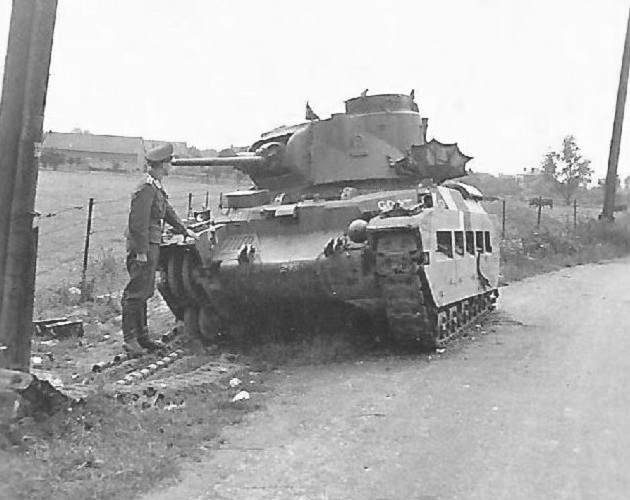
French Char B1 bis and Somua S35 tanks carried armour and guns capable of dominating many direct encounters with German vehicles. British Matilda II tanks at Arras also forced German formations to bring heavier anti-tank and artillery weapons into action. Allied armoured performance at Hannut, Stonne and Arras showed the combat power available inside individual units.

German advantage appeared most clearly in formation design and communications. Panzer divisions concentrated tanks with motorised infantry, engineers, artillery and reconnaissance, while radio-equipped command networks accelerated reports and changes of direction. Early Panzer III and Panzer IV variants carried modest armour by later standards, yet they operated inside a system designed to turn a local crossing or gap into movement at corps depth.

Air power amplified that system. Ju 87 dive bombers and other Luftwaffe formations struck crossing sites, artillery positions, communications and moving columns while Bf 109 fighters contested the air. French Dewoitine D.520s and British fighters remained dangerous opponents. The campaign's decisive air effects came from concentration over critical ground battles and the pressure placed on roads, headquarters and supply movement.

Char B1 bis
Char de Bataille B1bis
Willi Ude, uploaded by Ude · Source

Char B1 bis

France · heavy battle tank · 75 mm hull gun, 47 mm turret gun and up to 60 mm armour

The Char B1 bis was difficult for standard German anti-tank guns to defeat and performed effectively at Stonne. Its limitations included high fuel consumption, mechanical complexity, a one-man turret and restricted radio availability.

Somua S35
Two destroyed Somua S35 tanks in northern France during May 1940.
Bundesarchiv Bild 121-0412 · CC BY-SA 3.0 DE · Source

Somua S35

France · cavalry tank · 47 mm gun and cast armour

The S35 combined useful speed, protection and firepower and fought effectively during the armoured battles in Belgium. The one-man turret increased the commander's workload and many vehicles lacked reliable tactical communications.

Matilda II
A German officer is inspecting Matilda II “GOAT”.
Mike Research · Source

Matilda II

United Kingdom · infantry tank · 2-pounder gun and heavy armour

Matilda II tanks at Arras resisted most German anti-tank fire and caused local disruption. Their small numbers and the limited scale of the counterattack prevented a larger operational effect.

Panzer III Ausf. E/F
A German PzKpfw III Ausf H tank undergoes a technical inspection on the Eastern Front. Soldiers remove the tracks.
NAC GOV PL · Source

Panzer III Ausf. E/F

Germany · medium tank · 3.7 cm gun and radio-equipped crew

The Panzer III was intended for tank combat and served in concentrated armoured divisions. Its gun was not superior to the best French weapons, but radios and combined-arms organisation increased the formation's responsiveness.

Panzerkampfwagen IV Ausf. D
Panzer engineer in a foxhole.
Bundesarchiv Bild 183-J08365 · CC BY-SA 3.0 DE · Source

Panzerkampfwagen IV Ausf. D

Germany · medium support tank · short-barrelled 7.5 cm gun

The early Panzer IV supplied high-explosive fire against guns, buildings and infantry positions. It remained a minority vehicle during the campaign and operated alongside much lighter Panzer I and II tanks.

FuG 5 tank radio
A Panzer IV in a French town during the May 1940 campaign.
Bundesarchiv Bild 146-2007-0047 · CC BY-SA 3.0 DE · Source

FuG 5 tank radio

Germany · VHF transmitter-receiver used in command and platoon tanks

German armoured formations used radio networks for reports, orders and changes of direction. Not every German tank carried the same transmitter arrangement, but unit-level radio integration was stronger than in most Allied armoured formations.

Junkers Ju 87B
Luftwaffe pilots briefing beside a Ju 87 near Arras during the 1940 western campaign.
Bundesarchiv Bild 101I-429-0646-31 · CC BY-SA 3.0 DE · Source

Junkers Ju 87B

Germany · single-engine dive bomber · precision ground-attack aircraft

Ju 87 groups attacked artillery positions, road movement and defended crossings. At Sedan, repeated air attacks suppressed parts of the French defence while assault troops crossed the Meuse.

Messerschmitt Bf 109E
Messerschmitt Me 109 G-6 fighter aircraft of Jagdgeschwader 27 (JG 27) with two MG 151/20 machine guns under the wings
Bundesarchiv Bild 101I-662-6659-37 · CC BY-SA 3.0 DE · Source

Messerschmitt Bf 109E

Germany · single-seat fighter · cannon and machine-gun armament

The Bf 109E escorted bombers and contested air superiority over the Low Countries and France. Its performance was competitive with British and French fighters, while captured airfields reduced operating distances as the campaign advanced.

8.8 cm Flak 18/36
Southern France - Soldiers setting up a heavy 8.8 cm Flak 36 anti-aircraft gun on the coast
Bundesarchiv Bild 101I-258-1324-13 · CC BY-SA 3.0 DE · Source

8.8 cm Flak 18/36

Germany · heavy anti-aircraft gun used against aircraft, armour and ground targets

German units used the 8.8 cm gun in direct fire against heavily armoured Allied tanks, including during the Arras fighting. Its high velocity made it effective, but it was not the only German weapon or tactic used to stop the counterattack.

DFS 230 assault glider
DFS 230 Glider (registration LB+1-91) in tow flight
Bundesarchiv Bild 101I-567-1523-35A · CC BY-SA 3.0 DE · Source

DFS 230 assault glider

Germany · troop-carrying glider · used at Eben-Emael and bridge objectives

The DFS 230 delivered small assault teams directly onto or beside fortified objectives without a parachute dispersal pattern. At Eben-Emael it enabled engineers carrying shaped charges to land on the fortress roof.

The Cost

The military collapse produced mass captivity, civilian flight and a political division whose consequences extended far beyond the ceasefire.

French state and memorial sources commonly place military deaths in the May-June campaign near sixty thousand, while broader accounting series can produce higher totals depending on dates and categories. About 1.8 million French military personnel entered captivity, and roughly 1.6 million were transferred to Germany.

German campaign records list about twenty-seven thousand dead, roughly eighteen thousand missing and more than one hundred thousand wounded. British Army casualties reached tens of thousands across the fighting and evacuation, while Belgian, Dutch, French colonial, Polish and other Allied forces carried additional losses within their own national records.

The civilian exodus moved about eight million people onto roads and railways as the front crossed Belgium and northern France. Refugees travelled among military columns, government offices and withdrawing units under air attack and rapidly changing territorial control. Their movement became part of the operational landscape while families, towns and state institutions were displaced south and west.

Nearly 60,000

French military dead

French state and memorial summaries commonly use a figure near sixty thousand for the May–June campaign; totals vary with accounting boundaries.

About 1.8 million

French servicemen captured

Roughly 1.6 million were transferred to Germany, where many remained in captivity until 1945.

About 27,000

German military dead

German campaign records also list roughly 18,000 missing and more than 100,000 wounded.

338,226

Allied personnel evacuated at Dunkirk

Operation Dynamo removed British, French and other Allied servicemen between 26 May and 4 June.

About 8 million

Civilians in the exodus

People fled Belgium and northern and eastern France as the front, armies and government services moved south and west.

Books & Relics

The authenticity of the relics is not verified by WW2 Theatres.

This collection is curated by WW2 Theatres and not affiliated with our website, with all site photographs licensed to their respective owners.

Marc Bloch: A Staff Officer Inside the Defeat

A historian serving inside First Army recorded how institutions experienced a campaign moving faster than their procedures.

Marc Bloch entered the campaign as a reserve captain on the staff of French First Army, working with fuel and logistical matters during the movement into Belgium and the subsequent retreat. His position placed him close to headquarters traffic, transport problems and the daily effort to turn orders into movement while the front changed around the staff.

During the summer of 1940 he wrote L'Étrange Défaite. The book combines eyewitness memory with a historian's examination of command culture, professional education, social hierarchy and the handling of information. Bloch described officers and institutions shaped by the First World War confronting a campaign in which the speed of communications, armour and operational movement demanded a different rhythm of decision.

His account also records competence, courage and improvisation among French soldiers and junior officers. The defeat in his analysis grew from institutions, assumptions and command relationships operating together across the state and army. That perspective belongs beside the maps because the campaign's changing geography was experienced through headquarters trying to understand where units, fuel, roads and enemy columns were at a given moment.

Bloch later joined the French Resistance and was executed by the Germans in 1944. L'Étrange Défaite remains a contemporary document of the 1940 campaign and a work of historical interpretation written before the later mythology of the defeat had fully formed.

Sources & Archives

British official history · French military records · German operational files · state memorial collections · contemporary witnesses.

The chronology follows L. F. Ellis's British official history alongside French campaign journals and command files at the Service historique de la Défense and German Fall Gelb and Fall Rot records in the Bundesarchiv. Dunkirk is kept as a campaign phase here, with its detailed naval and perimeter chronology left to the dedicated operation page.

French casualty, prisoner and exodus figures are treated through state and memorial sources with their accounting boundaries preserved. Marc Bloch's L'Étrange Défaite supplies a contemporary staff officer's analysis of the institutions and command culture through which the campaign was experienced. Exact-date archive photographs are matched to chronology events separately from the historical source list.

  1. The War in France and Flanders 1939–1940, L. F. EllisUnited Kingdom Military Series
  2. French army operational records, campaign journals and command filesService historique de la Défense, Vincennes
  3. Fall Gelb and Fall Rot operational recordsBundesarchiv-Militärarchiv, Freiburg
  4. L'Étrange Défaite, Marc BlochBibliothèque nationale de France
  5. The Fall of France: The Nazi Invasion of 1940, Julian JacksonOxford University Press
  6. Operation Dynamo despatch and Dunkirk evacuation recordsThe London Gazette and The National Archives
  7. The Battle of Dunkirk and French First Army recordsFrench Ministry of the Armed Forces and Service historique de la Défense
  8. Eben-Emael and the Belgian campaignFort Eben-Emael Museum and Belgian official records
  9. French prisoners of war and military death recordsMémoire des hommes, French Ministry of the Armed Forces
  10. The civilian exodus during the defeat of 1940French Ministry of Culture
  11. La campagne de France, mai-juin 1940Chemins de mémoire, French Ministry of the Armed Forces
  12. The armistice of June 1940 and its diplomatic recordFrench and German published diplomatic documents
  13. Rotterdam bombing and city archive photographic recordStadsarchief Rotterdam
  14. The Netherlands campaign and airborne operationsNIOD / Nationaal Archief
  15. Battle of France photographs and official collectionsImperial War Museums
  16. Europe at the end of August 1939, historical basemap, San JoseWikimedia Commons · Public domain · palette and labels adapted for this site
Operation chronologyDates, locations and sourced event summaries
DateEventLocationSummary
Wednesday 10 January 1940 · Four months beforeA German aircraft lands in Belgium with western-offensive papersMechelen-aan-de-Maas, Belgium

A German liaison aircraft made a forced landing near Mechelen-aan-de-Maas on 10 January with documents relating to an earlier version of the western offensive. Belgian authorities recovered part of the material after the crew tried to burn it.

Sources 1, 3, 5
February 1940 · Plan revisedThe main German effort is shifted to the ArdennesGerman Army High Command

By February the revised Fall Gelb concentrated Army Group A and seven panzer divisions opposite Luxembourg and the Ardennes, making the Meuse sector the operational centre of the western offensive.

Sources 1, 3, 5
Thursday 9 May 1940 · Night beforeBoth sides wait behind their opening positionsWestern Europe

On the night of 9 May the Allied armies stood ready to execute the Dyle-Breda plan as soon as Germany entered Belgium and the Netherlands, while German Army Groups A and B waited behind their start lines.

Sources 1, 2, 3
Friday 10 May 1940 · Before dawnGlider troops land on Fort Eben-EmaelFort Eben-Emael, Belgium

German assault engineers landed DFS 230 gliders on the roof of Fort Eben-Emael before dawn on 10 May and attacked observation posts, gun positions and cupolas with shaped charges and demolition weapons.

Sources 1, 3, 8
Friday 10 May 1940 · Opening offensiveGermany invades the Netherlands, Belgium and LuxembourgThe Low Countries and Luxembourg

Germany opened the western offensive on 10 May across the Netherlands, Belgium and Luxembourg, combining ground attack with airborne and air-landed operations against bridges, airfields and command points.

Sources 1, 2, 3, 14
Friday 10 May 1940 · Dyle movement beginsThe Allied armies advance toward the DyleBelgium

The British Expeditionary Force and French First Army Group moved into Belgium on 10 May to occupy the Dyle position and join Belgian forces on a shorter defensive front.

Sources 1, 2
12–14 May 1940 · Armoured battleFrench and German armoured forces fight in BelgiumHannut and Gembloux

French mechanised divisions met German panzer formations around Hannut from 12 May and then withdrew toward the prepared Gembloux position after completing their delaying mission.

Sources 1, 2, 3
Sunday 12 May 1940 · Approach to the MeuseThe panzer columns reach the Meuse approachesThe Ardennes

German armoured and motorised columns emerged from the Ardennes on 12 May after a congested march through Luxembourg and the forest road network, reaching the Meuse from Sedan north toward Dinant.

Sources 1, 2, 3, 5
Monday 13 May 1940 · Meuse crossingGerman troops establish a bridgehead at SedanSedan

German infantry crossed the Meuse at Sedan on 13 May after concentrated Luftwaffe attacks struck French artillery, command posts and positions around the crossing sector.

Sources 1, 2, 3, 5
13–14 May 1940 · Parallel crossingsAdditional German bridgeheads widen the Meuse crisisDinant and Monthermé

German forces established additional bridgeheads at Dinant and Monthermé during 13–14 May, widening the crisis across the French Ninth and Second Army sectors.

Sources 1, 2, 3
Tuesday 14 May 1940 · Bombing during negotiationsGerman aircraft bomb central RotterdamRotterdam

German bombers struck central Rotterdam on 14 May while surrender negotiations were underway, igniting fires that devastated much of the city centre and killed hundreds of civilians.

Sources 3, 5, 13
Wednesday 15 May 1940 · Political warningPaul Reynaud tells Churchill that the battle is being lostParis and London

French prime minister Paul Reynaud telephoned Winston Churchill on 15 May as German columns expanded beyond the Meuse bridgeheads and the central French front deteriorated.

Sources 1, 4, 5
15–17 May 1940 · Repeated counterattacksStonne changes hands repeatedlyStonne

French and German troops fought repeatedly for Stonne south of Sedan between 15 and 17 May, turning the village and surrounding ridges into one of the campaign's most violent local battles.

Sources 2, 3, 5
17 and 19 May 1940 · French counterattackDe Gaulle attacks the southern flank of the German corridorMontcornet and Crécy-sur-Serre

Colonel Charles de Gaulle led the newly forming 4e Division cuirassée in attacks around Montcornet on 17 May and Crécy-sur-Serre on 19 May against the southern flank and communications of the German advance.

Sources 2, 5
Sunday 19 May 1940 · Change of commandMaxime Weygand replaces Maurice GamelinFrench General Headquarters

The French government replaced Maurice Gamelin with Maxime Weygand on 19 May as German mobile forces approached the Channel and the northern Allied armies faced separation.

Sources 1, 2, 5
Monday 20 May 1940 · Channel reachedGerman armour reaches the ChannelAbbeville and the Somme estuary

German mobile formations reached the Channel coast near Abbeville on 20 May, completing a corridor from the Meuse to the sea and dividing the Allied armies into northern and southern groups.

Sources 1, 2, 3
Tuesday 21 May 1940 · CounterattackBritish and French troops counterattack near ArrasArras

British and French forces counterattacked south of Arras on 21 May, striking elements of 7th Panzer Division and neighbouring German formations with infantry and tanks.

Sources 1, 2, 3
Thursday 23 May 1940 · Army Group A orderRundstedt orders the mobile formations to halt and close upCanal line west of Dunkirk

Army Group A ordered its mobile formations to halt and close up on 23 May as the panzer advance approached the canal line west and south of Dunkirk.

Sources 1, 3, 5
Friday 24 May 1940 · Halt endorsedHitler confirms the armoured haltArmy Group A headquarters

Hitler confirmed the Army Group A halt on 24 May and restored Rundstedt's control over the mobile formations after higher-command discussion of the advance toward Dunkirk.

Sources 1, 3, 5
Saturday 25 May 1940 · BEF changes directionGort turns the British Expeditionary Force toward DunkirkYpres sector

Lord Gort redirected the main effort of the British Expeditionary Force toward the Channel and Dunkirk on 25 May as the prospect of a coordinated north-south counterstroke faded.

Sources 1, 5
Sunday 26 May 1940 · 18:57Operation Dynamo beginsDunkirk

Operation Dynamo began on the evening of 26 May under Vice-Admiral Bertram Ramsay, moving troops from Dunkirk harbour and the beaches while British and French formations held the surrounding perimeter.

Sources 1, 6, 7
Tuesday 28 May 1940 · Belgian capitulationThe Belgian Army ceases resistanceBelgium

King Leopold III accepted the capitulation of the Belgian armed forces on 28 May after eighteen days of fighting and growing pressure along the Lys and the shrinking northern pocket.

Sources 1, 7, 8
28–31 May 1940 · Encircled battleFrench formations hold an encircled position at LilleLille

Elements of the French First Army fought inside and around Lille from 28 to 31 May after German formations closed around them during the retreat toward Dunkirk.

Sources 1, 2, 7
Tuesday 4 June 1940 · Final organised sailingThe final organised Dunkirk evacuation leavesDunkirk

The last organised naval lift from Dunkirk departed during the early hours of 4 June after French troops had filled the final scheduled embarkations.

Sources 1, 6, 7
Wednesday 5 June 1940 · Fall RotGermany opens the second offensive against FranceSomme and Aisne fronts

Fall Rot opened on 5 June against the French positions along the Somme and Aisne after the northern pocket had been eliminated and German formations had been redeployed south.

Sources 1, 2, 3
9–12 June 1940 · Front breaksGerman forces break through the Weygand LineLower Seine and Champagne

German forces broke through sectors of the Somme-Aisne defensive system between 9 and 12 June, extending the advance across the lower Seine and through Champagne.

Sources 1, 2, 3
Monday 10 June 1940 · Declaration of warItaly declares war on France and BritainRome

Mussolini declared war on France and Britain on 10 June as the French military position deteriorated across the northern half of the country.

Sources 1, 2, 5
Wednesday 12 June 1940 · CapitulationFrench IX Corps and the British 51st Highland Division surrenderSaint-Valery-en-Caux

French IX Corps elements and the British 51st Highland Division were trapped against the Channel around Saint-Valery-en-Caux and entered captivity on 12 June after evacuation attempts failed.

Sources 1, 2, 3
Friday 14 June 1940 · Capital occupiedGerman troops enter ParisParis

German troops entered Paris on 14 June after the French government had declared the capital an open city and moved south.

Sources 1, 2, 5, 10
Sunday 16 June 1940 · Government changesPaul Reynaud resigns and Pétain forms a governmentBordeaux

Paul Reynaud resigned on 16 June after the cabinet divided over continuing the war from North Africa, seeking an armistice, and the proposed Anglo-French union.

Sources 2, 4, 5
Monday 17 June 1940 · Evacuation disasterLuftwaffe aircraft sink the troopship LancastriaSaint-Nazaire

Luftwaffe aircraft struck the Cunard liner Lancastria off Saint-Nazaire on 17 June while the ship was crowded with British military personnel and civilians being evacuated from western France.

Sources 1, 6, 15
Tuesday 18 June 1940 · BBC broadcastCharles de Gaulle calls for continued French resistanceLondon

Charles de Gaulle broadcast from London on 18 June, calling on French soldiers, engineers and workers to continue the war alongside Britain and the resources of the French Empire.

Sources 5, 9
Friday 21 June 1940 · AfternoonGerman armistice terms are presented at CompiègneCompiègne

The French delegation led by General Charles Huntziger arrived at Compiègne on 21 June and entered the railway carriage associated with the 1918 armistice.

Sources 3, 5, 12
Saturday 22 June 1940 · EveningFrance signs an armistice with GermanyCompiègne

General Charles Huntziger signed the Franco-German armistice at Compiègne on the evening of 22 June in the railway carriage associated with the 1918 armistice.

Sources 1, 2, 3, 5, 12
Monday 24 June 1940 · Second armisticeFrance signs an armistice with ItalyRome

French and Italian delegations signed the Franco-Italian armistice at Villa Incisa outside Rome on 24 June at about 19:15.

Sources 2, 5, 12
Tuesday 25 June 1940 · 00:35The ceasefire takes effectFrance

The German and Italian armistices entered into force at 00:35 on 25 June, ending organised campaigning in metropolitan France after forty-seven days.

Sources 2, 3, 5, 9

Image rights and editorial standard. Bundesarchiv photographs retain the licence stated on their exact Commons file pages; British official photography follows the public-domain status recorded by Imperial War Museums and Commons; Dutch, Belgian, French and United States archive material retains the reuse basis of its individual record. Hero and chronology media use exact file records. Timeline images are attached only where the documented date and subject match the event, its immediate operational aftermath, or a tightly bounded action. PEOPLE and KIT may use later identity or exact-type imagery when the caption states that limitation. Front lines and territorial areas are generalised operational reconstructions. Casualty and prisoner figures retain the accounting boundaries of the cited historical series.