The Pacific
7 December 1941 to 2 September 1945 · Central, South and Southwest Pacific · Twelve operations
The Pacific war joined Japan's offensive for the resource-rich territories of Southeast Asia to a maritime struggle over bases, shipping and air power. By mid-1942 Japan had seized most of its initial southern objectives, but Coral Sea, Midway, New Guinea and Guadalcanal checked further expansion. From 1943 the Allies advanced along parallel axes while submarines, aircraft and mines cut Japan's sea communications, bringing the home islands within range of sustained blockade and bombing before the surrender of 1945.
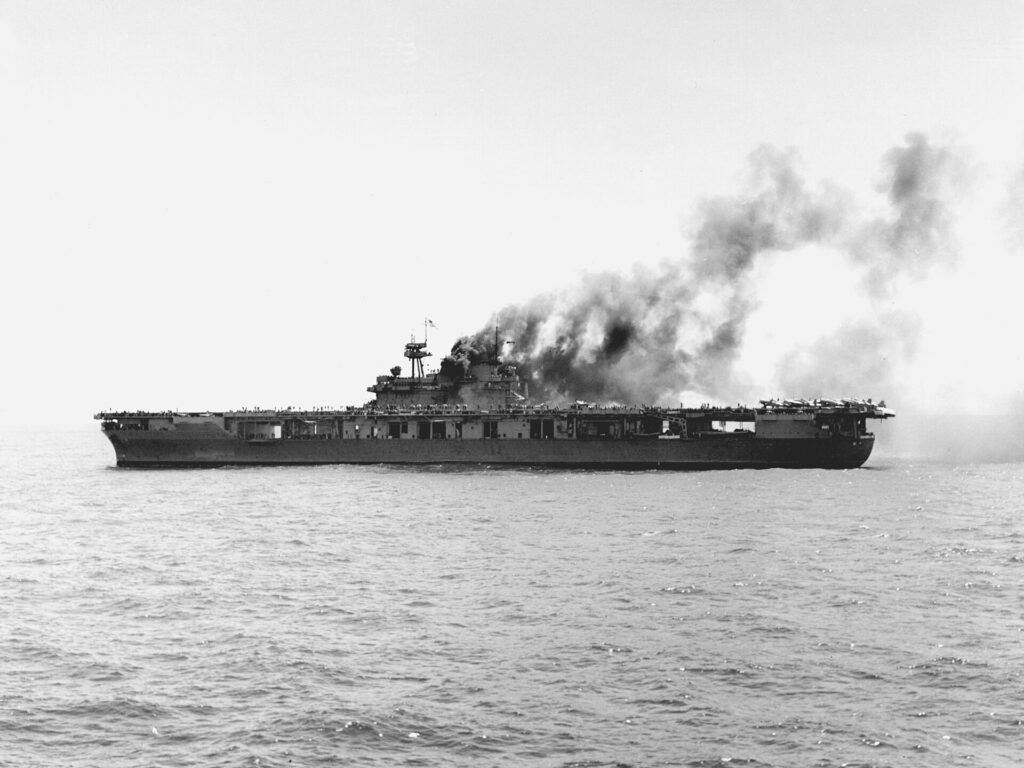
USS Yorktown under attack at Midway, 4 June 1942 · U.S. Navy · NARA · Public domain · Source
_is_hit_by_a_Japanese_Type_97_bomber_during_the_Battle_of_Midway,_4_June_1942.jpg)
- SPAN
- 1,365 elapsed daysFrom the attack on Pearl Harbor, 7 December 1941, to the formal surrender in Tokyo Bay, 2 September 1945
- JAPANESE MERCHANT SHIPPING
- 88% sunkShare of all merchant shipping available to Japan during the war that was lost, according to the U.S. Strategic Bombing Survey
- US SUBMARINE SHARE
- 55% of shipping lossesU.S. submarines accounted for more than half of Japan's lost merchant shipping
- NEW US FAST CARRIERS
- 16 by end of 1943Seven Essex-class fleet carriers and nine Independence-class light carriers commissioned between Pearl Harbor and the end of 1943
- PHILIPPINE SEA
- About 476 Japanese aircraftCarrier and land-based naval aircraft lost in the June 1944 battle, including aircraft destroyed on the ground
How Distance, Bases and Shipping Structured the Pacific War
Control of sea routes determined which armies and air forces could be sustained across the theatreJapan entered the Pacific War with an operational sequence designed to secure Malaya, the Philippines and the Netherlands East Indies while a carrier strike disabled the U.S. Pacific Fleet. The southern advance was intended to bring oil and other strategic resources inside a defensible perimeter before the United States could concentrate its greater industrial power. The plan achieved most of its territorial objectives during the first months of the war, but it also created a maritime empire whose garrisons, fleets and industries depended on vulnerable shipping over very long routes.
The Allied counteroffensive did not proceed along one continuous island chain. In the Southwest Pacific, forces under Douglas MacArthur advanced through New Guinea toward the Philippines; across the Central Pacific, Chester Nimitz's forces moved through the Gilberts, Marshalls and Marianas. Both commands used airfields, anchorages and amphibious lift to extend the range of the next operation. Strong positions could be bypassed when Allied air and naval power made isolation more useful than direct assault, as happened on a large scale around Rabaul and later along the New Guinea coast.
By 1944 the balance depended increasingly on systems that were less visible than an amphibious landing. New American carriers and escort forces made sustained operations possible far from fixed bases, while submarines and later aerial mining destroyed the merchant fleet carrying oil, food and industrial raw materials to Japan. The capture of the Marianas put the home islands within B-29 range; the return to the Philippines cut across remaining routes to Southeast Asia; Iwo Jima and Okinawa brought U.S. forces closer still. In 1945 blockade, conventional bombing, the atomic attacks and Soviet entry into the war converged on a Japanese government whose military and economic position had already deteriorated severely.
From Japanese Expansion to the Advance on Japan
Twelve operations trace the changing strategic problem from December 1941 to the final approach to the home islandsThe opening sequence links Pearl Harbor to the simultaneous offensives in Malaya, the Philippines and the Netherlands East Indies. Coral Sea then prevented the planned seaborne seizure of Port Moresby, while Midway removed four Japanese fleet carriers from a force that could not replace them quickly. The struggle did not become a simple Allied advance at that point: New Guinea and Guadalcanal turned 1942 and early 1943 into a contest of reinforcement, airfield control and maritime attrition.
From late 1943 the scale changed. Tarawa opened the Central Pacific drive, the Marianas placed heavy bombers within range of Japan, and the return to the Philippines forced the Imperial Japanese Navy into the Leyte Gulf operation. The final operations combined direct assault with economic and aerial pressure. Iwo Jima and Okinawa were fought close to the home islands while submarines, mines and B-29 attacks reduced Japan's capacity to sustain the war.

Pearl Harbor
On 7 December 1941, 353 Japanese carrier aircraft attacked Oʻahu in two waves. The raid killed 2,403 Americans and sank or damaged twenty-one U.S. ships, with the battleships at Pearl Harbor taking the most visible losses. The three U.S. Pacific Fleet aircraft carriers were away from the harbor and survived.
The strike gave Japan immediate freedom to begin its southern offensives, but it did not destroy the infrastructure needed for a prolonged American naval war. Pearl Harbor's submarine base, repair facilities and most bulk fuel storage remained usable, allowing damaged ships to be salvaged and surviving forces to operate while new construction entered service.

The Fall of the Southern Empires
Japan's southern offensive struck British, American and Dutch positions almost simultaneously after Pearl Harbor. Malaya and Singapore fell by 15 February 1942, Java capitulated in March, Bataan surrendered on 9 April and the remaining U.S.-Filipino forces on Corregidor surrendered on 6 May. At Singapore alone about 80,000 Commonwealth troops entered captivity.
The victories secured the principal resource region Japan had sought, including the oil-producing Netherlands East Indies, and dismantled much of the pre-war Western military position in Southeast Asia. They also produced a large prisoner population subjected in many areas to forced labour, severe malnutrition, disease and violence; among more than 22,000 Australian servicemen captured by Japan, over 8,000 died before liberation.

The Coral Sea
The Coral Sea was the first carrier battle in which the opposing surface fleets did not engage each other directly. Japan sank the carrier Lexington and other U.S. vessels and damaged Yorktown; American aircraft sank the light carrier Shōhō and badly damaged Shōkaku. In ship losses the exchange favored Japan, but the planned seaborne assault on Port Moresby was cancelled.
The operational consequence carried into the next battle. Shōkaku required repairs and Zuikaku's air group had been depleted, so neither carrier joined the Midway force four weeks later. Coral Sea therefore checked the southward seaborne advance and reduced the carrier strength available for Japan's attempt to seize Midway.
Coming soon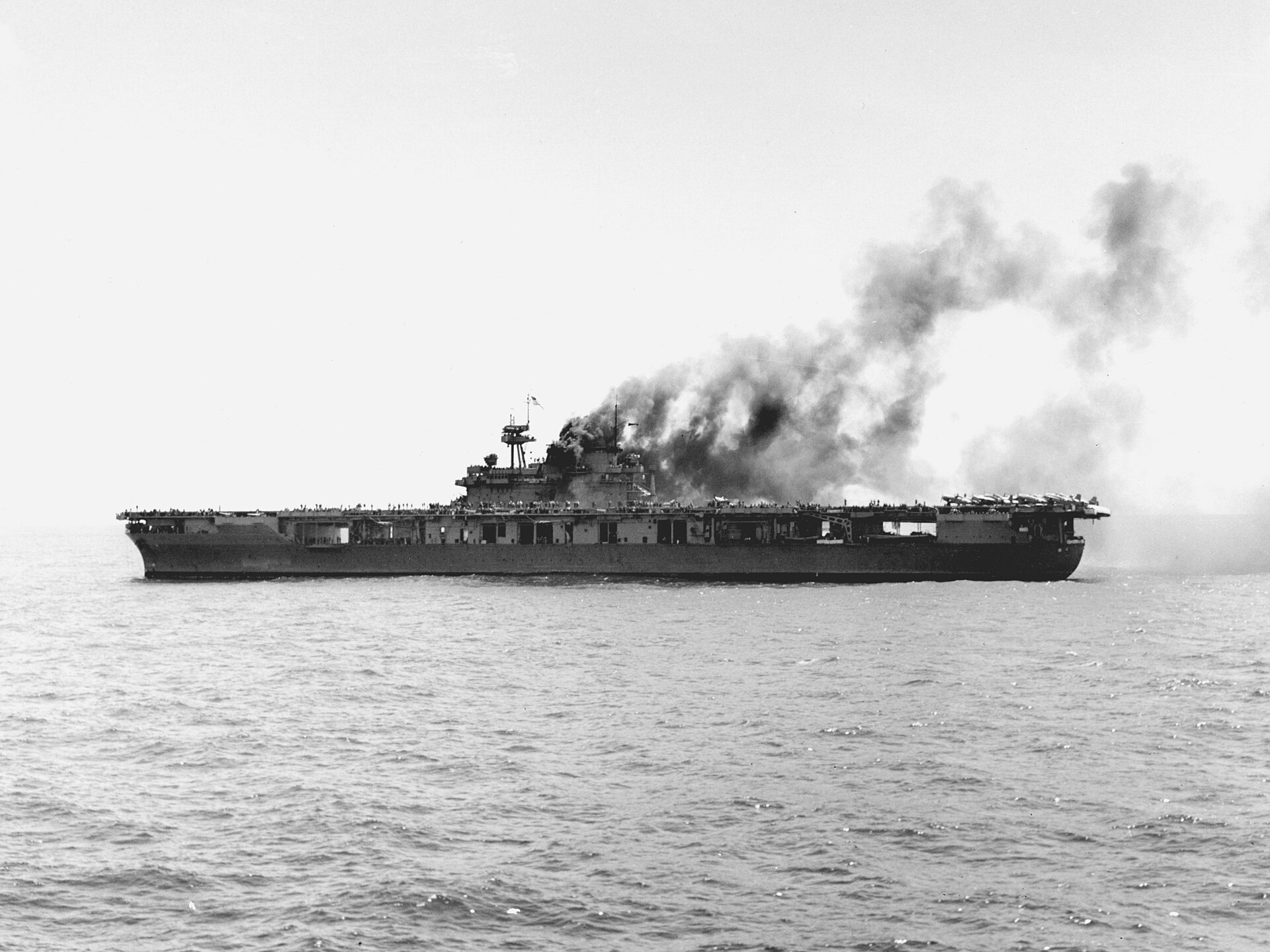
The Battle of Midway
American communications intelligence identified Midway as the principal Japanese objective and allowed Admiral Chester Nimitz to position three carriers northeast of the atoll before the Japanese striking force arrived. On 4 June U.S. carrier aircraft fatally damaged Akagi, Kaga and Sōryū in the late morning and Hiryū later in the day; all four Japanese fleet carriers were lost.
Midway ended the immediate attempt to extend Japan's perimeter eastward and removed the core carriers of the force that had struck Pearl Harbor. It did not destroy Japan's veteran naval aviators in the same proportion: many survived the battle and were lost later in the sustained air fighting around Guadalcanal and the Solomons.

New Guinea
Japanese forces landed on the north coast of Papua in July 1942 and advanced across the Owen Stanley Range toward Port Moresby while Allied forces fought to hold the approaches from the south. Terrain, disease and the difficulty of moving food, ammunition and medical support through mountains and jungle shaped the campaign as directly as battlefield strength.
By 1944 Allied air and sea superiority permitted much larger operational leaps along the northern coast. The Hollandia and Aitape landings went beyond major Japanese concentrations around Wewak, isolating rather than assaulting them directly. Airfields gained in western New Guinea then supported the return to the Philippines and connected MacArthur's advance with the wider Allied approach toward Japan.
Coming soon
Guadalcanal
U.S. Marines landed on Guadalcanal on 7 August 1942 and seized the unfinished airfield that became Henderson Field. Japan repeatedly tried to reinforce the island and suppress the airfield by sea and air, turning the campaign into six months of connected land fighting, carrier actions, night surface battles and contested supply runs.
Japan's inability to neutralize Henderson Field made reinforcement increasingly expensive, while destroyer supply runs could not sustain the army ashore. Ship and aircraft losses accumulated on both sides, but Japan also lost experienced aircrew it could replace only slowly. Imperial Headquarters accepted evacuation at the end of 1942, and the last organized Japanese forces left in February 1943.
Coming soon
Tarawa and the Central Pacific Drive
The assault on Betio at Tarawa began on 20 November 1943. Many landing craft could not cross the reef at the expected water depth, forcing Marines to wade several hundred yards under Japanese fire while amphibious tractors carried the first waves farther inshore. The island was secured after three days at a cost of roughly a thousand American dead.
Tarawa exposed weaknesses in hydrographic intelligence, bombardment timing, communications and the quantity of tracked amphibious vehicles available for a defended reef. The Central Pacific offensive continued into the Marshalls with those problems under close study, while the fast carrier force increasingly isolated objectives before the amphibious forces arrived.
Coming soon
The Marianas
U.S. forces landed on Saipan on 15 June 1944, beginning the campaign for the Marianas. Possession of Saipan, Tinian and Guam would put bases for B-29 operations within range of the Japanese home islands and breach an inner defensive line that Japanese naval planning considered important enough to justify a major fleet battle.
The resulting Battle of the Philippine Sea cost Japan three carriers and about 476 carrier and land-based naval aircraft. On Saipan the collapse of the defense also ended in mass civilian death. Contemporary and later records describe hundreds, perhaps thousands, of civilians and military personnel dying by suicide near the northern cliffs; the exact number is unknown, and Japanese propaganda, military coercion, wartime ideology and fear of capture all formed part of the setting.
Coming soon
Leyte Gulf
The return to the Philippines brought the principal surviving Japanese fleet forces toward Leyte in a multi-axis attempt to destroy the invasion shipping. From 23 to 26 October the battle unfolded through submarine attacks, the Sibuyan Sea, Surigao Strait, the action off Samar and Cape Engaño. Surigao Strait became the last battleship-versus-battleship action in naval history.
Off Samar, Japanese battleships and cruisers unexpectedly reached the small escort-carrier groups covering the landings, but determined resistance and confused command decisions contributed to Vice Admiral Takeo Kurita's withdrawal. On 25 October Japan also launched the first dedicated kamikaze attacks against U.S. carrier groups. The losses at Leyte left the Imperial Japanese Navy unable to mount another fleet operation on comparable scale.
Coming soon
The Blockade, the Bombing and the Bombs
B-29 attacks from the Marianas began against Tokyo in November 1944 while submarines continued to destroy shipping and B-29 mines increasingly closed Japanese ports and sea routes. The bombing campaign shifted toward low-level incendiary area attacks in 1945; the raid on Tokyo during the night of 9–10 March killed an estimated 80,000 to 100,000 people.
The atomic bomb destroyed Hiroshima on 6 August, and the City of Hiroshima estimates about 140,000 deaths by the end of 1945. The Soviet Union entered the war against Japan on 8–9 August as a second atomic bomb struck Nagasaki. Japan's Supreme Council remained divided until Emperor Hirohito intervened in favor of accepting the Potsdam terms; the interaction of atomic attack, Soviet entry, blockade and the already devastated strategic position remains central to the historical debate over surrender.
Coming soon
Iwo Jima
U.S. Marines landed on Iwo Jima on 19 February against a Japanese defense organized in depth through caves, tunnels and fortified positions rather than a decisive defense at the waterline. The thirty-six-day battle produced more than 26,000 American casualties, including about 6,800 dead; of roughly 20,000 Japanese defenders, only 1,083 survived.
The island was intended to support fighter operations, air-sea rescue and the B-29 campaign from the Marianas. By the end of the war about 2,400 B-29s had made unscheduled landings there, but that figure does not by itself settle the cost-benefit question: historians continue to examine how many aircraft actually required Iwo Jima to avoid loss and how fully its other planned uses developed before the war ended.

Okinawa
The U.S. Tenth Army landed on Okinawa on 1 April 1945 and encountered the main Japanese defense farther south around successive fortified lines, culminating at Shuri. American casualties reached 49,151, including 12,520 killed or missing. More than 100,000 Japanese military personnel were killed, and Okinawan civilian deaths also reached into the tens of thousands; exact civilian totals vary substantially by definition and source.
The naval battle offshore was dominated by sustained suicide attack. U.S. Navy analysis counted 793 kamikaze aircraft that reached Allied ships in the Okinawa area; 181 hit. Kamikazes sank twenty-six U.S. and Allied ships and damaged 225, while thirty-six ships and craft were lost to all causes during the campaign. The scale of the losses informed American planning for any further advance toward the home islands.
Coming soonHow the Pacific War Is Reconstructed
Operational records describe what commands attempted; post-war reconciliation is needed to establish what was actually lostAmerican naval operations are unusually well documented through action reports, war diaries, intelligence records and the photographic holdings of the Naval History and Heritage Command and the National Archives. The U.S. Army and Marine Corps official histories add the land campaigns, logistics and command arrangements that naval records alone cannot explain. Their figures still require care: wartime claims for aircraft and ships destroyed were often revised after Japanese records became available.
Japanese planning and losses are reconstructed from surviving Imperial Army and Navy records, the post-war Japanese Monograph series, Senshi Sōsho and scholarship built from Japanese operational sources. These records are essential for separating contemporary Allied assessments from what Japanese commands were actually attempting, particularly at Midway, Guadalcanal, the Philippine Sea and Leyte Gulf.
The economic collapse of Japan is documented differently again. The U.S. Strategic Bombing Survey and post-war shipping assessments allow merchant losses, industrial disruption and the effects of blockade to be compared with combat operations. The final decision to surrender has a documentary record of cabinet and imperial deliberations, but the relative weight of the atomic bombs, Soviet entry, blockade and the existing destruction of Japanese cities remains a historical question that cannot be reduced to a single trigger.
- World War II — Asiatic-Pacific Theater: campaign summariesU.S. Army Center of Military History
- Pacific War operational histories and action reportsNaval History and Heritage Command
- Japan's Struggle to End the WarUnited States Strategic Bombing Survey, 1946 / Naval History and Heritage Command
- Battle of the Coral SeaNaval History and Heritage Command
- Battle of MidwayNaval History and Heritage Command
- Guadalcanal CampaignNaval History and Heritage Command
- Operation Galvanic — Tarawa and MakinNaval History and Heritage Command
- Securing New Guinea: Operations Reckless and PersecutionNaval History and Heritage Command
- Operation Forager and the Battle of the Philippine SeaNaval History and Heritage Command
- Battle of Leyte GulfNaval History and Heritage Command
- Battle for Iwo JimaNaval History and Heritage Command
- Battle of OkinawaNaval History and Heritage Command
- The Most Difficult Antiaircraft Problem Yet Faced By the FleetNaval History and Heritage Command
- Stolen Years: Australian prisoners of the JapaneseAustralian War Memorial
- The Far East campaignNational Army Museum, London
- Hiroshima: atomic-bomb death estimate and city recordsCity of Hiroshima / Hiroshima Peace Memorial Museum
- Japan's Surrender and AftermathNaval History and Heritage Command
Operation chronologyDates, locations and sourced event summaries
| Date | Event | Location | Summary |
|---|---|---|---|
| 7 December 1941 · 01 | Pearl Harbor | Pearl Harbor, Hawaii | On 7 December 1941, 353 Japanese carrier aircraft attacked Oʻahu in two waves. The raid killed 2,403 Americans and sank or damaged twenty-one U.S. ships, with the battleships at Pearl Harbor taking the most visible losses. The three U.S. Pacific Fleet aircraft carriers were away from the harbor and survived. |
| December 1941 to 6 May 1942 · 02 | The Fall of the Southern Empires | Malaya, Singapore, the Philippines and the Netherlands East Indies | Japan's southern offensive struck British, American and Dutch positions almost simultaneously after Pearl Harbor. Malaya and Singapore fell by 15 February 1942, Java capitulated in March, Bataan surrendered on 9 April and the remaining U.S.-Filipino forces on Corregidor surrendered on 6 May. At Singapore alone about 80,000 Commonwealth troops entered captivity. |
| 4 to 8 May 1942 · 03 | The Coral Sea | The Coral Sea | The Coral Sea was the first carrier battle in which the opposing surface fleets did not engage each other directly. Japan sank the carrier Lexington and other U.S. vessels and damaged Yorktown; American aircraft sank the light carrier Shōhō and badly damaged Shōkaku. In ship losses the exchange favored Japan, but the planned seaborne assault on Port Moresby was cancelled. |
| 4 to 7 June 1942 · 04 | The Battle of Midway | The Central Pacific | American communications intelligence identified Midway as the principal Japanese objective and allowed Admiral Chester Nimitz to position three carriers northeast of the atoll before the Japanese striking force arrived. On 4 June U.S. carrier aircraft fatally damaged Akagi, Kaga and Sōryū in the late morning and Hiryū later in the day; all four Japanese fleet carriers were lost. |
| 21 July 1942 to 31 December 1944 · 05 | New Guinea | New Guinea | Japanese forces landed on the north coast of Papua in July 1942 and advanced across the Owen Stanley Range toward Port Moresby while Allied forces fought to hold the approaches from the south. Terrain, disease and the difficulty of moving food, ammunition and medical support through mountains and jungle shaped the campaign as directly as battlefield strength. |
| 7 August 1942 to 9 February 1943 · 06 | Guadalcanal | Guadalcanal and the southern Solomons | U.S. Marines landed on Guadalcanal on 7 August 1942 and seized the unfinished airfield that became Henderson Field. Japan repeatedly tried to reinforce the island and suppress the airfield by sea and air, turning the campaign into six months of connected land fighting, carrier actions, night surface battles and contested supply runs. |
| 20 to 23 November 1943 · 07 | Tarawa and the Central Pacific Drive | Tarawa, Gilbert Islands | The assault on Betio at Tarawa began on 20 November 1943. Many landing craft could not cross the reef at the expected water depth, forcing Marines to wade several hundred yards under Japanese fire while amphibious tractors carried the first waves farther inshore. The island was secured after three days at a cost of roughly a thousand American dead. |
| 15 June to 10 August 1944 · 08 | The Marianas | Saipan, Tinian and Guam | U.S. forces landed on Saipan on 15 June 1944, beginning the campaign for the Marianas. Possession of Saipan, Tinian and Guam would put bases for B-29 operations within range of the Japanese home islands and breach an inner defensive line that Japanese naval planning considered important enough to justify a major fleet battle. |
| 23 to 26 October 1944 · 09 | Leyte Gulf | Leyte Gulf and waters around the Philippines | The return to the Philippines brought the principal surviving Japanese fleet forces toward Leyte in a multi-axis attempt to destroy the invasion shipping. From 23 to 26 October the battle unfolded through submarine attacks, the Sibuyan Sea, Surigao Strait, the action off Samar and Cape Engaño. Surigao Strait became the last battleship-versus-battleship action in naval history. |
| 24 November 1944 to August 1945 · 10 | The Blockade, the Bombing and the Bombs | The Japanese home islands | B-29 attacks from the Marianas began against Tokyo in November 1944 while submarines continued to destroy shipping and B-29 mines increasingly closed Japanese ports and sea routes. The bombing campaign shifted toward low-level incendiary area attacks in 1945; the raid on Tokyo during the night of 9–10 March killed an estimated 80,000 to 100,000 people. |
| 19 February to 26 March 1945 · 11 | Iwo Jima | Iwo Jima | U.S. Marines landed on Iwo Jima on 19 February against a Japanese defense organized in depth through caves, tunnels and fortified positions rather than a decisive defense at the waterline. The thirty-six-day battle produced more than 26,000 American casualties, including about 6,800 dead; of roughly 20,000 Japanese defenders, only 1,083 survived. |
| 1 April to 22 June 1945 · 12 | Okinawa | Okinawa | The U.S. Tenth Army landed on Okinawa on 1 April 1945 and encountered the main Japanese defense farther south around successive fortified lines, culminating at Shuri. American casualties reached 49,151, including 12,520 killed or missing. More than 100,000 Japanese military personnel were killed, and Okinawan civilian deaths also reached into the tens of thousands; exact civilian totals vary substantially by definition and source. |
Image rights and provenance are stated per record. U.S. Navy, Marine Corps, Army, Army Air Forces and National Archives photographs created as federal works are public domain; Australian and British official photographs are credited under the status stated on their individual Commons File pages, and Marine Corps Archives Flickr material is used under CC BY 2.0 where specified. The map is a generalized theatre-scale reconstruction: control areas and movement arrows show operational direction and strategic position rather than surveyed front lines.