Skip to content
WW2 Theatres Theatres of the Second World War
Home / The Opening Campaigns / Operation Weserübung
German mountain troops landing in Norway, April 1940.

Operation Weserübung

Operation Weserübung · 9 April to 10 June 1940 · Denmark, Norway and the Norwegian Sea

Follow Operation Weserübung from Germany's rapid occupation of Denmark and simultaneous landings along the Norwegian coast to the battles at Narvik and Norway's capitulation on 10 June 1940. The timeline explains why Germany attacked, how the Blücher was sunk, why the Allied landings in central Norway failed, how Narvik was recaptured and why the campaign changed both naval strength and British political leadership.

Photo: Bagn Bygdesamling – Valdres Folkemuseum, Norway · CC BY-SA 3.0 DE · Source

CAMPAIGN
63 days9 April to 10 June 1940
OPENING METHOD
Six Norwegian objectivesOslo, Kristiansand, Stavanger, Bergen, Trondheim and Narvik were attacked in separate naval and airborne groupings
NARVIK DESTROYERS
Ten lostEvery German destroyer committed to the Narvik landing was sunk, scuttled or driven ashore by 13 April
NARVIK RECAPTURED
28 MayNorwegian, French and Polish ground forces retook the port during the final Allied offensive
NORTRASHIP
About 1,000 shipsRoughly four million gross register tons of Norwegian merchant shipping came under government control for the Allied war effort
Marker affiliation Allied Axis Other / contested
Map layers

01 / 28

A Campaign Along the Coast

Ports, fjords, airfields and narrow inland routes separated the campaign into distinct operational zones.

Norway's coastline stretched across hundreds of miles of fjords, islands and mountain barriers. Oslo, Bergen, Trondheim and Narvik formed separate military problems connected more easily by sea and air than by road. A force established in one port required ships, aircraft or a long overland movement before it could influence another. This geography encouraged the German decision to attack several objectives simultaneously.

Narvik carried an additional economic weight. Swedish iron ore from Kiruna reached the ice-free port by rail during the winter months, giving Germany access to shipments that complemented the Baltic route. Farther south, Trondheim and Bergen offered naval and air bases on the Norwegian coast, while Stavanger's Sola airfield opened a landing ground for Luftwaffe operations over the North Sea.

Central Norway turned roads and railways into channels of movement. Allied troops landing at Namsos and Åndalsnes had to move through valleys under German air attack while German columns pushed north from Oslo. Around Narvik, mountain routes, snow, fjord crossings and the Ofot railway shaped a separate campaign in which Norwegian, French and Polish infantry gradually compressed Dietl's isolated force toward the Swedish frontier.

Surprise, Ports and Airfields

Weserübung converted strategic risk at sea into speed ashore.

German planning treated Denmark and Norway as one combined operation. Denmark supplied airfields, straits and the land approach to southern Norway, while separate naval groups carried troops directly to the principal Norwegian ports. The method exposed cruisers and destroyers to coastal guns and the Royal Navy, yet it also placed organised landing parties inside key objectives before Norwegian mobilisation could develop across the whole country.

The sinking of Blücher created the largest opening disruption. The Oslo group lost its flagship in Drøbak Narrows and delayed the occupation of the capital long enough for Norway's constitutional authorities and gold reserve to leave. German success elsewhere followed a different path. Airborne and air-landed troops seized or reinforced airfields, Ju 52 transports moved personnel and supplies, and Luftwaffe aircraft gave the scattered German enclaves a common support system.

The Allied response divided into central and northern campaigns. Namsos and Åndalsnes aimed toward Trondheim under severe air and transport constraints, while the Narvik force developed more slowly into a combined Norwegian, French, Polish and British operation. By late May the northern battle had turned in Allied favour. The crisis in France then changed the strategic allocation of ships, aircraft and trained formations, leading to the evacuation of northern Norway.

Birger Eriksen
Colonel, Norway

Birger Eriksen

Commandant, Oscarsborg Fortress

Ordered the fortress to fire on the German Oslo group without waiting for further instructions. The sinking of Blücher delayed the occupation of Oslo and enabled Norway's constitutional authorities to leave the capital.

Torgeir Ekerholt Sæveraas · CC BY 1.0 · Source
Haakon VII
King of Norway

Haakon VII

Norwegian head of state

Rejected the German demand to appoint Quisling and told the cabinet he would abdicate rather than accept it. He left Norway with the government in June and remained the constitutional head of the Norwegian state in exile.

Unknown photographer · Public domain · Source
Otto Ruge
Major General, Norway

Otto Ruge

Commander-in-Chief of the Norwegian Army

Took command on 10 April and organised delaying operations north of Oslo while attempting to coordinate with Allied forces. He remained in Norway after the government departed and entered German captivity following the capitulation.

Norwegian Official Photo / National Archives of Norway, RA/RAFA-2017/E/Ea/L0088/0013 · CC BY 4.0 · Source
Carl Gustav Fleischer
Major General, Norway

Carl Gustav Fleischer

Commanding, Norwegian 6th Division

Directed Norwegian operations around Narvik and coordinated with French and Polish formations during the final advance. His troops helped force Dietl's command away from the port before the Allied evacuation.

Municipal Archives of Trondheim, Tor.H42.B53.F3915 · CC BY 2.0 · Source
Bernard Warburton-Lee
Captain, Royal Navy

Bernard Warburton-Lee

Commanding, 2nd Destroyer Flotilla

Led five destroyers into Ofotfjord on 10 April and attacked the larger German flotilla at Narvik. He was mortally wounded during the withdrawal and received the Victoria Cross posthumously.

Imperial War Museums · IWM Non-Commercial Licence · Source
Winston Churchill
First Lord of the Admiralty, later Prime Minister

Winston Churchill

British naval policy and political leadership

Supported action against the Norwegian ore route and was closely involved in Admiralty decisions during the campaign. The Norway Debate destroyed Chamberlain's parliamentary authority, and Churchill formed a coalition government on 10 May.

Yousuf Karsh / Library and Archives Canada, MIKAN 3915740 · CC BY 2.0 · Source
Nikolaus von Falkenhorst
General der Infanterie, Germany

Nikolaus von Falkenhorst

Commanding, Operation Weserübung

Prepared and commanded the combined occupation of Denmark and Norway. The plan depended on surprise, simultaneous naval landings, captured airfields and rapid reinforcement of isolated port garrisons.

Bundesarchiv Bild 183-2006-0529-501 · CC BY-SA 3.0 DE · Source
Eduard Dietl
Generalleutnant, Germany

Eduard Dietl

Commanding, 3rd Mountain Division at Narvik

Landed at Narvik with mountain troops carried by ten destroyers. After the destroyers were lost, their crews reinforced his command. His force withdrew toward Sweden after the Allied capture of Narvik but remained intact until the evacuation.

Bundesarchiv Bild 146-1984-019-20 · CC BY-SA 3.0 DE · Source
Erich Raeder
Grand Admiral, Germany

Erich Raeder

Commander-in-Chief of the Kriegsmarine

Warned Hitler about the danger of Allied action in Norway and supported occupation despite the risk to Germany's smaller fleet. The operation secured bases but cost the navy cruisers, destroyers and months of repair time.

Bundesarchiv Bild 146-1980-128-63 · CC BY-SA 3.0 DE · Source
Vidkun Quisling
Leader, Nasjonal Samling

Vidkun Quisling

Coup announcement and collaboration

Declared himself head of government in a radio broadcast on 9 April without constitutional authority. The Germans initially set his improvised government aside, though he later returned as minister-president under occupation.

National Archives of Norway · No known copyright restrictions · Source

Ships, Aircraft and Amphibious Lift

Naval gunfire, coastal artillery, transports and land-based aircraft carried much of the campaign's operational weight.

Oscarsborg's 28 cm Krupp guns and submerged torpedo battery demonstrated the power of a fixed coastal position against a warship committed to a confined channel. At Narvik, German destroyers served as troop transports and fighting ships in the same operation, delivering mountain troops far beyond the normal reach of German land forces before becoming trapped by fuel shortages and Royal Navy attack.

Airfields transformed the campaign after the opening day. Ju 52 transports carried troops and supplies into captured or improvised landing grounds, while Luftwaffe bombers attacked Allied ports, columns and shipping. British fighter cover in central Norway remained thin and temporary. By the later Narvik phase, carrier-borne Gladiators and Hurricanes operating from Bardufoss created a stronger local air presence around the northern battle.

Allied sea power produced its greatest tactical effects around Narvik. Destroyers attacked the German flotilla on 10 April, and Warspite with nine destroyers completed its destruction on 13 April. French Hotchkiss tanks, naval gunfire and landing craft later supported the Bjerkvik and Narvik operations. The same sea routes then carried the Allied force out of Norway in June.

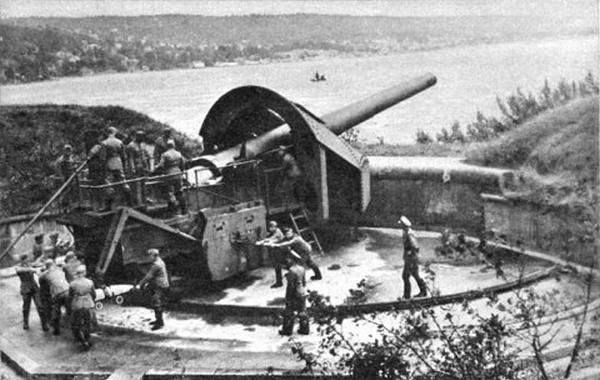
28 cm Krupp coastal gun
One of the three 28 cm Krupp guns at Oscarsborg Fortress; two guns fired on Blücher in 1940.
Krister Brandser · released to public domain · Source

28 cm Krupp coastal gun

Norway · Oscarsborg main battery · installed in the 1890s

Two guns of the main battery hit Blücher at close range in Drøbak Narrows. Their age did not prevent them from penetrating and setting fires in a modern heavy cruiser.

45 cm Whitehead shore torpedo
A Swedish Navy M/93 45 cm Whitehead torpedo acquired in 1893.
Marinmuseum · CC BY 4.0 · Source

45 cm Whitehead shore torpedo

Norway · Concealed Oscarsborg torpedo battery · early twentieth-century design

The hidden battery fired two torpedoes into Blücher after the cruiser had passed the main guns. The underwater hits contributed decisively to the loss of the ship.

Heavy cruiser Blücher
German heavy cruiser Blücher, view from starboard
Bundesarchiv · CC BY-SA 3.0 DE · Source

Heavy cruiser Blücher

Germany · Admiral Hipper class · eight 20.3 cm guns

Blücher led the Oslo invasion group and carried troops, staff and occupation personnel. The ship was sunk during its first combat operation, delaying the seizure of the capital.

Type 1934A Z5 Class destroyer
Destroyer Richard Beitzen
Bundesarchiv DVM 10 Bild-23-63-25 · CC BY-SA 3.0 DE · Source

Type 1934A Z5 Class destroyer

Germany · 12.7 cm guns and torpedoes · principal Narvik landing transport

Ten German destroyers carried Dietl's troops to Narvik. Fuel shortages and British attacks trapped the flotilla in the fjord, where all ten ships were destroyed or scuttled by 13 April.

Junkers Ju 52/3m
Ju 52 transport aircraft at Oslo-Fornebu during the Norwegian campaign.
Bundesarchiv Bild 101I-760-0171-19 · CC BY-SA 3.0 DE · Source

Junkers Ju 52/3m

Germany · three-engine transport aircraft · troop and supply carrier

Ju 52s delivered airborne troops, flew reinforcements into captured airfields and supplied isolated formations. Air transport helped connect landing groups that could not support each other quickly by road.

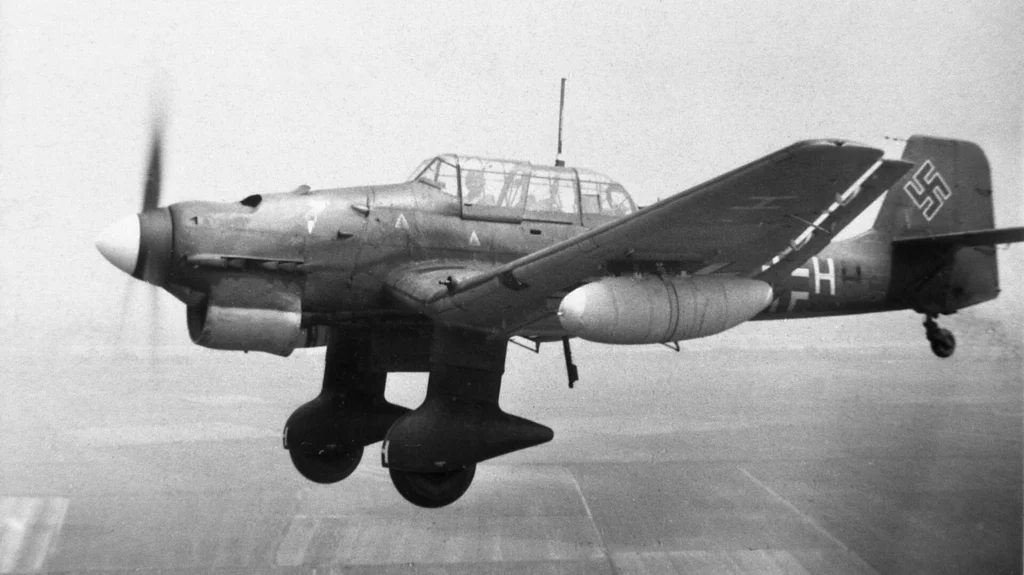
Junkers Ju 87R
A Junkers Ju 87 B-2 "Stuka" loaded with bombs on a camouflaged parking area at Schiphol Air Base.
Bundesarchiv (Opitz) · CC BY-SA 3.0 de · Source

Junkers Ju 87R

Germany · long-range dive bomber · adapted for maritime and Norwegian operations

Ju 87 units attacked ships, ports, roads and ground positions. Their effectiveness depended on German fighter bases and the limited Allied ability to maintain air cover over central Norway.

HMS Warspite
HMS Warspite in action off Narvik on 13 April 1940.
Imperial War Museums, A 38 · Public domain · Source

HMS Warspite

United Kingdom · Queen Elizabeth-class battleship · eight 15-inch guns

Warspite led the second British attack into Ofotfjord on 13 April. Its guns and accompanying destroyers eliminated the remaining German destroyer force at Narvik.

Fairey Swordfish Mk I
Three Fairey Swordfish Mark IIIs (NF374 'NH-M', NF343 'NH-Q' and 'NH-L') of No. 119 Squadron RAF, based at B58/Knokke le Zoute, Belgium, flying in loose starboard echelon formation over the North Sea.
Imperial War Museums, CL 2290 · Public domain · Source

Fairey Swordfish Mk I

United Kingdom · carrier reconnaissance and torpedo aircraft

A Swordfish launched from Warspite reconnoitred the fjord and sank U-64 with bombs, the first U-boat destroyed by a British aircraft during the war.

Hotchkiss H39
British troops talking to French and Polish (Independent Podhalan Rifles Brigade) soldiers around a French Hotchkiss H39 tank in Steinsland.
Imperial War Museums, N 229 · Public domain · Source

Hotchkiss H39

France · light tank · 37 mm gun · used around Narvik

French light tanks landed in northern Norway and supported operations around Bjerkvik and Narvik. They provided rare armoured support in terrain where roads, snow and landing capacity restricted heavy equipment.

HMS Glorious
The aircraft carrier HMS Glorious at anchor circa 1934.
Royal Navy official photographer / Imperial War Museums, Q 65695 · Public domain · Source

HMS Glorious

United Kingdom · aircraft carrier · returning from Operation Alphabet

Glorious carried RAF fighters evacuated from Norway when Scharnhorst and Gneisenau intercepted it on 8 June. The carrier and its two destroyer escorts were sunk with the loss of about 1,519 men.

The Cost

The campaign imposed heavy naval losses and created strategic assets that continued fighting after the mainland fell.

British official history records 1,869 British land casualties and about 530 French and Polish casualties in central and northern Norway. Norwegian military losses were recorded at 1,335 for the campaign. German General Staff figures recorded 5,296 casualties, including losses during the sea passage.

Naval losses carried effects beyond June. Germany lost Blücher, two light cruisers and all ten destroyers committed to Narvik, while other major ships required repair. Britain lost the carrier Glorious, cruisers, destroyers, submarines and smaller vessels. The campaign reduced available surface strength on both sides during the next stage of the war.

Norway also retained a strategic resource far outside the occupied mainland. Temporary provisions on 22 April and 18 May placed overseas shipping under government control, and Nortraship grew into a state shipping organisation managing about one thousand ships and four million gross register tons. Those vessels supplied Britain and the wider Allied war while the Norwegian government operated from exile.

1,335

Norwegian military casualties

Campaign total recorded in the British official history, excluding prisoners.

1,869

British land casualties

British official-history figure for land operations in Norway.

About 530

French and Polish casualties

British official-history total for French and Polish forces in central and northern Norway.

5,296

German campaign casualties

German General Staff figure cited in the British official history, including losses during the sea passage.

About 1,000 ships

Nortraship-controlled merchant fleet

Roughly four million gross register tons placed under Norwegian government control for the Allied war effort.

Books & Relics

The authenticity of the relics is not verified by WW2 Theatres.

This collection is curated by WW2 Theatres and not affiliated with our website, with all site photographs licensed to their respective owners.

The Norwegian State Continued at Sea

Occupation of the mainland left Norway with a government, a flag and one of the world's largest merchant fleets operating beyond German control.

Norway entered the invasion with one of the world's major merchant fleets scattered across global trade routes. Ships outside German-controlled waters remained physically beyond the reach of the occupation authorities, creating an immediate question of command, chartering, insurance, crews and revenue.

Temporary provisions on 22 April and 18 May 1940 brought the overseas fleet under Norwegian government control. The Norwegian Shipping and Trade Mission—Nortraship—developed in London to administer the fleet, with a New York organisation following in June. Nasjonalarkivet records a fleet of about 4.8 million gross register tons in total, with roughly four million tons and about one thousand ships coming under Nortraship control.

The fleet gave the government-in-exile an economic foundation and gave the Allies tankers and cargo ships at a moment when shipping capacity was a strategic resource. Norwegian crews carried oil, food, ammunition and other cargo through the Atlantic war, and shipping revenue became a central source of finance for the government abroad.

This changes the meaning of 10 June 1940. German forces held the Norwegian mainland and ports, while the Norwegian state retained political authority, armed personnel and a global merchant fleet. Norway's campaign on land had ended; its maritime war expanded.

Sources & Archives

British official histories · Norwegian state archives · German records · Narvik collections · parliamentary records.

The operational chronology follows T. K. Derry's British official history and S. W. Roskill's naval history, checked against Norwegian state records and German planning material. Nasjonalarkivet preserves Hitler's 1 March order, the Oscarsborg watch journal, the constitutional record around the king's refusal and the documentary history of Nortraship.

Narvik receives additional treatment through Norwegian and Polish institutional sources because its campaign involved separate naval, mountain and amphibious phases. Hansard anchors the political crisis in London, while exact-date photographs from IWM, Bundesarchiv, Norwegian archives and Commons are matched to chronology states only after date and subject verification.

Operation chronologyDates, locations and sourced event summaries
DateEventLocationSummary
Friday 16 February 1940 · Seven weeks beforeHMS Cossack boards Altmark in Norwegian watersJøssingfjord

HMS Cossack entered Jøssingfjord and sent a boarding party onto the German tanker Altmark, freeing 299 British merchant seamen taken by Admiral Graf Spee.

Sources 1, 2, 4
Friday 1 March 1940 · Directive issuedHitler approves the operation against Denmark and NorwayBerlin

Hitler signed the directive for Weserübung on 1 March. The order linked occupation of Denmark with simultaneous seizure of the principal Norwegian ports and airfields.

Sources 1, 3, 11
Sunday 7 April 1940 · Invasion fleet sailsThe invasion groups sail for NorwayGerman Baltic and North Sea ports

German naval groups carrying assault troops left their bases for the Norwegian coast on 7 April. The northern force bound for Narvik faced the longest voyage and the greatest exposure to the Royal Navy.

Sources 1, 2, 3
Monday 8 April 1940 · Operation WilfredThe Royal Navy lays mines along the Norwegian coastNorwegian coastal waters

British destroyers laid mines in Norwegian territorial waters under Operation Wilfred on 8 April, aiming to force German iron-ore traffic away from the protected coastal route and into waters where the Royal Navy could intercept it.

Sources 1, 2, 11
Monday 8 April 1940 · Warning ashoreRio de Janeiro survivors reveal German troops at seaNear Lillesand

The Polish submarine Orzeł torpedoed the German transport Rio de Janeiro off southern Norway. Norwegian rescuers brought uniformed German soldiers ashore after the sinking.

Sources 1, 4
Tuesday 9 April 1940 · Before dawnGermany occupies DenmarkDenmark

German forces crossed the Jutland frontier, landed troops near Copenhagen and seized bridges, ports and airfields during the opening hours of Weserübung.

Sources 1, 3
Tuesday 9 April 1940 · 04:25Oscarsborg opens fire on BlücherDrøbak Narrows

The Oscarsborg watch journal recorded a German warship entering Drøbak Narrows at about 04:25. Colonel Birger Eriksen ordered the main battery to fire as Blücher led the Oslo invasion group north.

Sources 4, 5
Tuesday 9 April 1940 · MorningAirborne and air-landed troops secure key airfieldsSola and Fornebu airfields

German airborne and air-landed forces targeted Sola near Stavanger, Fornebu outside Oslo and Aalborg in Denmark during the opening operation.

Sources 1, 3
Tuesday 9 April 1940 · 07:15The king, government and parliament leave OsloOslo

A special train left Oslo at 07:15 carrying King Haakon VII, the royal family, government leaders and members of parliament toward Hamar and the interior.

Sources 4, 5, 12
Tuesday 9 April 1940 · Opening dayGerman landing groups secure the principal portsBergen, Trondheim and Narvik

German naval groups entered Bergen, Trondheim, Narvik and other coastal objectives during the opening day and landed troops inside the port areas.

Sources 1, 2, 3
Tuesday 9 April 1940 · Evening broadcastQuisling announces a coup governmentOslo

Vidkun Quisling used Norwegian radio on the evening of 9 April to proclaim a new government and order resistance to cease.

Sources 1, 4, 12
Wednesday 10 April 1940 · DawnBritish destroyers attack at NarvikNarvik and Ofotfjord

Captain Bernard Warburton-Lee led five British destroyers into Ofotfjord at dawn on 10 April and attacked the German ships around Narvik harbour.

Sources 2, 6, 13
Wednesday 10 April 1940 · Afternoon and eveningKing Haakon rejects the German political demandElverum and Nybergsund

German minister Curt Bräuer met King Haakon and Foreign Minister Halvdan Koht at Elverum on 10 April and pressed for acceptance of a government led by Quisling.

Sources 4, 12
Saturday 13 April 1940 · AfternoonWarspite and nine destroyers destroy the Narvik flotillaOfotfjord

HMS Warspite entered Ofotfjord on 13 April with nine destroyers for the second British naval action at Narvik.

Sources 2, 6, 13
Sunday 14 April 1940 · Allied landingAllied troops land north of TrondheimNamsos

British troops began landing at Namsos to form the northern arm of an Allied movement toward Trondheim, followed by French troops and additional British formations.

Sources 1, 2
Thursday 18 April 1940 · Allied landingA second Allied force lands at ÅndalsnesÅndalsnes

British troops landed at Åndalsnes and moved inland toward Dombås and the Gudbrandsdal to support Norwegian units retreating north from the Oslo region.

Sources 1, 2
21–28 April 1940 · Valley fightingNorwegian and British forces fight through the central valleysGudbrandsdal

Norwegian and British units fought delaying actions through the Gudbrandsdal as German troops pushed north from Oslo toward Dombås and Trondheim.

Sources 1, 4
Monday 22 April 1940 · Emergency shipping measureNorway begins placing its overseas merchant fleet under state controlLondon

Temporary provisions issued on 22 April authorised Norwegian control over large parts of the overseas merchant fleet for national and Allied service.

Sources 8
2–3 May 1940 · EvacuationThe Allies evacuate central NorwayNamsos and Åndalsnes

The Allied forces at Namsos and Åndalsnes withdrew by sea during the opening days of May after the Trondheim operation lost its operational basis.

Sources 1, 2
7–8 May 1940 · Parliamentary debateThe Norway Debate breaks Chamberlain's parliamentary positionHouse of Commons, London

The House of Commons opened a two-day debate on the conduct of the Norwegian campaign on 7 May. Critics focused on planning, equipment, command arrangements and the gap between political intentions and the forces committed.

Sources 7
Friday 10 May 1940 · Change of governmentChurchill forms a coalition governmentLondon

Neville Chamberlain resigned on 10 May as German forces opened their offensive in the Low Countries and France. King George VI asked Winston Churchill to form a government.

Sources 7
Night of 12–13 May 1940 · After midnightFrench troops land at BjerkvikBjerkvik

French Foreign Legion troops crossed Herjangsfjord and landed at Bjerkvik after naval bombardment during the night of 12–13 May.

Sources 1, 2, 13, 14
Friday 24 May 1940 · Evacuation decisionThe Allied governments decide to withdraw from northern NorwayLondon

The military collapse in France forced Britain and France to redirect shipping, aircraft and trained formations from Norway toward the main western theatre.

Sources 1, 2
Tuesday 28 May 1940 · Town recapturedNorwegian, French and Polish forces recapture NarvikNarvik

Norwegian, French and Polish forces completed the offensive around Narvik on 28 May and re-entered the town after German troops withdrew toward the Swedish frontier.

Sources 1, 10, 13, 14
4–8 June 1940 · Operation AlphabetOperation Alphabet removes the Allied force from NarvikNorthern Norway

The Allied evacuation from the Narvik area began on 4 June under Operation Alphabet. Troops, aircraft and selected equipment moved toward embarkation points around Harstad and the northern fjords.

Sources 1, 2, 13
Friday 7 June 1940 · Government departsKing Haakon and the Norwegian government leave for BritainTromsø

King Haakon VII, Crown Prince Olav and the Norwegian government sailed from Tromsø aboard HMS Devonshire on 7 June.

Sources 1, 4, 8, 12
Saturday 8 June 1940 · AfternoonScharnhorst and Gneisenau sink HMS Glorious and her escortsNorwegian Sea

Scharnhorst and Gneisenau encountered HMS Glorious and the destroyers Acasta and Ardent as the carrier returned from the Norwegian evacuation.

Sources 2, 6
Monday 10 June 1940 · Capitulation agreementNorwegian forces in mainland Norway capitulateNorthern Norway

After the Allied withdrawal and the government's departure, the remaining Norwegian command agreed to cease organised resistance on the mainland on 10 June.

Sources 1, 4, 8

Image rights and editorial standard. Norwegian archive photographs, Imperial War Museums material, Bundesarchiv files and other Commons records retain the reuse basis stated on each exact file page. Hero, chronology, PEOPLE and KIT visuals use exact file records rather than category pages or generic archive landing pages. Chronology media is attached only where the image date, subject and operational attribution match the event closely; later equipment and artifact photographs remain clearly identified in their captions. Map lines and pockets are generalised operational reconstructions. Casualty figures retain the categories and campaign boundaries used by the source that produced them.