Strategic Theatres of the Second World War
1937–1945 · Eight theatres · Sixty-six operations
WW2 Theatres is a fully interactive, source-driven reconstruction of the Second World War. Sixty-six operations are researched date by date from official histories, war diaries, orders, intelligence reports and archival collections. Fronts move with the record, command decisions appear where they change the battle, and photographs and film are returned to the dates, places and units they captured.
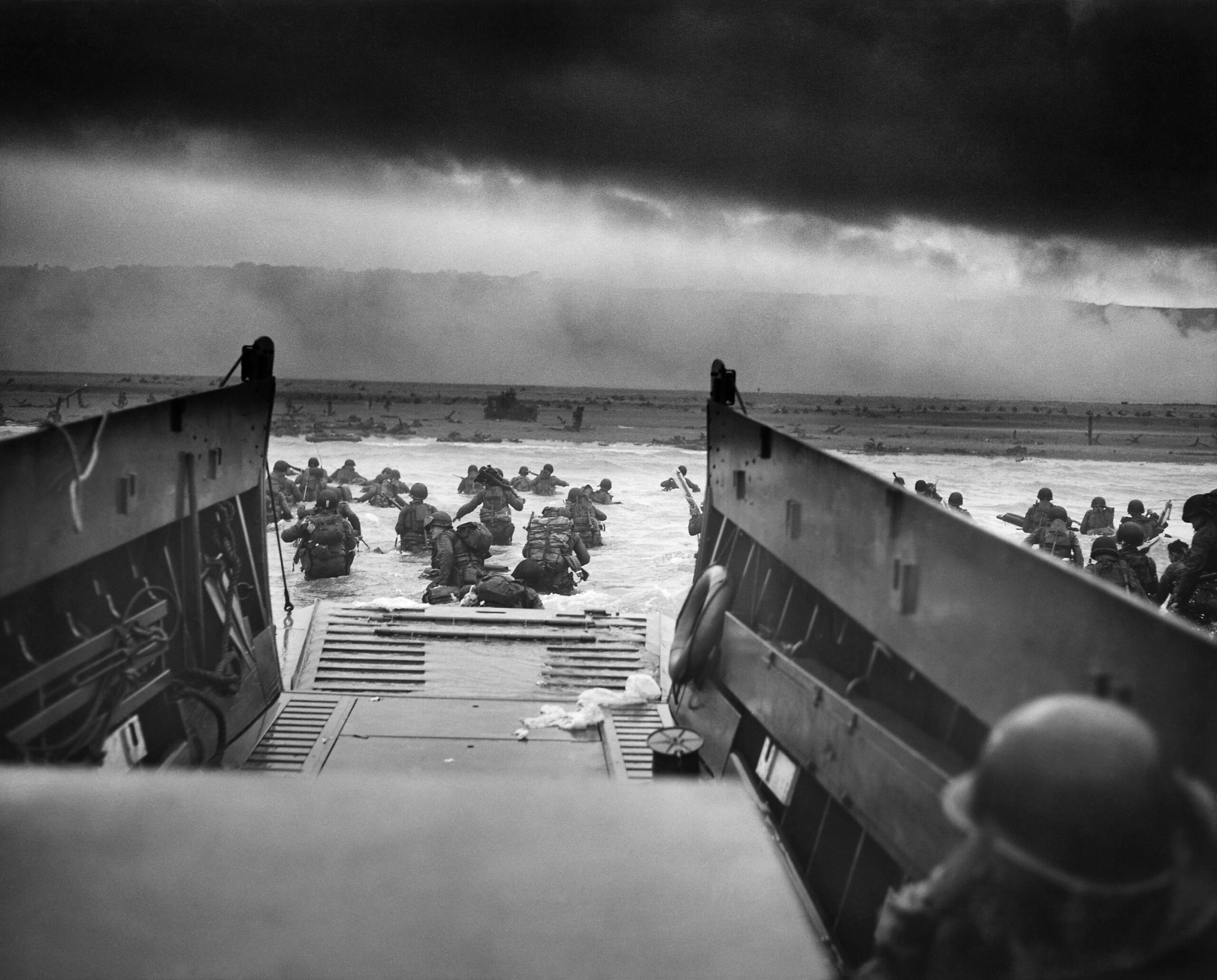
“Into the Jaws of Death” · CPhoM Robert F. Sargent, US Coast Guard · NARA 26-G-2343 · Public domain · Source

The War, Reconstructed Date by Date
Sixty-six operations across eight theatres, tied to the surviving record.Every dated change has to be supported by the record. A bridgehead expands, an army turns, a defensive line breaks, a pocket closes, a withdrawal begins: the map changes when the evidence shows that the campaign changed.
Opposing formations, objectives and command decisions remain attached to the same date. The result is a continuous view of the confrontation as it developed, with the ground, forces and choices visible together.
Researched Beyond the Famous Dates
War diaries, orders, intelligence, after-action reports and official histories.The research goes beyond the dates already familiar from textbooks. Unit records, operational orders, intelligence reports and after-action accounts are used to identify the lesser-known moments when a front shifted, a route opened, a reserve moved, a relief attempt failed or a command decision changed the next day of the battle.
Dates, front lines, commanders, casualties, equipment and routes are checked against one another before they are brought together on the page. That work preserves weeks of movement and decision with the precision of the surviving record, including the lesser-known changes between famous milestones.

The Road to War
Between 1919 and 1939, the postwar settlement was altered by force, treaty revision and repeated tests of collective security. Japan seized Manchuria and expanded the war in China; Italy invaded Ethiopia; Germany rearmed, remilitarised the Rhineland, annexed Austria and dismantled Czechoslovakia.
The sequence runs from Versailles to the invasion of Poland through decisions made in Tokyo, Rome, Berlin, London, Paris, Moscow and Warsaw. Each crisis changed the military balance and narrowed the choices available at the next.

The Opening Campaigns
Germany invaded Poland on 1 September 1939. During the next twenty-one months German forces overran Denmark, Norway, the Low Countries, France, Yugoslavia and Greece, while Britain survived the air campaign of 1940 and the war spread into the Mediterranean.
The early campaigns transformed the military position of Europe. By June 1941, Germany controlled or dominated much of the continent, Britain remained at war, and the invasion of the Soviet Union was about to open a land campaign on a far greater scale.

The Eastern Front
Operation Barbarossa opened on 22 June 1941 along a front stretching from the Baltic to the Black Sea. German armies reached the approaches to Leningrad and Moscow and later the Volga and Caucasus before successive Soviet offensives carried the front west through Ukraine, Belarus, Poland and into Germany.
The fighting was inseparable from occupation and racial war. Mass shootings, starvation, forced labour, the murder of Soviet prisoners of war and the destruction of civilian communities followed the armies across the same ground.

The Mediterranean, North Africa and Italy
From 1940 to 1945, the Mediterranean linked the desert war in North Africa to Malta, convoy routes, amphibious landings, Sicily and the campaign up the Italian peninsula. Ports, shipping, fuel and airfields determined how far armies could move and how long they could remain supplied.
El Alamein and Operation Torch were followed by the destruction of the Axis position in Tunisia, the invasion of Sicily and the long advance through Italy. Mountain ranges, rivers and prepared defensive lines turned the route north into a succession of hard-fought campaigns.

The Western Front
Allied armies landed in Normandy on 6 June 1944 and established the western land front that would carry them into Germany. The campaign moved from the beachhead through the breakout, the pursuit across France and Belgium, and the battles along the German frontier.
Arnhem, the Scheldt, Hürtgen, the Ardennes, the Rhineland and the Ruhr followed. Ports, fuel, roads, rivers and the condition of the German field armies shaped the pace of the advance as much as the distance shown on the map.

The Battle of the Atlantic
From September 1939 to May 1945, the Atlantic carried the shipping that sustained Britain, supplied the Soviet Union, moved American forces overseas and accumulated the men and matériel used to return to Western Europe.
German U-boats attacked those routes across a battle space that shifted with bases, convoy lanes and air cover. Escorts, long-range aircraft, radar, high-frequency direction finding, intelligence and escort carriers progressively changed the balance.

The Air War over Europe
The air war over Europe grew from the campaigns of 1939–40 into the Blitz, the defence of Britain, the Allied bomber offensive and the tactical air campaigns that accompanied the return to continental Europe.
Targets changed with strategy: cities and industrial regions, aircraft production, transport networks, oil and direct support of ground operations. Fighters, radar, anti-aircraft guns, dispersal and repair systems shaped the defence, while bombing killed civilians and devastated towns across Europe.
The Pacific
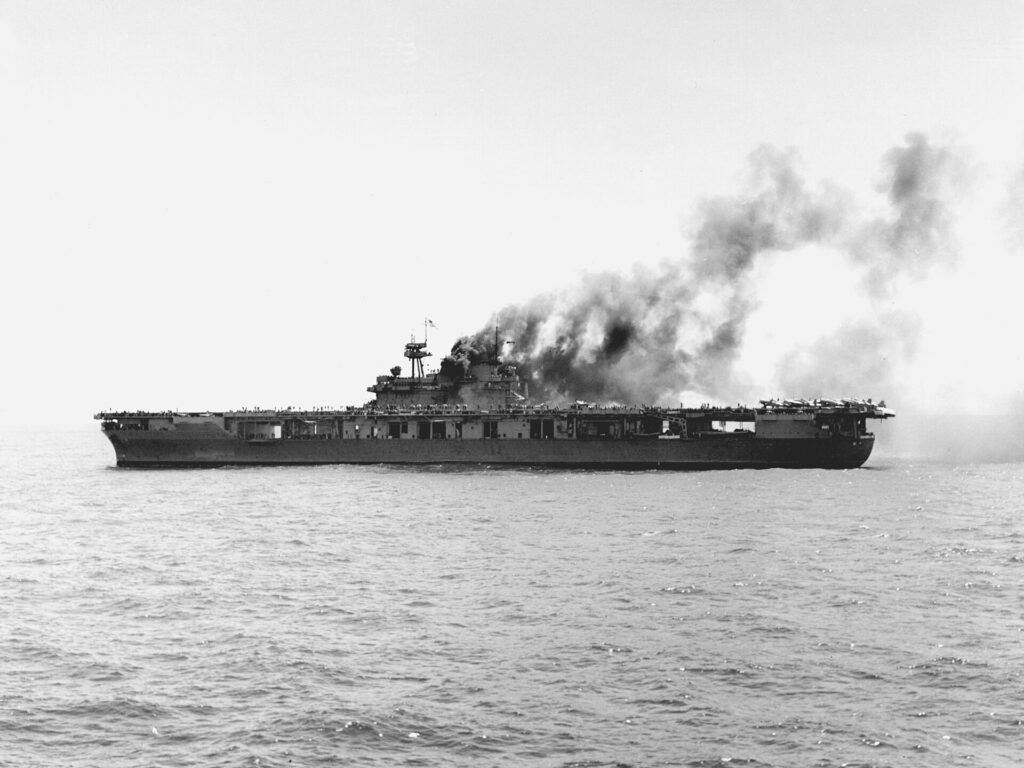
Japan’s offensives of 1941–42 created an empire stretching from Burma and the Netherlands East Indies across the western and central Pacific. The campaigns that followed were fought over the bases, sea routes and island positions required to sustain that perimeter or break through it.
Midway, Guadalcanal, New Guinea, the Central Pacific advance, Leyte, Iwo Jima and Okinawa brought Allied naval and air power progressively closer to Japan. Carrier aviation, submarines, amphibious forces, shipping and fuel shaped the campaign across distances measured in thousands of miles.

China, Burma and India
Full-scale war between China and Japan began in July 1937 and continued through the end of the Second World War. Chinese armies fought across a vast front while Japanese forces occupied major cities and transport corridors and sought to sever China from outside supply.
After Japan seized Burma in 1942, northeast India and the routes into China became part of the same strategic struggle. The airlift over the Himalayas, Imphal and Kohima, Chinese operations in Burma and the reopening of an overland route all served the effort to keep China in the war.

The Holocaust
The Holocaust was the systematic persecution and murder of six million European Jews by Nazi Germany and its collaborators. Exclusion, dispossession, ghettoisation and forced concentration developed into mass shootings, deportations and killing centres as German rule expanded across Europe.
The chronology follows the institutions and places through which genocide was carried out: ghettos, Einsatzgruppen operations, Operation Reinhard, Auschwitz-Birkenau, deportation networks, forced labour, resistance and liberation.

The War Against Civilians
Occupation and war exposed civilians to forced labour, deportation, hostage-taking, reprisals, siege, famine, racial persecution, massacre and the destruction of cities. German occupation in Eastern Europe and the Soviet Union and Japanese occupation across Asia created vast systems of exploitation, coercion and killing.
Strategic bombing, artillery and urban combat added further destruction across Europe and Asia. Displacement, hunger, occupation violence and mass death were central parts of the war in every major theatre.

The Cost
The Second World War killed tens of millions of people. Military dead, murdered civilians, victims of genocide, prisoners of war, forced labourers and people who died from famine, siege and occupation were recorded by different institutions under different conditions.
The surviving totals are presented by country, population, category and source range, preserving the distinctions between combat deaths, civilian losses, genocide, imprisonment, famine and occupation.
Watch the Confrontation Change
Front movement, command decisions and opposing forces in the same chronology.Advance through an operation and the military picture changes with the date: reserves are committed, axes turn, crossings succeed or fail, withdrawals begin, pockets form and supply routes open or disappear. The map keeps both sides inside the same confrontation as those changes unfold.
Command decisions appear where they alter the campaign. A delayed withdrawal, a redirected armoured column, a failed relief attack or the loss of a port is connected to the forces and ground affected by it, preserving the sequence that produced the next move.
Archival Images, Returned to Their Moment
Photographs and film reconnected to the dates, places and units they document.Wartime photographs and film survive across NARA, the Imperial War Museums, the Bundesarchiv, ECPAD, Canadian collections and other national archives. Many are publicly catalogued but separated from the campaign chronology that explains what was happening when the camera was there.
WW2 Theatres traces that material back through archive captions, dates, locations and unit identifications, then places it back inside the operation it records. Published images that are easy to overlook in large collections regain their historical meaning when they sit beside the front, decision and date they captured.
- United States Army in World War II, the official history seriesUS Army Center of Military History
- Operational records of the British and Commonwealth forcesThe National Archives, Kew
- Records of the Allied Expeditionary Force and the American armiesUS National Archives and Records Administration
- German military records, Heeresgruppe and Oberkommando seriesBundesarchiv, Militärarchiv Freiburg
- Photograph, film and sound collections of the Second World WarImperial War Museums
- The Victory Campaign and the Canadian official historiesVeterans Affairs Canada and the Department of National Defence
- French defence audiovisual and operational archivesECPAD and the Service historique de la Défense
- Documenting numbers of victims of the Holocaust and Nazi persecutionUnited States Holocaust Memorial Museum
- Cemeteries, memorials and battlefield interpretationAmerican Battle Monuments Commission and the Commonwealth War Graves Commission
- Wikimedia Commons file records used to reach originating photographic collectionsWikimedia Commons
Photographs are credited individually on the page they appear on. Material from the US National Archives and the American armed services is in the public domain. Material from the Imperial War Museums is used under the IWM Non-Commercial Licence. Material from the Bundesarchiv is licensed CC BY-SA 3.0 DE. French, Dutch, Belgian and Canadian holdings are credited to the institution that holds them.