Skip to content
WW2 Theatres Theatres of the Second World War
Home / Pacific Theatre / The Blockade, the Bombing and the Bombs
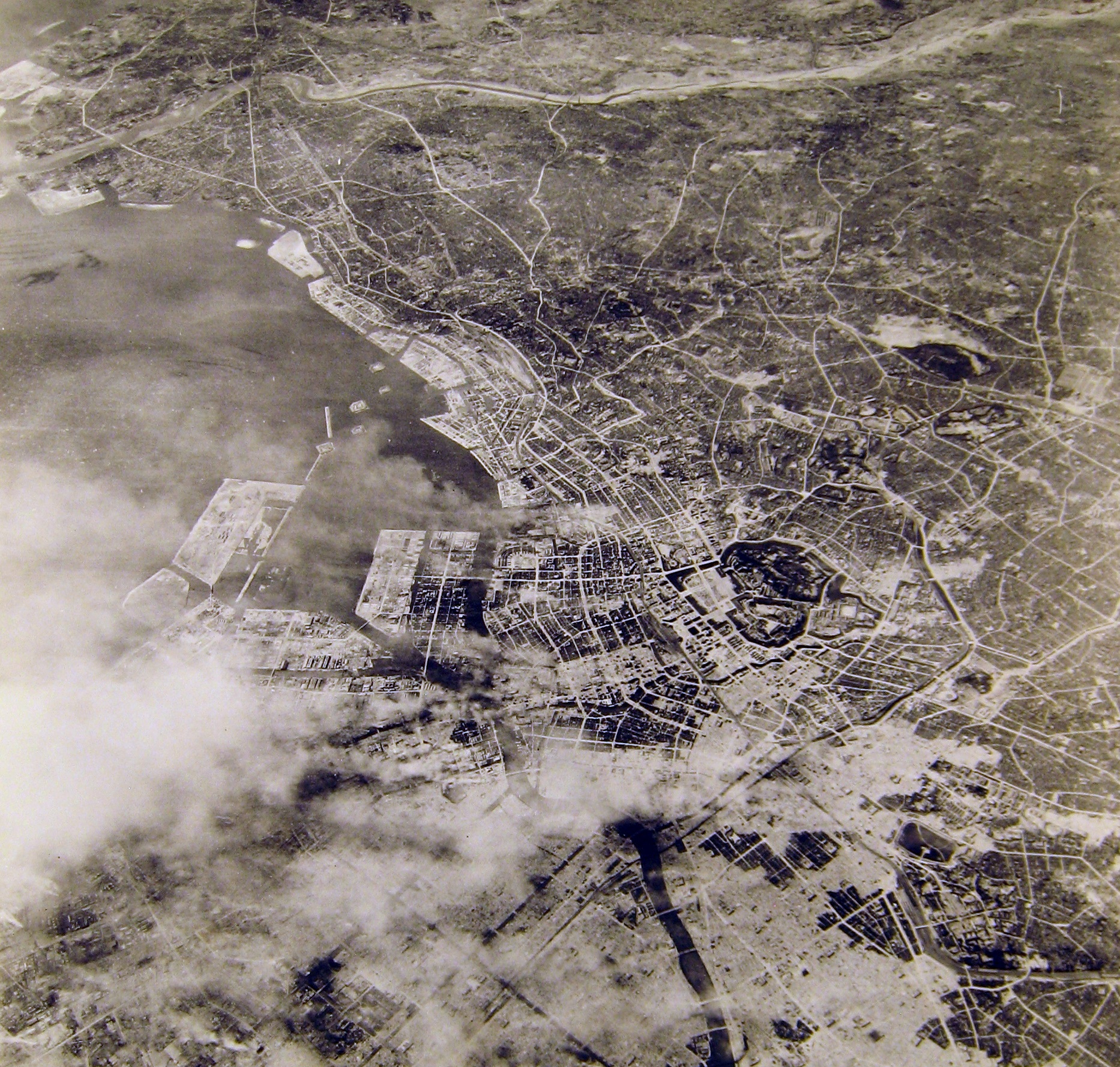
Aerial photograph of Tokyo showing destruction after the American incendiary bombing of 9–10 March 1945.

The Blockade, the Bombing and the Bombs

24 November 1944 to 15 August 1945

B-29s began sustained bombing from the Marianas in November 1944 while American submarines were destroying Japan’s shipping and cutting the home islands off from essential imports. In 1945 low-altitude incendiary raids devastated Japanese cities, aircraft laid mines across shipping routes and carrier aircraft attacked the remaining fleet. Atomic bombs struck Hiroshima and Nagasaki in August as the Soviet Union entered the war against Japan.

Tokyo after the 9–10 March 1945 incendiary raid · U.S. Army Air Forces · public domain · Source photograph

This operation sits inside Pacific Theatre, where it appears as a single entry. This page carries it in full.

BACK TO PACIFIC THEATRE
CAMPAIGN PERIOD
24 Nov 1944–15 Aug 1945First Marianas-based B-29 raid to Japan’s announcement of surrender
THE AIR WAR
B-29 strategic bombingFactory attacks followed by widespread incendiary raids on Japanese cities
THE NAVAL BLOCKADE
Submarines, mines, carriersSea routes closed by repeated shipping losses and minefields around key ports
ATOMIC ATTACKS
6 and 9 August 1945Hiroshima and Nagasaki, with mass civilian fatalities and long-term injuries
JAPAN ANNOUNCES SURRENDER
15 August 1945Following imperial decisions amid bombing, blockade and the Soviet offensive
Marker affiliation Allied Axis Other / contested
Map layers

01 / 21

How the Marianas Put the Japanese Home Islands Within B-29 Range

The capture of Saipan, Tinian and Guam allowed the Twentieth Air Force to fly sustained missions against Japan from late November 1944.

The Allied capture of the Mariana Islands in 1944 moved long-range air bases within reach of the Japanese home islands. Engineers built extensive bomber fields on Saipan, Tinian and Guam, with runways, bomb dumps and workshops for a force that depended on enormous quantities of fuel and specialized maintenance. The new bases made a sustained offensive possible without the long supply route through China used by earlier B-29 raids.

General Henry H. Arnold retained unusually direct control of the Twentieth Air Force, while Major General Haywood S. Hansell commanded XXI Bomber Command in the Marianas. Hansell pursued high-altitude daylight attacks against factories central to Japan’s aircraft industry. On 24 November 1944, B-29s attacked the Nakajima aircraft plant near Tokyo. Fierce winds at altitude, cloud cover, mechanical failures and difficulties concentrating bombs made precision attack less effective than its planners hoped.

Japanese air defenses imposed costs, but the principal limitation of the first months was the difficulty of placing bombs on selected factories from very high altitude. U.S. commanders had to judge whether larger numbers of aircraft, new tactics and attacks on different target systems would reduce Japan’s ability to continue the war more rapidly.

How Submarines and Mines Closed Japan’s Maritime Supply Routes

Japan depended on imports of fuel, food and industrial raw materials; losses at sea could not be replaced by its shrinking merchant fleet.

Japan’s merchant ships connected its home islands to oil, ore, food and garrisons across Asia. American submarines had been attacking those routes since the beginning of the Pacific War. By 1944, effective radar, improved torpedoes, intelligence and coordinated patrols were destroying shipping faster than replacement vessels could be built. Coal, food and raw materials remained stranded in ports or overseas even when factories had escaped direct bombing.

The Navy developed a second means of interdiction: aerial mines that could close narrow straits, harbors and approaches. In late March 1945 the 313th Bombardment Wing began Operation Starvation, dropping mines principally in Japanese coastal waters and the Shimonoseki Strait. The mines forced ships to await clearance, take longer routes or risk sinking in waters essential to Japan’s coastal traffic. Mine-laying could inflict disruption with fewer bomber sorties than an equivalent factory campaign.

The postwar U.S. Strategic Bombing Survey judged attacks on shipping, fuel and transport exceptionally damaging to the wartime economy. That was a retrospective assessment made with records gathered after Japan surrendered. Japanese policymakers during the summer of 1945 were confronting the immediate consequences: mounting shipping losses, shortages, production cuts, and diminishing means of feeding and supplying the islands.

Why LeMay Shifted from Factory Bombing to Incendiary Raids on Cities

After January 1945 the B-29 offensive increasingly attacked urban industrial districts, including small workshops intermingled with homes.

Major General Curtis LeMay took command of XXI Bomber Command in January 1945. He inherited an offensive that had consumed aircraft and fuel while producing disappointing results against many of its designated industrial plants. Japan’s industrial output was distributed across large factories and numerous subcontractors, workshops and warehouses in crowded city districts. LeMay increasingly used low-altitude night raids with incendiary bombs to attack these concentrations.

On the night of 9–10 March, American aircraft struck densely built areas of Tokyo with incendiaries. The resulting fire spread through residential and industrial neighborhoods, trapping residents as escape routes vanished. The destruction was immense; estimates of those killed in that single raid commonly reach about 100,000. In subsequent months Osaka, Nagoya, Kobe and many smaller Japanese cities suffered incendiary attacks. Civilian deaths, displacement, burns and the loss of housing were intrinsic consequences of the way this target system was attacked.

The bombing program also changed Japan’s industrial capacity and daily life. Destroyed workshops could no longer supply parts to major factories, and the dispersal of workers and equipment disrupted production elsewhere. The U.S. command could measure burned urban area relatively quickly. The relationship between that destruction and Japanese decisions to surrender remained much harder to establish while the war continued.

From the Trinity Test to the Bombings of Hiroshima and Nagasaki

The Manhattan Project produced two different atomic weapons, used against Japanese cities on 6 and 9 August 1945.

The Manhattan Project’s laboratories and production sites produced uranium-235 for a gun-type weapon and plutonium for an implosion weapon. The successful Trinity test in New Mexico on 16 July 1945 demonstrated the implosion system. President Harry S. Truman received reports while meeting Allied leaders at Potsdam, where the United States, Britain and China issued a declaration calling on Japan to surrender and warning of severe consequences if it refused.

On 6 August the B-29 Enola Gay dropped the uranium bomb Little Boy over Hiroshima. The explosion destroyed central districts, killed large numbers of people immediately and exposed survivors to burns and radiation. On 9 August Bockscar dropped the plutonium bomb Fat Man over Nagasaki after its primary target, Kokura, proved difficult to attack. Nagasaki’s terrain influenced the pattern of damage, but thousands were killed and many more injured. Hospitals, water systems and transport infrastructure were overwhelmed.

Contemporaneous U.S. statements presented the atomic attacks as a means of ending the war; those statements are evidence of official policy and wartime justification. Assessing the bombs’ independent effect on surrender requires also examining Japan’s blockade, urban devastation, remaining military plans, Soviet entry and deliberations within its governing elite. Estimates of deaths by the end of 1945 include people who died weeks or months after the explosions, and should not be presented as immediate casualty totals.

How Soviet Entry and Japanese Cabinet Divisions Shaped the Surrender

The Soviet Union entered the Pacific war as the Japanese high command confronted two atomic bombings and a broken maritime economy.

Japanese policymakers were divided over how to end a war in which the navy had been crippled, cities burned and maritime supply routes cut. Some ministers sought a way to preserve the imperial institution through negotiation. Others favored continued resistance and hoped an Allied invasion could be made costly enough to improve the terms. The Soviet Union had been considered a possible diplomatic intermediary; its decision to declare war on Japan on 8 August and attack Japanese forces in Manchuria on 9 August destroyed that assumption.

The atomic bombing of Nagasaki occurred on 9 August as the Soviet offensive developed. Japan’s Supreme War Council and cabinet remained split over surrender terms, particularly the status of the emperor and safeguards against occupation or disarmament. Foreign Minister Shigenori Tōgō and Navy Minister Mitsumasa Yonai pressed for accepting the Allied declaration; War Minister Korechika Anami and other army leaders resisted capitulation without additional conditions. Prime Minister Kantarō Suzuki referred the division to Emperor Hirohito.

The emperor intervened in favor of ending the war. After exchanges with the Allies over the imperial institution and further deliberations, he directed acceptance of the Allied terms on 14 August. His recorded message was broadcast on 15 August. The formal instrument of surrender was signed on 2 September, beyond the date range of this campaign. Historians continue to examine the relative weight of the atomic bombings, Soviet intervention, blockade, conventional bombing and invasion fears; the surviving evidence establishes that these pressures converged rather than supplying a single universally accepted cause.

The Air, Naval and Political Leaders Behind Japan’s Defeat in 1945

American air and naval commands applied pressure while Japanese ministers disputed the terms under which the war would end.

Arnold retained control of the Twentieth Air Force through Washington, and in January 1945 replaced Hansell with LeMay at XXI Bomber Command. LeMay directed the incendiary offensive and assigned the 313th Bombardment Wing to mine the Japanese shipping routes. Nimitz’s Pacific Fleet meanwhile sent carrier task forces against Japan’s remaining warships and airfields. In Tokyo the question of accepting the Potsdam terms divided the Supreme War Council in August; Hirohito intervened when the ministers could not agree on the conditions of surrender.

Henry H. Arnold
General · Commanding General, U.S. Army Air Forces · Allied

Henry H. Arnold

Strategic air command and priorities

Arnold placed the Twentieth Air Force under direct control from Washington, seeking sustained long-range attacks against Japan’s war-making capacity. His command supplied the B-29 force operating from the Marianas and set strategic priorities, while field commanders worked through difficult operating conditions. Decisions about factory targets, incendiary missions and mining brought the air arm into closer coordination with the wider blockade.

U.S. Army Air Forces official portrait · public domain · Source
Haywood S. Hansell Jr.
Major General · XXI Bomber Command, 1944–January 1945 · Allied

Haywood S. Hansell Jr.

Opens the Marianas-based bombing offensive

Hansell organized the first B-29 raids against Japan from newly built fields on Saipan, including the November 1944 attack on the Nakajima plant near Tokyo. He believed that concentrated destruction of aircraft factories could shorten the war and resisted broad area incendiary tactics. Weather, jet-stream winds and target obscuration frustrated those plans, and he was replaced as operational methods changed.

U.S. Air Force biography photograph · public domain · Source
Curtis E. LeMay
Major General · XXI Bomber Command from January 1945 · Allied

Curtis E. LeMay

Changes the air offensive to low-level incendiaries

LeMay took over XXI Bomber Command after months of disappointing precision results. He directed low-altitude night incendiary raids against built-up Japanese urban districts, beginning with the destructive Tokyo operation of March 1945 and extending to many other cities. His force also allocated B-29s to mine-laying. He treated widespread industrial and housing destruction as an operational means of reducing Japan’s capacity to continue the war.

U.S. Air Force wartime portrait · public domain · Source
Chester W. Nimitz
Fleet Admiral · Commander in Chief, U.S. Pacific Fleet · Allied

Chester W. Nimitz

Naval blockade and carrier pressure

Nimitz commanded Pacific naval forces prosecuting the submarine campaign, carrier strikes and the blockade of Japan. Navy planners developed the aerial mine program in cooperation with the Army Air Forces; American submarines continued attacks on merchant shipping while carriers hit airfields and ships close to the Japanese coast. These operations diminished Japan’s supplies and reduced the naval and air threats to a planned invasion.

U.S. Navy wartime portrait · public domain · Source
Harry S. Truman
President of the United States from April 1945 · Allied

Harry S. Truman

Atomic use and surrender policy

Truman succeeded Franklin Roosevelt in April 1945 and inherited both the Manhattan Project and plans for a costly invasion of Japan. He received reports about the Trinity test during the Potsdam meetings and participated in the decision process that authorized atomic bombing. His administration issued the Potsdam Declaration and considered Japan’s subsequent surrender terms, balancing war termination with the unresolved status of the Japanese emperor.

U.S. government official portrait · public domain · Source
Emperor Hirohito
Emperor of Japan · Axis

Emperor Hirohito

Decides to accept surrender

Hirohito occupied the central constitutional and ceremonial position in Japan’s wartime system and intervened in the final surrender deliberations. Senior ministers and military chiefs remained sharply divided after the Soviet attack and the second atomic bombing. During the imperial meetings he supported ending the war on Allied terms. His recorded surrender rescript, broadcast on 15 August, informed the public that the government would cease resistance.

Library of Congress cph.3a40859 · PD-Japan-oldphoto · Source
Kantarō Suzuki
Prime Minister of Japan, April–August 1945 · Axis

Kantarō Suzuki

Convenes the cabinet during the surrender crisis

Suzuki took office as prime minister in April 1945, with Japan facing expanding air raids, shipping losses and preparation for an expected invasion. His cabinet contained officials prepared to seek a settlement and commanders who demanded assurances before surrender. After the atomic attacks and Soviet entry he referred the unresolved split to the emperor. His government helped transmit Japan’s conditional acceptance and implement the subsequent decision.

Japanese government historical portrait · PD-Japan-oldphoto · Source
Shigenori Tōgō
Foreign Minister of Japan, April–August 1945 · Axis

Shigenori Tōgō

Presses to accept the Potsdam terms

Tōgō sought a diplomatic way out of a war whose strategic situation was deteriorating rapidly. He had supported efforts to approach the Soviet Union as an intermediary before Moscow entered the conflict. After the declaration of war by the Soviet Union, he pressed for acceptance of Allied terms with particular attention to the emperor’s position. His disagreements with senior army commanders shaped the late-night meetings preceding surrender.

Japanese historical portrait · PD-Japan-oldphoto · Source
Korechika Anami
General · War Minister, April–August 1945 · Axis

Korechika Anami

Opposes surrender without additional conditions

Anami represented army leaders who feared that capitulation would destroy Japan’s state and military institutions. Even as cities burned, the merchant fleet dwindled and Soviet forces advanced in Manchuria, he pressed for conditions beyond the limited guarantee sought by the foreign minister. He accepted the emperor’s final direction despite his objections. His stance reflected the split within the ruling military hierarchy, rather than a unified Japanese response to the bombing.

Japanese historical portrait · PD-Japan-oldphoto · Source
Mitsumasa Yonai
Admiral · Navy Minister, July 1944–August 1945 · Axis

Mitsumasa Yonai

Supports bringing the war to an end

Yonai served as navy minister while Allied submarines and aircraft destroyed Japan’s remaining maritime mobility. Japanese naval leaders understood the consequences of fuel scarcity and the loss of experienced ships and pilots. During the final meetings Yonai was among the ministers who supported ending the war under the Potsdam framework. His position helped make the divide between surrender advocates and continued-resistance leaders explicit.

Japanese historical portrait · PD-Japan-oldphoto · Source

B-29 Bombers, Submarines, Naval Mines and Atomic Weapons

M69 incendiaries over Tokyo, Mark 25 mines in the inner shipping routes and the 509th Composite Group on Tinian.

The B-29s operating from the Marianas carried M69 incendiaries into Tokyo on the night of 9–10 March. Later that month aircraft of the 313th Wing began laying mines in Shimonoseki Strait; in May they used large numbers of Mark 25 influence mines, which were difficult for the Japanese to sweep. The specially modified aircraft of the 509th Composite Group carried Little Boy and Fat Man from Tinian in August, using the airfield and supply installations built there after the island’s capture in 1944.

Boeing B-29 Superfortress
B-29 of the 498th Bomb Group at Isely Field, Saipan, in late 1944.
U.S. Army Air Forces period photograph · public domain · Source

Boeing B-29 Superfortress

Four-engine, long-range heavy bomber · U.S. Army Air Forces

The B-29’s range allowed operations from the Marianas against the Japanese home islands. Its large payload, specialized pressurization and advanced navigation made it central to both factory strikes and the later incendiary offensive. The same type of aircraft delivered naval mines and, in specially modified versions, the atomic weapons. Maintenance demands and high-altitude winds shaped how the force actually fought.

USS Barb (SS-220)
USS Barb departing Pearl Harbor on 8 June 1945 for her twelfth war patrol.
Horace Bristol / U.S. Navy 80-G-335390, NARA NAID 520690 · public domain · Source

USS Barb (SS-220)

Gato-class fleet submarine · U.S. Navy

American fleet submarines attacked the maritime network supplying Japan with food, petroleum and industrial materials. Barb was one of the active boats of the late-war campaign, carrying out commerce interdiction and attacks close to the home islands. Radar, torpedo reliability and information from intelligence sources helped submarine commanders find ships and escape escort forces. The image shows the boat departing Pearl Harbor in June 1945.

AN-M69 incendiary bomblet
U.S. AN-M69 six-pound incendiary submunition; contemporary official ordnance record.
U.S. government ORDATA photograph · public domain · Source

AN-M69 incendiary bomblet

Six-pound-class incendiary submunition · U.S. Army Air Forces

The AN-M69 was carried in clusters that scattered small incendiary weapons over urban districts. These loads could set closely built wooden structures and workshop buildings alight in many places at once. The weapon contributed to the rapid spread of fire during low-level night bombing. Photographs of the physical submunition help distinguish the means of attack from the larger B-29 aircraft that delivered it.

Mark 25 aerial naval mine
Surviving U.S. Navy Mark 25 mine exhibited in Japan, photographed decades after World War II.
H yamaguchi · photographed 15 August 2017 · CC BY 2.0 · Source

Mark 25 aerial naval mine

Aircraft-delivered influence mine · U.S. Navy

Aircraft-dropped naval mines were central to Operation Starvation, particularly in narrow shipping routes and harbor approaches. The Mark 25 was an acoustic influence mine used in the late-war mining program. Its presence could disrupt traffic even where no vessel was sunk because ships had to wait for clearing operations or accept dangerous detours. This surviving mine is shown in a modern photograph, not wartime deployment footage.

AN-M64 general-purpose bomb
U.S. AN-M64 500-pound general-purpose bomb in an official 1943 ordnance image.
U.S. government ORDATA photograph · public domain · Source

AN-M64 general-purpose bomb

500-pound-class high-explosive bomb · U.S. Army Air Forces

High-explosive general-purpose bombs remained part of the B-29 arsenal for attacks on factories, rail facilities, transport targets and military infrastructure. Their effects differed from those of incendiary clusters, which were intended to start many dispersed fires. The AN-M64 is shown in an official wartime ordnance image; the illustration identifies the bomb type rather than a specific shipment or aircraft load used on a dated raid.

Grumman F6F-5 Hellcat
U.S. Navy F6F-5 Hellcats of VF-85 flying during 1945.
U.S. Navy official photograph · public domain · Source

Grumman F6F-5 Hellcat

Single-engine carrier-based fighter · U.S. Navy

Hellcats supported fast-carrier operations against Japanese airfields, remaining naval vessels and coastal targets in the final months of the Pacific war. Carrier fighter sweeps reduced the danger posed by Japanese aircraft while strike groups attacked ports and ships at anchor. Its role was distinct from that of the B-29: the Hellcat was a tactical carrier aircraft rather than a long-range strategic bomber.

Little Boy uranium bomb
The Little Boy combat unit being assembled on Tinian before the Hiroshima mission in August 1945.
U.S. War Department / National Archives · public domain · Source

Little Boy uranium bomb

Uranium-235 gun-type fission weapon · Hiroshima

Little Boy used enriched uranium and a gun-type assembly. It was carried by the modified B-29 Enola Gay and detonated over Hiroshima on 6 August 1945, destroying much of the central city and causing large-scale immediate and delayed deaths. The image shows its combat unit during assembly on Tinian, a period photograph rather than a modern museum replica.

Fat Man plutonium bomb
A Fat Man unit on a trailer cradle outside Assembly Building No. 2 at Tinian, August 1945.
U.S. War Department / NARA Record Group 77 · public domain · Source

Fat Man plutonium bomb

Plutonium implosion fission weapon · Nagasaki

Fat Man used an implosion assembly tested at Trinity. It was carried by the modified B-29 Bockscar and detonated over Nagasaki on 9 August 1945. The blast, heat and subsequent radiation exposure caused mass civilian casualties. The photograph shows a Fat Man unit being placed on its cradle at Tinian in August 1945, with its wartime setting clearly documented.

Civilian Deaths, Shipping Losses and the Destruction of Japanese Cities

The air, sea and atomic campaigns harmed Japan’s economic infrastructure and exposed millions of civilians to bombing and shortage.

Civilian casualties from conventional firebombing and atomic attacks were enormous, and estimates differ by city, reporting date and method. The Tokyo raid of 9–10 March is often estimated to have killed around 100,000 people. Hiroshima and Nagasaki suffered further mass fatalities from blast, heat, burns and radiation, with many deaths occurring after the attacks. These losses belong alongside the destruction of homes, hospitals and productive capacity.

Operation Starvation cost the 313th Wing 15 B-29s and 103 aircrew, according to the U.S. Navy’s retrospective history. Its account credits the 1,529 sorties with laying 12,135 mines in 26 fields and estimates the tonnage of ships sunk or seriously damaged at more than 1.25 million tons. Those figures cover the mining operation from March to August, during which Japanese coastal shipping was still moving between ports that the bombers were progressively closing. The Strategic Bombing Survey’s later assessment of economic collapse drew on shipping and industrial evidence collected after Japan surrendered.

~100,000

Deaths in Tokyo’s March fire raid

The 9–10 March 1945 bombing killed an estimated 100,000 people; the figure is approximate and relates to this raid alone, not the entire air offensive.

12,135

Mines laid in Operation Starvation

The U.S. Navy historical account records 12,135 mines in 46 missions during the 1945 B-29 campaign; the effects included sunk vessels, closed routes and delays.

Hiroshima and Nagasaki

Two atomic bombings

The attacks on 6 and 9 August caused immediate mass deaths and injuries followed by further deaths from burns and radiation; casualty totals depend on the date and method of counting.

Thousands of ships

Merchant shipping losses

Submarine attacks accumulated throughout the Pacific war, while mines and air raids further disrupted shipping and coastal communications during 1945.

14–15 August 1945

Decision and announcement of surrender

The emperor directed acceptance of Allied terms on 14 August and the recorded announcement was broadcast on 15 August; the formal surrender was signed on 2 September.

Operational Records, Bombing Surveys and Japan’s Surrender Decisions

Air Force histories, naval records, original public statements and postwar surveys document the final months of the war.

U.S. Army Air Forces histories establish how the B-29 offensive was organized and why its tactics changed. U.S. Navy operational records document the mining, submarine blockade, and carrier attacks. The Strategic Bombing Survey provides a detailed retrospective examination of economic damage and strategic effects, while its interpretation of how Japan might otherwise have surrendered reflects postwar judgments made after access to Japanese records.

The Truman Library preserves contemporary U.S. policy statements and decision records. The National Park Service chronicles the Manhattan Project and the attacks on Hiroshima and Nagasaki. Naval historical accounts of Japan’s surrender bring together the deliberations of Japanese political and military leaders and the timing of Soviet intervention.

  1. The B-29 Story: How the Superfortress Paced the Attack Against Japan, Air & Space Forces MagazineFirst Marianas-based Tokyo raid, Hansell’s targeting and LeMay’s operational change
  2. The Twentieth Against Japan, Air & Space Forces MagazineAAF command structure, B-29 tactics and the firebombing offensive
  3. Operation Starvation: The Aerial Mine Campaign Against Japan, Naval History and Heritage CommandThe 313th Bomb Wing, mining sequence, sorties and effects on shipping
  4. United States Strategic Bombing Survey: Summary Report (Pacific War), U.S. Strategic Bombing Survey, July 1946Postwar investigation of production, transport, blockade, bombing and surrender; retrospective institutional assessment
  5. Japan’s Surrender and Aftermath, Naval History and Heritage CommandU.S. Navy synthesis of Japan’s military condition and surrender sequence
  6. Manhattan Project Timeline, National Park ServiceDates of Trinity, Potsdam, Hiroshima, Nagasaki and announcement of surrender
  7. Decision to Drop the Bomb, Harry S. Truman Presidential LibraryDecision records, Truman’s notes and competing contemporary descriptions of atomic targeting
  8. Timeline of the Atomic Bombings of Hiroshima and Nagasaki, National Park ServiceCivilian experience, mission details and aftermath of both atomic attacks
  9. 80-G-490147: Raids on Japanese Home Islands, 24 July 1945, National Museum of the U.S. NavyDated photograph of Tone under attack near Kure
  10. H-053-2: The Surrender of Japan, Naval History and Heritage CommandSoviet entry, Supreme War Council divisions, imperial decisions and surrender chronology
  11. The U.S. Navy at War: 1941–1945, Final Official Report, Department of the NavyJuly 1945 carrier strikes at Kure, bombardments and blockade operations
  12. Manhattan Project: National Historical Park, National Park ServiceDevelopment, production and use of uranium and plutonium weapons
  13. Statement by the President Announcing the Use of the Atomic Bomb at Hiroshima, Harry S. Truman Presidential LibraryPrimary contemporaneous presidential statement; rhetoric distinguished from subsequent assessments
  14. The Atomic Bombs and August 1945, World War II Memorial / National Park ServiceCivilian casualties and surrender sequence in August 1945
  15. The Key to the Central Pacific: Mariana Islands, NOAA Ocean ExplorationCapture and role of Saipan, Tinian and Guam in the bombing offensive
  16. The Surrender of Japan and Its Causes: U.S. Navy Historical Review, Naval History and Heritage CommandCombined consequences of mining, carrier strikes, atomic bombing and Soviet entry
  17. Manhattan Project Leaders: Harry S. Truman, National Park ServiceJune 1945 policy discussions and the president’s role in the atomic decision
Operation chronologyDates, locations and sourced event summaries
DateEventLocationSummary
24 November 1944 · Daylight raidB-29s from Saipan Strike the Nakajima Aircraft PlantMusashino, Tokyo, Japan

On 24 November 1944, XXI Bomber Command dispatched B-29s from Saipan against the Nakajima aircraft-engine works at Musashino on the outskirts of Tokyo. The mission began sustained strategic bombing from the captured Marianas, with American airfields now close enough to reach central Japan and return.

Sources 1, 2, 15
20 January 1945 · Change of commandCurtis LeMay Takes Command of XXI Bomber CommandGuam, Mariana Islands

Major General Curtis LeMay assumed command of the Marianas-based XXI Bomber Command in January 1945 after the initial precision-bombing effort had produced limited results. High winds over Japan made accurate bombing at altitude exceptionally difficult, and many missions consumed substantial resources without disabling their nominated plants.

Sources 1, 2
25 February 1945 · Daytime incendiary raidLarge Incendiary Attack Tests New Methods Against TokyoTokyo, Japan

On 25 February 1945, a large B-29 force attacked Tokyo with incendiaries as cloud cover frustrated the use of more selective bombing methods. The raid burned extensive parts of the city and showed the vulnerability of densely built districts to widespread fire.

Sources 1, 2
10 March 1945 · Overnight, 9–10 March, Japan timeTokyo Burns During Operation MeetinghouseShitamachi districts, Tokyo, Japan

During the night of 9–10 March 1945, hundreds of B-29s carried incendiary bombs over crowded districts of eastern Tokyo. The attackers flew at lower altitude than in earlier daylight precision missions, seeking to ignite the urban industrial and residential areas that supplied the Japanese war economy.

Sources 2, 4, 5
14 March 1945 · Night of 13–14 MarchIncendiary Attacks Spread to Osaka and Other CitiesOsaka, Japan

After the Tokyo raid, LeMay extended major incendiary attacks to Osaka and other industrial cities. In the night of 13–14 March, B-29 incendiaries struck densely developed sections of Osaka, causing widespread fires in an important manufacturing center.

Sources 1, 2, 4
27 March 1945 · First phase of B-29 aerial miningOperation Starvation Begins to Mine Japan’s Shipping RoutesShimonoseki Strait, Japan

In late March 1945, B-29s of the 313th Bombardment Wing began the aerial mining operation known as Starvation. Navy-designed minefields targeted the Shimonoseki Strait and other maritime approaches that linked Japanese ports, inland-sea traffic and coastal shipping.

Sources 3, 4
7 April 1945 · Midday and afternoonU.S. Carrier Aircraft Sink the Battleship YamatoEast China Sea south of Kyushu

On 7 April 1945, U.S. carrier aircraft intercepted the battleship Yamato and its escort force while it sailed toward Okinawa. Japanese commanders intended to attack the invasion fleet and, under the mission’s desperate fuel constraints, bring the warship into an operation from which return was unlikely.

Sources 5, 11
12 April 1945 · Presidential successionHarry Truman Succeeds Roosevelt as U.S. PresidentWashington, D.C., United States

Franklin D. Roosevelt died on 12 April 1945 and Vice President Harry S. Truman assumed the presidency. Truman now had responsibility for the Pacific campaign, plans for the invasion of Japan and the secret program developing atomic weapons.

Sources 7, 12, 18
26 May 1945 · Night of 25–26 MayA Renewed Night Raid Burns More of TokyoTokyo, Japan

On the night of 25–26 May 1945, U.S. B-29s mounted another major incendiary raid on Tokyo. Fires spread through further urban districts after the earlier March devastation, extending the damage to factories, government buildings, housing and transport facilities.

Sources 1, 2, 4
5 June 1945 · Large incendiary raidKobe Suffers Another Major Incendiary BombingKobe, Japan

On 5 June 1945, B-29s carried out a major incendiary attack against Kobe, an important port and industrial city. The air offensive now covered multiple urban centers whose productive activities depended on workshops, warehouses and rail links embedded in residential districts.

Sources 1, 2, 4
14 July 1945 · Naval bombardmentAllied Warships Bombard Kamaishi’s SteelworksKamaishi, northeastern Honshu, Japan

On 14 July 1945, Allied surface warships bombarded the industrial facilities at Kamaishi on Japan’s northeastern coast. The attack extended the pressure from the air and sea blockade to direct naval gunfire against the home islands.

Sources 3, 5, 11
16 July 1945 · 05:29 Mountain War Time, 16 JulyThe Trinity Test Demonstrates a Plutonium Implosion BombTrinity test site, New Mexico, United States

At 5:29 a.m. local time on 16 July 1945, the United States detonated the first nuclear explosive at the Trinity site in New Mexico. The device used a plutonium implosion arrangement developed at Los Alamos, confirming the principle behind the weapon intended for later use over Nagasaki.

Sources 6, 7, 12
24 July 1945 · Daylight carrier strikesCarrier Aircraft Attack Japan’s Remaining Warships at KureKure Naval Base, Hiroshima Prefecture, Japan

On 24 July 1945, British and American carrier aircraft struck shipping, naval facilities and vessels anchored around Kure and the Inland Sea. Japan’s remaining heavy ships were already severely limited by fuel scarcity, but their presence still mattered to invasion planning and the threat of renewed operations.

Sources 9, 11, 3
26 July 1945 · Allied declarationThe Allies Issue the Potsdam DeclarationPotsdam, Germany

On 26 July 1945, the United States, Britain and China issued the Potsdam Declaration, demanding Japan’s surrender and warning of severe destruction if its government continued the war. Truman and his advisers were simultaneously considering the military use of atomic weapons.

Sources 6, 7, 18
6 August 1945 · 08:15 Japan Standard TimeThe Atomic Bomb Little Boy Destroys Central HiroshimaHiroshima, Japan

At approximately 8:15 a.m. on 6 August 1945, the U.S. B-29 Enola Gay dropped the uranium bomb Little Boy over Hiroshima. The explosion devastated the central city, killed large numbers of civilians and military personnel and exposed survivors to severe burns and radiation.

Sources 6, 8, 12, 13, 14
8 August 1945 · Evening in Moscow; already 9 August in East AsiaThe Soviet Union Declares War on JapanMoscow, Soviet Union

On 8 August 1945, the Soviet government declared war on Japan, ending Tokyo’s hope that Moscow could serve as a mediator in negotiations with the Allies. The decision fulfilled earlier Soviet commitments to enter the Pacific war after Germany’s defeat.

Sources 5, 10, 16
9 August 1945 · Early hours, local timeSoviet Forces Begin Their Offensive in ManchuriaManchuria, northeast Asia

In the opening hours of 9 August 1945, Soviet forces attacked the Japanese Kwantung Army across Manchuria and adjacent frontiers. The offensive rapidly widened the war and threatened Japan’s remaining forces and political position on the Asian mainland.

Sources 5, 10, 16
9 August 1945 · 11:02 Japan Standard TimeBockscar Drops Fat Man on NagasakiNagasaki, Japan

At about 11:02 a.m. on 9 August 1945, the B-29 Bockscar dropped the plutonium bomb Fat Man over Nagasaki. Its first assigned target, Kokura, had not provided suitable bombing conditions. Nagasaki’s industrial districts and surrounding neighborhoods suffered catastrophic destruction, severe burns and radiation exposure.

Sources 6, 8, 10, 14
10 August 1945 · Cabinet and diplomatic exchangesJapan Signals a Conditional Acceptance of SurrenderTokyo, Japan

After meetings through 9 and 10 August, Japanese leaders communicated willingness to accept the Potsdam terms if the sovereign prerogatives of the emperor could be preserved. The decision followed prolonged disagreement between ministers seeking an end to the war and army leaders demanding additional safeguards.

Sources 5, 10, 16
14 August 1945 · Imperial conference and rescriptHirohito Directs Acceptance of the Allied TermsImperial Palace, Tokyo, Japan

On 14 August 1945, after another prolonged dispute among Japan’s civilian and military leaders, Emperor Hirohito directed the government to accept the Allied surrender terms. The decision required officials and commanders to bring a war still being fought in several theaters to an end.

Sources 5, 6, 10, 16
15 August 1945 · 12:00 Japan Standard TimeJapan Hears the Emperor’s Surrender BroadcastTokyo, Japan

At noon on 15 August 1945, Japanese radio carried Emperor Hirohito’s recorded announcement that Japan would accept the Allied terms and end the war. The broadcast marked the public termination of organized Japanese resistance under central government authority, although instructions still had to reach formations dispersed across Asia and the Pacific.

Sources 5, 6, 10, 16

Period archival images are credited individually by source and rights status. U.S. military, War Department, National Archives and Department of Energy official works used here are in the public domain. Japanese historical portraits and period photographs are tagged PD-Japan-oldphoto where specified. One photographed surviving naval mine is from a modern museum display and retains its source attribution; it is not presented as a 1945 photograph. Contemporary image captions distinguish dated missions from aftermath or broader wartime photographs.