Skip to content
WW2 Theatres Theatres of the Second World War
Home / Pacific Theatre / Guadalcanal Campaign
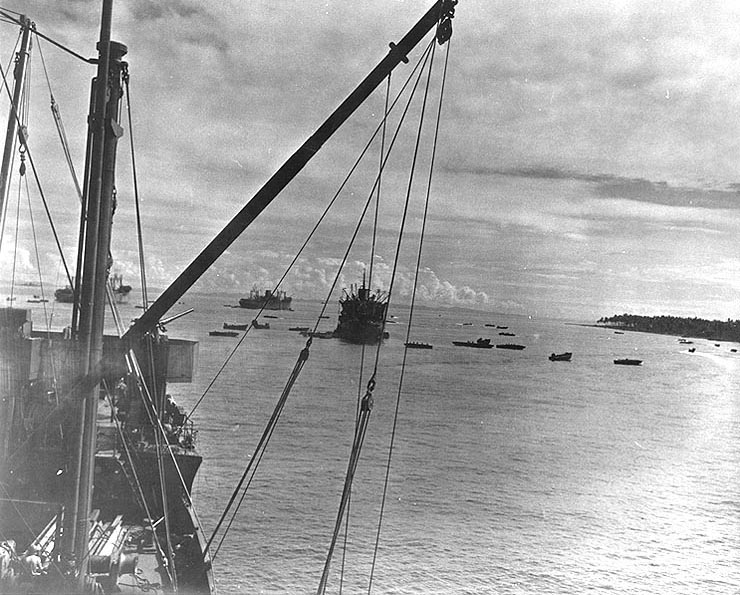
Allied transports and landing craft off the invasion beaches on Guadalcanal, 7 August 1942.

Guadalcanal Campaign

7 August 1942 – 9 February 1943 · Solomon Islands · 187 days

The American landing on Guadalcanal seized an unfinished Japanese airfield, but six months of naval combat, air attacks and jungle fighting followed before the island was secure. The battle for Henderson Field became a contest over whether either side could keep its troops and aircraft supplied.

U.S. Navy / NARA 80-G-374870 · Public domain · Source

This operation sits inside Pacific Theatre, where it appears as a single entry. This page carries it in full.

BACK TO PACIFIC THEATRE
CAMPAIGN
7 Aug 1942 – 9 Feb 1943The assault on Guadalcanal and Tulagi through the Japanese evacuation
STRATEGIC OBJECTIVE
Henderson FieldControl of the airfield near Lunga Point shaped the land, naval and aerial campaign
INITIAL U.S. FORCE
1st Marine DivisionSupported by U.S. Navy amphibious and carrier forces; Army units reinforced the island from October
JAPANESE DEFENCE
Seventeenth ArmyJapanese ground force directed from Rabaul and supplied predominantly by sea
OUTCOME
Allied controlJapanese forces evacuated; U.S. commanders declared the island secured on 9 February 1943
Marker affiliation Allied Axis Other / contested
Map layers

01 / 21

Why Both Sides Fought for Henderson Field

An unfinished Japanese runway near Lunga Point became the fixed point of a six-month struggle at sea, in the air and on land.

In July 1942 Japanese construction parties were extending an airfield near Lunga Point on Guadalcanal, within reach of Allied sea routes toward Australia. From the American perspective, leaving the runway in Japanese hands would allow aircraft to threaten the passage between New Caledonia, the New Hebrides and Australia. The landing force could seize the coastal site quickly, but holding it would require a reliable stream of supplies across waters still dominated at night by Japanese surface warships.

Henderson Field, named for Marine aviator Lofton Henderson, began receiving American aircraft less than two weeks after the landing. Fighters made daylight movement safer for Allied ships; dive bombers raised the cost of Japanese supply convoys. Each side attempted to exploit the opposite hours. Japanese destroyers and cruisers approached after dark, and American engineers repaired the field after shellfire and bombing so aircraft could fly again by morning.

Guadalcanal tied together the Japanese forward base at Rabaul, American naval power in the South Pacific and the hard limits of both armies’ shipping. A tactical success at sea or on a ridge could lose its value if food, gasoline, guns and aircraft could not reach the men who needed them. The campaign therefore extended through repeated ground assaults and naval clashes rather than a single battle for the runway.

Operation Watchtower and the Supply Crisis after Savo Island

The August invasion took the airfield but left the new perimeter exposed to interruption at sea.

Vice Admiral Frank Jack Fletcher supplied carrier cover while Rear Admiral Richmond Kelly Turner directed the transports, and Major General Alexander Vandegrift led the assault troops. Marines landed on Guadalcanal and on smaller islands around Tulagi on 7 August. Japanese defenders on Guadalcanal largely moved inland, whereas the fighting on Tulagi, Gavutu and Tanambogo was fierce. The Marines took the unfinished airfield on 8 August and established the Lunga perimeter.

The Japanese Eighth Fleet attacked the Allied screening force near Savo Island on the night of 8–9 August. Mikawa’s cruisers sank four Allied heavy cruisers. The Japanese ships then departed, leaving the transports in the anchorage, but the danger from air attack and the lack of secure carrier cover led Turner to remove the ships before all supplies were unloaded. The Marines began the defense with limited rations and ammunition, and their first priority was to keep the runway and perimeter intact.

Japanese commanders underestimated the American force. The advance detachment led by Colonel Ichiki attacked across Alligator Creek in the early hours of 21 August and suffered a disastrous defeat. Subsequent Japanese efforts assembled larger formations but repeatedly confronted the difficulty of bringing artillery, communications equipment and sufficient food along narrow tracks to coordinated assault positions.

Rabaul, the Cactus Air Force and the Night Supply Runs

The opposing sides controlled different parts of the daily cycle around Guadalcanal.

Japanese aircraft based at Rabaul flew long missions down the Solomon chain. American fighters and bombers on Henderson Field could intercept those raids and attack ships close to the island, though the runway, aircraft and maintenance crews were continually damaged or depleted. The Cactus Air Force was a changing mixture of Marine, Navy and Army aviation rather than a permanently equipped single squadron.

Japanese destroyers carried soldiers, ammunition and supplies down the Slot after dark, a practice American troops called the Tokyo Express. Destroyers could make the journey quickly, but their cargo capacity was small compared with merchant transports. Cargo dropped in waterproof drums could be lost at sea or could not be collected before daylight. A Japanese army of thousands required quantities of rice, shells and medical stores the destroyer service could not consistently provide.

Carrier battles at the Eastern Solomons and Santa Cruz damaged both fleets. Japan sank USS Hornet in October and temporarily deprived the Americans of much of their carrier strength. Japanese air groups suffered losses among experienced aviators that proved difficult to replace. The limited carrier resources on each side ensured that the land-based runway remained central even during major fleet actions.

Why the September and October Japanese Attacks Failed

Steep ridges, dark jungle approaches and poor supply prevented Japanese units from combining their strength against Lunga.

In September Colonel Kawaguchi tried to enter the American perimeter from the south. The attacks on Edson’s Ridge during the nights of 12–14 September brought Japanese troops close to Henderson Field but failed to break the defended ridge. The terrain split formations into separate columns, while Marine riflemen, machine guns and artillery held routes onto the crest. The Japanese failed to achieve the rapid concentration required for an assault on a fortified position.

Lieutenant General Hyakutake planned a larger October offensive with reinforced Seventeenth Army units. Approaching the American lines meant crossing jungle with limited maps, inadequate roads and unreliable communications. Units arrived late or attacked separately; American defenders retained reserve forces able to meet breakthroughs. Heavy naval gunfire temporarily damaged Henderson Field, but the airfield was repaired and the Japanese ground attack failed.

The Japanese garrison’s growing shortage of food changed its ability to fight. Many men were weakened by malaria, dysentery and malnutrition. American forces also suffered disease, exhaustion and supply shortages, yet regular reinforcement by sea and air allowed the Lunga defenses to expand. During the final months Japanese units could increasingly only delay American advances while their senior command considered withdrawal.

The Naval Battles of 12–15 November and the Failed Reinforcement Convoy

A major Japanese attempt to destroy the runway by battleship gunfire led to a costly sequence of naval engagements.

In November Yamamoto’s command sent large transports carrying soldiers and equipment toward Guadalcanal. The plan depended on a battleship bombardment neutralizing Henderson Field long enough for the convoy to unload. American cruisers and destroyers intercepted the first Japanese bombardment force in a violent night battle early on 13 November. Both sides lost ships and senior officers, and the Japanese battleship Hiei was disabled, then lost following air attack.

A second Japanese battleship force returned during the night of 14–15 November. USS Washington’s radar-directed fire disabled Kirishima while the American formation suffered damage and losses. American aircraft then attacked the reinforcement ships approaching the island, forcing transports ashore with much of their equipment and supplies destroyed. Some soldiers landed, but the Japanese had failed to create the material conditions for a renewed offensive.

Tassafaronga on 30 November showed that Japan still possessed formidable night-fighting skill. Its destroyers torpedoed four American heavy cruisers, sinking Northampton, despite early American radar contact. Yet the Japanese supply mission remained too small to restore the strength and food stocks of the Seventeenth Army. After mid-November Japanese leaders increasingly assessed how to extract the surviving formation rather than how to retake Henderson Field.

Patch’s January Offensive and the Japanese Evacuation

New American Army formations advanced west as Japanese command turned to removing survivors.

The 1st Marine Division began leaving Guadalcanal in December. Major General Alexander Patch coordinated the Americal Division and additional Army and Marine forces as XIV Corps prepared to advance beyond the original perimeter. Attacks on Mount Austen, the Galloping Horse and the Sea Horse were slowed by prepared bunkers and ridge country. The American offensive nevertheless gained strength as fresh troops and supplies reached the island.

Japanese commanders authorized Operation Ke by the end of 1942. Destroyers gathered survivors at western embarkation points during a series of February runs, protected by diversionary naval movements and air activity. American commanders initially interpreted part of this activity as preparation for another attack. The resulting uncertainty allowed the Japanese navy to remove several thousand troops while American columns continued their westward movement.

On 9 February 1943 Patch reported Guadalcanal secured. Its airfield and the surrounding approaches passed firmly into Allied hands, and Japan lost the prospect of using Guadalcanal to dominate the southeast Solomons. The United States and its allies then pressed toward New Georgia and Bougainville while operations in New Guinea continued. The struggle had consumed large numbers of naval vessels, aircraft and trained personnel on both sides.

Who Commanded the Guadalcanal Campaign

Allied naval and ground commanders faced Japanese army and fleet leaders trying to regain Henderson Field.
Alexander A. Vandegrift
Major General · United States Marine Corps · Allied

Alexander A. Vandegrift

Commanding General, 1st Marine Division

Vandegrift organized the initial amphibious landing and kept the Marines concentrated around Henderson Field while naval support and supplies were uncertain. His defense of the Lunga perimeter through the October attacks bought time for Army reinforcement and the eventual Allied offensive.

U.S. Marine Corps C51822 · public domain · Source
Alexander M. Patch
Major General · United States Army · Allied

Alexander M. Patch

Commander, Americal Division and XIV Corps

Patch arrived with Army reinforcements and assumed command of the Guadalcanal ground forces in December 1942. He planned the XIV Corps offensive westward and announced the island secure on 9 February 1943. His staff converted a perimeter defense into a multi-division operation by coordinating artillery, roads, and supply movement across the island.

U.S. Army Signal Corps / Library of Congress · public domain · Source
William F. Halsey Jr.
Vice Admiral · United States Navy · Allied

William F. Halsey Jr.

Commander, South Pacific Area and Force

Halsey took over the South Pacific command in October 1942 amid Japanese ground attacks and heavy American carrier losses. He committed fleet forces and maintained naval support for the struggle to preserve the Guadalcanal airfield. The decision to send two modern battleships into the November fighting was taken as naval forces sought to prevent another Japanese bombardment.

U.S. Navy official photograph · public domain · Source
Frank Jack Fletcher
Vice Admiral · United States Navy · Allied

Frank Jack Fletcher

Carrier force commander during the landings

Fletcher commanded the carrier covering force for Operation Watchtower and the Eastern Solomons carrier battle. His need to protect a limited carrier force influenced the withdrawal of carrier air cover from Guadalcanal soon after the August landings. The withdrawal left amphibious shipping and the new perimeter without continuous carrier aviation until Henderson Field could provide it.

U.S. Navy official portrait · public domain · Source
Richmond Kelly Turner
Rear Admiral · United States Navy · Allied

Richmond Kelly Turner

Amphibious force commander

Turner controlled the amphibious transports and landing force support during the initial operation. After Japanese air attacks and the cruiser disaster at Savo Island he ordered the vulnerable transport force withdrawn, leaving Marines ashore still short of stores. He had to balance Japanese air and surface threats against the urgent need to land Marine artillery, medical stores and food.

U.S. Navy 80-G-607995 · public domain · Source
Isoroku Yamamoto
Admiral · Imperial Japanese Navy · Axis

Isoroku Yamamoto

Commander-in-Chief, Combined Fleet

Yamamoto directed the Japanese fleet’s effort to suppress Henderson Field and reinforce the Seventeenth Army. The August, October and November carrier and battleship actions consumed warships and veteran aircrews while the Japanese garrison remained exposed. His November effort combined heavy night bombardment with large troop transports, showing how central the runway had become to Japanese planning.

Japanese wartime portrait · public-domain status per Commons file record · Source
Harukichi Hyakutake
Lieutenant General · Imperial Japanese Army · Axis

Harukichi Hyakutake

Commander, Seventeenth Army

Hyakutake commanded Japanese ground forces assigned to recapture Henderson Field. Reinforcement delays, difficult approaches, and inadequate artillery and food undermined the September and October attacks. His army then fought a defensive campaign under worsening supply conditions. He depended on Rabaul and the Slot for reinforcements; poor roads prevented movement of sufficient ammunition and food to forward units.

Japanese official wartime portrait · public-domain status per Commons file record · Source
Gunichi Mikawa
Vice Admiral · Imperial Japanese Navy · Axis

Gunichi Mikawa

Commander, Japanese Eighth Fleet

Mikawa led the surface force that overwhelmed Allied cruiser screens at Savo Island on 8–9 August. His withdrawal without striking the invasion transports left the Marines’ supplies and anchorage largely intact after a major Japanese naval success. His victory removed much of the Allied heavy-cruiser screen but failed to cut the troop and supply movement around Lunga completely.

U.S. Naval History and Heritage Command NH 63697 · public domain · Source
Hiroaki Abe
Vice Admiral · Imperial Japanese Navy · Axis

Hiroaki Abe

Commander, November bombardment force

Abe commanded the Japanese battleship force seeking to neutralize Henderson Field on the night of 12–13 November. The close-range encounter with American cruisers disabled Hiei and disrupted the bombardment plan; Abe withdrew with the principal objective unfulfilled. The loss of Hiei and the withdrawal disrupted the attempt to clear a daylight corridor for the troop transports following behind.

Imperial Japanese Navy official portrait · public domain per Commons · Source
Hitoshi Imamura
Lieutenant General · Imperial Japanese Army · Axis

Hitoshi Imamura

Commander, Eighth Area Army at Rabaul

Imamura assumed responsibility for Japanese Army operations from Rabaul during the later Guadalcanal fighting. His headquarters faced the limits of destroyer supply runs, air losses and the need to preserve surviving troops after repeated failed attacks on the Lunga perimeter. By the final weeks, Japanese commanders had to choose between attempting to renew the offensive and withdrawing men vulnerable to famine.

Japanese military portrait · public-domain status per Commons file record · Source

Aircraft, Warships and Guns Used at Guadalcanal

Henderson Field’s fighters and dive bombers, Japanese carrier aircraft, warships, artillery and landing craft all shaped the fighting.
Grumman F4F-4 Wildcat
F4F-4 Wildcats on the ground at Henderson Field in November 1942.
U.S. Navy / U.S. Marine Corps · public domain · Source

Grumman F4F-4 Wildcat

Carrier- and land-based fighter · six .50-calibre machine guns

Marine and Navy Wildcats protected Henderson Field and intercepted Japanese aircraft arriving from Rabaul. Their availability depended on fuel, ground crews and repairs to the runway after bombardment. The fighter also provided a local response when Japanese aircraft arrived before ships offshore could maneuver clear of danger.

Douglas SBD Dauntless
Marine Corps SBD Dauntless at Henderson Field, circa 1942.
U.S. Marine Corps / NARA NAID 74237238, photo 127-GR-4-50985 · public domain · Source

Douglas SBD Dauntless

Naval dive bomber · 1,000-lb class bomb capacity

SBD units based on Guadalcanal attacked Japanese transports and warships by daylight. Their ability to strike reinforcements explains the Japanese dependence on nighttime destroyer runs. At close range the aircraft could attack cargo vessels unloading on beaches, where ships had little protection from daylight raids.

Mitsubishi A6M Zero
A6M Zero fighters at Rabaul preparing for a sortie, August–November 1942.
Japanese wartime photograph · PD-Japan-oldphoto per Commons · Source

Mitsubishi A6M Zero

Japanese naval fighter · 20 mm cannon and machine guns

A6M fighters operating from Rabaul and carriers escorted Japanese bombers and contested American air cover over Guadalcanal. Long flights across the Solomons strained fuel and aircrew endurance. Its escort role was essential to protecting the long-range bombers that Japanese command used to strike the exposed runway.

75 mm pack howitzer M1
An 11th Marines 75 mm pack howitzer crew on Guadalcanal, September or October 1942.
U.S. Navy / U.S. Marine Corps · public domain · Source

75 mm pack howitzer M1

Light artillery · 75 mm · breakdown pack carriage

The 11th Marines used 75 mm pack howitzers to provide responsive fire on jungle approaches to the Lunga perimeter. Guns could be repositioned over ground impassable to heavier field artillery. The low-weight carriage and smaller ammunition were important on island routes where trucks and heavy guns often became immobilized.

USS Washington (BB-56)
USS Washington off New York on 21 August 1942, months before her Guadalcanal action. · NH 33803
U.S. Navy / NHHC · public domain · Source

USS Washington (BB-56)

North Carolina-class battleship · nine 16-inch guns · radar fire control

Washington used radar-directed main-battery gunfire to disable Kirishima during the night of 14–15 November, helping prevent a Japanese bombardment of Henderson Field. Her participation showed how radar and trained crews changed nighttime naval gunnery in waters where Japanese torpedo attacks remained dangerous.

USS Enterprise (CV-6)
USS Enterprise burning after damage on 24 August 1942. · NARA 80-G-288799
U.S. Navy / U.S. Marine Corps · public domain · Source

USS Enterprise (CV-6)

Yorktown-class aircraft carrier · carrier air group

Enterprise supported naval air operations in the Solomon Islands, suffered damage in the Eastern Solomons battle, and remained central to the depleted American carrier force in the autumn fighting. The carrier’s air group fought over a wide region, while maintenance and battle damage limited how often its strength could be employed.

USS Hornet (CV-8)
USS Hornet burning at Santa Cruz on 26 October 1942. · NARA 80-G-32813
U.S. Navy / U.S. Marine Corps · public domain · Source

USS Hornet (CV-8)

Yorktown-class aircraft carrier · carrier air group

Hornet furnished one of the remaining American carrier air groups in October. Japanese carrier aircraft disabled her at Santa Cruz, showing the cost of naval air control around the Solomons. The loss reduced the availability of deck space for fighters and attack aircraft at the most dangerous moment of the autumn campaign.

Higgins LCVP landing craft
American landing craft off Beach Red, Guadalcanal, about 7–9 August 1942. · NH 97760
U.S. Navy / U.S. Marine Corps · public domain · Source

Higgins LCVP landing craft

Personnel landing craft · bow ramp · approximately 36 troops

American transports used small landing craft to deliver troops and cargo onto poorly developed beaches. The Guadalcanal landings demonstrated the vulnerability of ammunition and food supply when the transports had to leave. Beach unloading remained slow where there were no docks and Japanese aircraft could return before cargo reached safe inland dumps.

The Human Cost of Guadalcanal and Japan’s Withdrawal

The campaign lasted from August 1942 to February 1943; the death toll and the evacuation are recorded separately.

7 August 1942 – 9 February 1943

Campaign dates

The American amphibious assault opened the campaign; the island was formally declared secured after the Japanese evacuation.

More than 7,000

U.S. dead, all services

Navy and Army/Marine casualties across the campaign; totals vary with inclusion of sea and air actions. NHHC summarizes about 7,100 U.S. dead.

Around 24,000

Japanese ground-force dead

The National WWII Museum reports about 14,800 killed in action and another 9,000 dying of disease or malnutrition, with differing totals in other official histories.

February 1943

Japanese evacuation

Destroyer runs during Operation Ke removed thousands of Japanese troops from the western coast, ending the remaining garrison’s organized resistance.

What the Operational Records Establish

Marine and Army operational histories document the fighting ashore, while naval accounts reconstruct the repeated night battles.

The U.S. Marine Corps campaign monograph and the U.S. Army official history give the principal sequence of the Lunga defense, reinforcement and XIV Corps offensive. Their accounts identify the units engaged, the uncertain and sometimes contradictory reports available to commanders, and the engineering and medical conditions affecting the defense.

Naval History and Heritage Command histories and ship records establish the timing and consequences of Savo Island, the two carrier battles, the naval battle in November and Operation Ke. Japanese command decisions are reconstructed through postwar and captured documentary records in these studies. The Australian Department of Veterans’ Affairs records the regional consequences for the wider Southwest Pacific war. Ship losses and casualty categories depend on the boundaries used by each historian, so the figures below are identified by service and scope.

  1. The Guadalcanal Campaign, Historical Division, Headquarters, U.S. Marine CorpsU.S. Marine Corps wartime operational monograph
  2. Guadalcanal: The First Offensive, John Miller Jr.U.S. Army Center of Military History, CMH Pub 5-3
  3. H-Gram 073: Guadalcanal Naval Campaign, Naval History and Heritage CommandU.S. Navy historical analysis
  4. Guadalcanal and Tulagi Landings, Naval History and Heritage CommandU.S. Navy campaign history
  5. Battle of Savo Island: Orders of Battle, Naval History and Heritage CommandU.S. Navy operational records
  6. Guadalcanal Historical Summary, Naval History and Heritage CommandU.S. Navy chronological campaign summary
  7. The Solomon Islands Campaign: Guadalcanal, The National WWII MuseumMuseum article
  8. Guadalcanal: The Joint Fight, The National WWII MuseumMuseum study of the Army, Marines, and Navy
  9. Japanese Withdrawal from Guadalcanal, Naval History and Heritage CommandU.S. Navy historical account
  10. The Battle of Guadalcanal and Australia, Australian Department of Veterans’ AffairsAnzac Portal
  11. Guadalcanal Campaign Photographs, August 1942–February 1943, National Museum of the U.S. NavyNaval History and Heritage Command photo catalogue
  12. The Guadalcanal Campaign, 7 August 1942–9 February 1943, U.S. Marine Corps History DivisionHistorical monograph, digitised by Marine Corps University
Operation chronologyDates, locations and sourced event summaries
DateEventLocationSummary
7 August 1942 · Morning landingsU.S. Marines Land on Guadalcanal and TulagiBeach Red, Lunga Point, Guadalcanal

The 1st Marine Division lands on Guadalcanal on the morning of 7 August as Allied naval forces simultaneously attack Tulagi, Gavutu and Tanambogo. Major General Alexander Vandegrift intends to seize the unfinished Japanese airfield near Lunga Point and establish a defended lodgement before aircraft based at Rabaul can disrupt the landing force.

Sources 1, 4, 7
8 August 1942Marines Take the Lunga AirfieldLunga Point airfield, Guadalcanal

Marine patrols occupy the unfinished Japanese runway at Lunga Point on 8 August and secure captured stores and construction equipment. The airfield offers an answer to the central problem of the landings: American carriers cannot remain continuously near Guadalcanal, but fighters and bombers based ashore could cover shipping and attack reinforcement convoys.

Sources 1, 2, 4
9 August 1942 · Night of 8–9 AugustMikawa Destroys Four Allied Cruisers at Savo IslandSavo Island, Ironbottom Sound

During the night of 8–9 August Vice Admiral Gunichi Mikawa brings Japanese cruisers down from Rabaul through Allied screening forces and attacks the ships guarding the transports off Guadalcanal. Four Allied heavy cruisers, including HMAS Canberra, are lost; another cruiser suffers damage. The battle exposes the night-fighting advantage of Japanese surface forces at this stage of the campaign.

Sources 3, 5, 10
20 August 1942The First Marine Aircraft Reach Henderson FieldHenderson Field, Lunga Point

Marine F4F Wildcats and SBD Dauntless dive bombers arrive at Henderson Field on 20 August, beginning sustained operations by the force later known as the Cactus Air Force. The arrival gives the isolated garrison fighter cover during daylight and the ability to strike Japanese shipping approaching the island.

Sources 1, 2, 3
21 August 1942 · Night of 20–21 AugustIchiki’s Advance Force Is Defeated at Alligator CreekAlligator Creek, east Lunga perimeter

Colonel Kiyonao Ichiki’s advance detachment attacks the eastern Marine perimeter at the Ilu River, commonly called Alligator Creek, during the night of 20–21 August. Marine infantry and machine guns stop successive assaults across the stream, and American counterattacks destroy much of the Japanese force after daylight.

Sources 1, 2, 12
22 August 1942Henderson Field Is Operating Under Japanese Air ThreatHenderson Field, Guadalcanal

Aerial photographs on 22 August show the recently captured runway at Henderson Field as the first American fighter and dive-bomber units begin using the base. The unfinished field is becoming a forward striking position against Japanese transports and warships, but aircraft still depend on irregular deliveries of fuel and ammunition.

Sources 1, 3, 11
24 August 1942Carrier Battle of the Eastern SolomonsWaters east of Guadalcanal

American and Japanese carrier groups exchange air strikes on 24 August as Japanese commanders attempt to reinforce Guadalcanal. Aircraft from USS Saratoga sink the light carrier Ryūjō; Japanese aircraft damage USS Enterprise. Both fleets seek to cover or disrupt the movement of transports and warships toward the disputed airfield.

Sources 3, 6, 7
14 September 1942 · Nights of 12–14 SeptemberMarines Hold Edson’s Ridge after Two Nights of AttacksEdson’s Ridge, south of Henderson Field

Colonel Kiyonao Kawaguchi’s troops attack the southern approaches to Henderson Field on the nights of 12–13 and 13–14 September. Marine Raider and Parachute units under Colonel Merritt Edson fall back to a narrow ridge, holding their final positions after confused and costly fighting in darkness.

Sources 1, 2, 12
13 October 1942 · Night of 13–14 OctoberJapanese Battleships Bombard Henderson FieldHenderson Field and Ironbottom Sound

During the night of 13–14 October the Japanese battleships Kongō and Haruna bombard Henderson Field with heavy guns, destroying aircraft and fuel and temporarily crippling flying operations. The raid is timed to support a major effort to bring Japanese soldiers and equipment to the island.

Sources 1, 2, 3
25 October 1942 · 23–26 October offensiveJapanese Seventeenth Army Attacks the Lunga PerimeterSouth and east of Henderson Field

Lieutenant General Harukichi Hyakutake’s Seventeenth Army mounts a larger offensive on the Marine perimeter late in October after moving troops through difficult jungle and ridge country. Attacks on the southern defensive line are disordered by darkness, delays and inadequate coordination, while Marine artillery and prepared positions inflict heavy casualties.

Sources 1, 2, 12
26 October 1942Santa Cruz Carrier Battle Costs the United States USS HornetSanta Cruz Islands, east of Guadalcanal

Japanese carrier aircraft repeatedly hit USS Hornet during the Battle of the Santa Cruz Islands on 26 October. The carrier is abandoned and later sunk, while USS Enterprise is damaged; American aircraft damage Japanese carriers and their air groups. Japan gains an immediate tactical result at sea as American carrier availability falls sharply.

Sources 3, 6, 7
12 November 1942Japanese Reinforcement Convoy Approaches GuadalcanalEastern approaches to Ironbottom Sound

Japanese commanders dispatch a major reinforcement convoy supported by battleships assigned to bombard Henderson Field. American transports simultaneously bring Army and Marine reinforcements into the Lunga anchorage. Both sides recognize that the runway can determine whether the incoming Japanese soldiers are supplied or exposed in daylight.

Sources 3, 6, 7
13 November 1942 · Early hours of 13 NovemberFirst Night of the Naval Battle of GuadalcanalIronbottom Sound, north of Guadalcanal

During the early hours of 13 November an American cruiser-and-destroyer group under Rear Admiral Daniel Callaghan engages a Japanese bombardment force led by Vice Admiral Hiroaki Abe. The ships collide in a confused close-range night battle. The Japanese battleship Hiei is disabled, and American losses include cruisers and destroyers with both admirals Callaghan and Scott killed.

Sources 3, 6, 7
15 November 1942 · Night of 14–15 NovemberU.S. Battleships Stop the Second Bombardment and Reinforcement RunIronbottom Sound and Tassafaronga coast

During the night of 14–15 November USS Washington and USS South Dakota confront a Japanese force led by Kirishima. Washington’s radar-directed gunfire cripples Kirishima, which is later scuttled. As the Japanese battleship force withdraws, most of the troop transports approaching Guadalcanal are sunk or forced aground under American air and naval attack.

Sources 3, 6, 7
30 November 1942 · Night of 30 November–1 DecemberJapanese Torpedoes Hit Four U.S. Cruisers at TassafarongaCape Esperance and Tassafaronga waters

American cruisers and destroyers intercept a Japanese destroyer supply run off Tassafaronga on the night of 30 November. U.S. radar detects the Japanese formation, but Japanese destroyers launch effective long-range torpedoes after coming under fire, sinking USS Northampton and damaging Minneapolis, New Orleans and Pensacola.

Sources 3, 6, 9
9 December 1942Army Command Takes Over the Guadalcanal Ground CampaignLunga perimeter, Guadalcanal

Major General Alexander Patch assumes command on Guadalcanal as the exhausted 1st Marine Division begins withdrawing for rest and refitting. Army formations of the Americal Division have already reinforced the island; further reinforcements are arriving and the Allied command can plan a broader advance beyond the original Lunga defenses.

Sources 1, 2, 8, 12
31 December 1942Japanese High Command Approves EvacuationImperial General Headquarters, Tokyo

Japanese senior commanders accept the recommendation to withdraw the remaining Seventeenth Army troops from Guadalcanal. Attempts to defeat the American perimeter have consumed combat units, experienced aircrews and warships while the men ashore suffer severe shortages and disease.

Sources 3, 6, 9, 10
10 January 1943XIV Corps Begins Its Westward OffensiveMount Austen and the Galloping Horse, Guadalcanal

U.S. XIV Corps launches a coordinated offensive west and south of the Lunga perimeter, including the Mount Austen, Galloping Horse and Sea Horse positions. Army and Marine units attack Japanese defenses on ridges and in jungle ravines while artillery and air support try to overcome positions that are difficult to identify from a distance.

Sources 1, 2, 8
23 January 1943American Forces Clear the Mount Austen DefensesMount Austen, Guadalcanal

American troops secure the main organized Japanese positions around Mount Austen after weeks of fighting that included the reduction of the Gifu strongpoint. Capturing the heights eases the threat to the Lunga area and allows XIV Corps to push its lines farther west.

Sources 1, 2, 8
1 February 1943 · Night of 1–2 FebruaryOperation Ke Begins Removing Japanese TroopsCape Esperance, western Guadalcanal

Japanese destroyers begin Operation Ke, lifting Seventeenth Army survivors from the western coast of Guadalcanal during the night of 1–2 February. The runs demand high speed, darkness and carefully controlled embarkation points. Japanese air and naval diversions help obscure the purpose of the operation.

Sources 3, 6, 9
9 February 1943U.S. Command Declares Guadalcanal SecureCape Esperance and western Guadalcanal

Major General Alexander Patch reports Guadalcanal secure on 9 February after American troops reach the western end of the island and find the main Japanese formations gone. Japanese destroyers have evacuated thousands of surviving soldiers during a series of nighttime voyages, ending the six-month struggle for the airfield and the coastal approaches.

Sources 1, 2, 3, 9, 10

Photographs credited as official federal works from the U.S. Navy, U.S. Marine Corps, U.S. Army and U.S. National Archives are public domain. Japanese portraits and images use the public-domain terms identified on their Commons File pages. Chronology captions specify date ranges and later aftermath where relevant. Map arrows are schematic movement directions, not surveyed lines of control.