Skip to content
WW2 Theatres Theatres of the Second World War
Home

World War II calendar

WWII On This Day: September 7

What happened on September 7 during World War II? This date brings together 5 events from 1939, 1940 and 1943, with period photographs and links to the full operations documented across WW2 Theatres.

1939
The German battleship Schleswig-Holstein firing on the Polish depot at Westerplatte, September 1939.
Schleswig-Holstein firing on Westerplatte, 1 September 1939 · Public domain · Source
Invasion of Poland 1939

The Wizna position blocks the Narew route

A small Polish force under Captain Władysław Raginis defended incomplete fortifications around Wizna as Guderian's XIX Corps sought crossings over the Narew and routes south. Bunkers, field positions and river obstacles forced the attackers into a deliberate reduction of the position. By 10 September German forces had broken through and Raginis was dead. Wizna consumed time at a restricted crossing point on an axis whose value depended on continuous movement. The later 'Polish Thermopylae' label captures the disparity in strength; the operational significance lay in hours gained along the Narew…

Continue in Invasion of Poland 1939 →
1940
A Heinkel He 111, designed for close support of an army and used as a strategic bomber.
A Heinkel He 111, designed for close support of an army and used as a strategic bomber. Imperial War Museums MH 6547 · Public domain Source
The Battle of Britain

London becomes the principal target

A large German formation approached London on the afternoon of 7 September and attacked the docks and surrounding districts of the East End. The raid was followed by night bombing, beginning the period remembered as the Blitz while the daylight Battle of Britain was still being fought. For Fighter Command, the shift changed where 11 Group had to concentrate its interceptions and reduced some of the sustained pressure on sector stations. It did not mean that RAF airfields ceased to be attacked or that the control system immediately recovered every…

Continue in The Battle of Britain →
The Surrey Commercial Docks burning on the first night, 7 September 1940.
The Surrey Commercial Docks burning on the first night, 7 September 1940. IWM HU 651 · IWM Non-Commercial Licence Source
The Blitz

Black Saturday

On the afternoon of 7 September roughly 350 bombers, heavily escorted by fighters, approached London and struck the docks and industrial districts of the East End. Fires in warehouses, wharves and factories marked the target for the night force that followed. About 430 civilians were killed and around 1,600 injured during the first day's attack. The physical concentration of docks, warehouses, housing and industry along the Thames meant that an attack on the port system was also an attack on densely populated neighbourhoods. The shift reduced the immediate concentration of…

Continue in The Blitz →
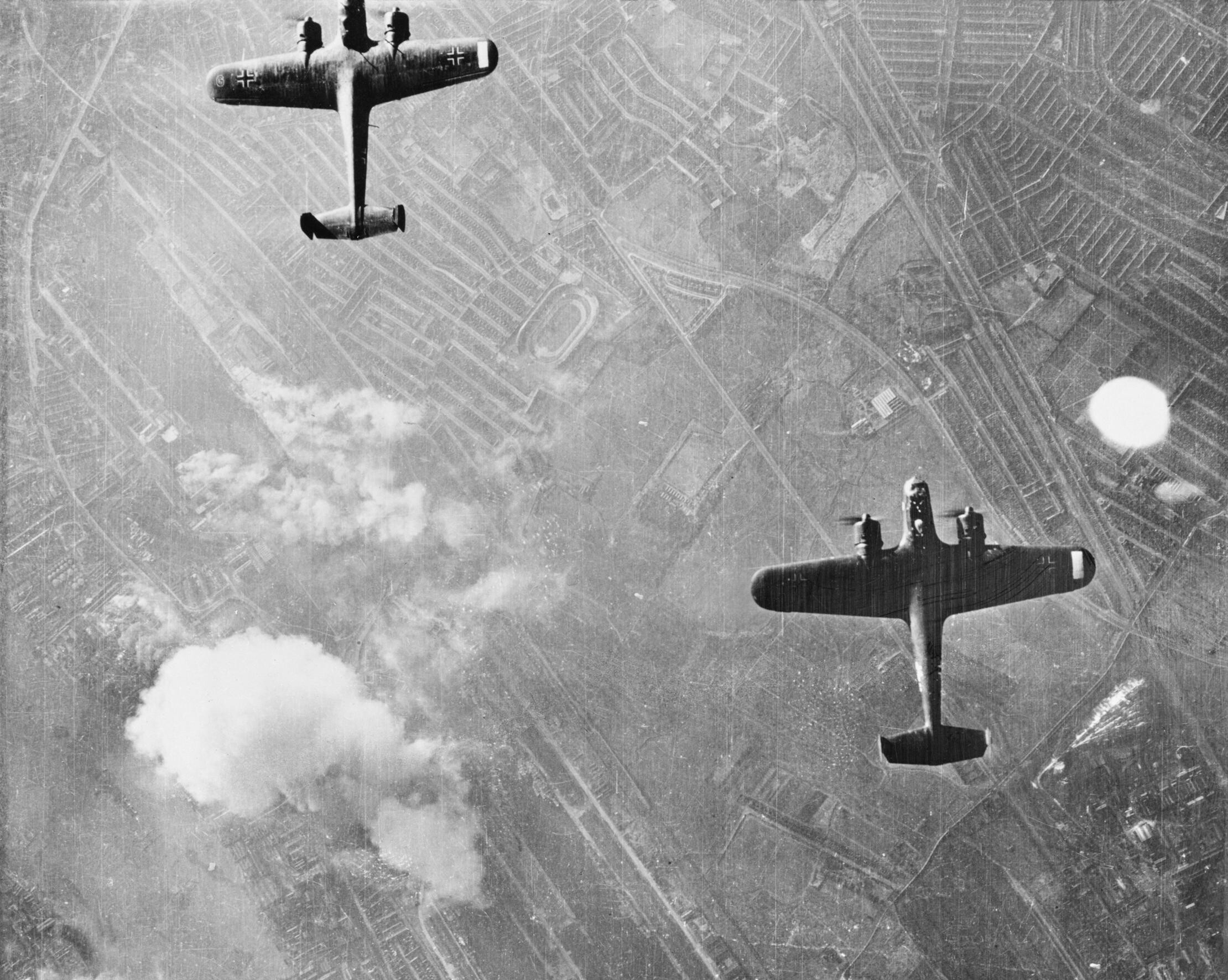
Two German Dornier Do 17Z bombers over West Ham above fires near the Beckton gas works during the first day of the Blitz, 7 September 1940.
Two German Dornier Do 17Z bombers over West Ham above fires near the Beckton gas works during the first day of the Blitz, 7 September 1940. Royal Air Force official photographer / Imperial War Museums, C 5423 · Public domain Source
The Bombing of Cities

Black Saturday

On 7 September 1940 the Luftwaffe shifted its main daylight weight toward London, attacking the docks and industrial districts along the Thames before a night force followed the fires into the capital. London combined port facilities, railways, factories, government functions and dense housing. German commanders also expected an attack on the capital to draw Fighter Command into a large battle. The city was therefore both a military-economic target system and a source of expected political and morale effects. The raid opened fifty-seven consecutive nights in which London was bombed. The…

Continue in The Bombing of Cities →
1943
Red Army troops crossing the Dnieper on the Kyiv axis in 1943.
Yefim Kopyt · Russian archival photograph · Public domain
The Dnieper Crossings

Destruction and forced removal during the retreat

German authorities implemented destruction and evacuation measures as the front moved west: transport facilities, crops, livestock and industrial plant were removed or destroyed where time allowed, and civilians were driven west for labour or displaced by the fighting. The withdrawal therefore changed more than the military map. Soviet formations advanced through areas whose food supply, bridges, railways and housing had been deliberately damaged, adding another burden to an already extended logistics system.

Continue in The Dnieper Crossings →