Skip to content
WW2 Theatres Theatres of the Second World War
Home

World War II calendar

WWII On This Day: September 6

What happened on September 6 during World War II? This date brings together 8 events from 1939, 1940, 1941, 1942 and 1944, with period photographs and links to the full operations documented across WW2 Theatres.

1939
A child survivor of SS Athenia is carried ashore from the Norwegian rescue ship Knute Nelson at Galway on 6 September 1939.
Press Agency photographer · Imperial War Museums HU 51014 · IWM Non-Commercial Licence
The Opening Convoy War

The convoy system is put back into operation

Regular east-coast convoys begin on 6 September, and outward ocean convoys from the Thames and Liverpool follow on 7 September. The Admiralty is applying a system whose purpose is to reduce the number of isolated targets at sea and concentrate scarce escort ships around groups of merchantmen. The first arrangements do not provide continuous protection across the Atlantic, but they change the geometry of the submarine campaign immediately. Early OA and OB convoys are escorted through the approaches and then dispersed beyond the danger area. Inbound systems from Halifax, Sierra…

Continue in The Opening Convoy War →
1940
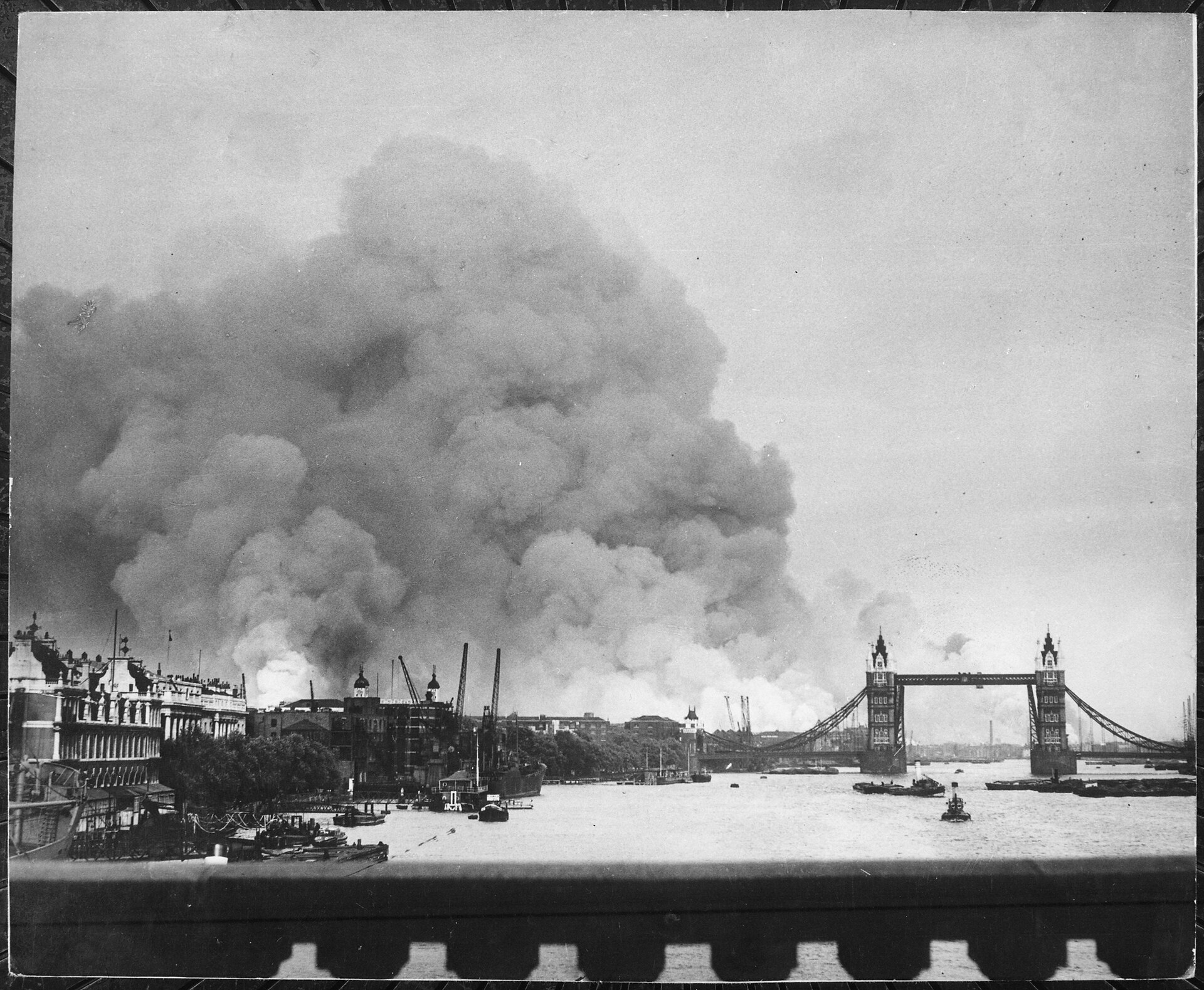
London, 7th September 1940 · London's dock area. Tower Bridge stands out against a background of smoke and fires. New York Times Paris Bureau Collection.
U.S. National Archives and Records Administration (NARA 541917) · Public domain
The Blitz

Fighter Command is strained, not destroyed

By 6 September No. 11 Group and the southern sector stations had been under severe pressure. Keith Park later described damage to several forward airfields and six of seven sector stations as having a serious effect on fighting efficiency. The strain was real: pilots were tired, squadrons were being rotated, and damaged operations rooms had to be repaired or replaced. It does not follow that Fighter Command was a fortnight from certain collapse. Aircraft continued to be produced and repaired, damaged stations often returned to use quickly, and the control…

Continue in The Blitz →
1941
Georgy Zhukov and Colonel Pavel Mironov study a map on the positions of the 107th Rifle Division near Yelnya, September 1941.
Georgy Zhukov and Colonel Pavel Mironov study a map on the positions of the 107th Rifle Division near Yelnya, September 1941. Pavel Troshkin · Public domain Source
Operation Barbarossa

The Germans complete the evacuation of the Yelnya salient

German forces completed their withdrawal from the Yelnya salient and Soviet troops re-entered the town. The withdrawal shortened the German line and released formations from an exposed position that had become expensive to defend. For the Soviet command, the recapture provided a rare offensive success after the frontier disasters. Several formations that distinguished themselves in the fighting were soon redesignated as Guards units. On the same day Hitler issued Directive No. 35, preparing the return to the Moscow axis once the flank operations were complete. Army Group Centre was beginning…

Continue in Operation Barbarossa →
1942
A German tank commander in southern Soviet territory in June 1942, shortly before the opening of Case Blue.
Bundesarchiv Bild 101I-218-0528-30 · CC BY-SA 3.0 DE · Source
Case Blue and the Drive to the Caucasus

German forces break into Novorossiysk

On 6 September Seventeenth Army broke into Novorossiysk and captured the city centre and naval installations after fighting through the approaches from the north. The result did not equal possession of the whole bay. Soviet troops continued to hold the eastern and southern side, and by 11 September the German advance had been stopped around the cement works. Novorossiysk illustrates the Caucasus front's fragmentation. A city could be entered and its central installations taken without opening the coastal route or eliminating the Soviet forces nearby. Army Group A was accumulating…

Continue in Case Blue and the Drive to the Caucasus →
1944
German paratroops descending over Crete, May 1941.
Bundesarchiv Bild 141-0864 · CC BY-SA 3.0 DE · Source
The Balkans and Crete

What the Allies learned instead

Germany read Crete as proof that airborne invasion did not work. Britain and the United States read exactly the same battle as proof that it did, and built the airborne divisions that jumped into Sicily, Normandy, the Netherlands and across the Rhine. Both readings came from the same twelve days. The German conclusion was drawn from what it had cost; the Allied one from the fact that 22,000 lightly armed men had taken a defended island from a garrison twice their size.

LVT-4 Alligator amphibious vehicles pass Terrapin amphibious vehicles near Terneuzen during the Battle of the Scheldt, 13 October 1944.
Department of National Defence / Library and Archives Canada · 13 October 1944 · Public domain in Canada · Source
The Battle of the Scheldt

Operation Ferry begins

German naval and army staffs began the organised ferrying of Fifteenth Army troops and equipment across the West Scheldt from the Breskens area toward Flushing and South Beveland. Barges, ferries and small craft worked largely at night under Allied air pressure. The evacuation continued through September and preserved tens of thousands of men together with guns, vehicles and horses. Those forces gave the German command manpower with which to rebuild the line north of Antwerp and defend the Scheldt.

Continue in The Battle of the Scheldt →
Robert McDowell, George Musulin, Nick Lalich, Draža Mihailović and Michael Rajacich at Pranjani on 6 September 1944 during Operation Halyard. The Commons copy is horizontally reversed.
Robert McDowell, George Musulin, Nick Lalich, Draža Mihailović and Michael Rajacich at Pranjani on 6 September 1944 during Operation Halyard. The Commons copy is horizontally reversed. Unknown photographer · Public domain (PD-Yugoslavia) Source
Operation Halyard

The American missions meet Mihailović as the political ground shifts

A surviving photograph from 6 September shows OSS officers with Draža Mihailović at Pranjani. It captures the operational partnership that made Halyard possible after official Allied backing for Mihailović had already been withdrawn in favour of Tito's Partisans. The picture should not be read as a simple alliance diagram. By 1944 Chetnik formations were fighting the Partisans as their principal rival, and scholarship documents military cooperation between Chetnik and German forces in parts of Serbia. Halyard's aircrew rescue operated inside that wider civil-war and collaborationist setting.

Continue in Operation Halyard →
Warsaw Uprising: Two medics and a soldier (right) from "Parasol" battalion after coming out of sewers at Warecka Street near Nowy Świat (North Śródmieście district). In the center Maria Stypułkowska-Chojecka "Kama". On the right Krzysztof Palester "Krzych".
Warsaw Uprising - Soldiers from Parasol on Warecka Street 1 September 1944 · Jerzy Chrzanowski · Public domain · Source
The Warsaw Rising

Powiśle is cleared

By 6 September German attacks had taken most of Powiśle, including the power-station area and streets descending toward the Vistula. Surviving Home Army units withdrew uphill toward northern Śródmieście. The loss removed the main central insurgent sector from the river bank and narrowed the remaining Vistula contact to Czerniaków farther south. German pressure could now be concentrated against that enclave and the southern districts.

Continue in The Warsaw Rising →