Skip to content
WW2 Theatres Theatres of the Second World War
Home

World War II calendar

WWII On This Day: June 8

What happened on June 8 during World War II? This date brings together 5 events from 1940 and 1944, with period photographs and links to the full operations documented across WW2 Theatres.

1940
HMS Glorious sinking after engagement with Scharnhorst and Gneisenau on 8 June 1940.
HMS Glorious sinking after engagement with Scharnhorst and Gneisenau on 8 June 1940. UK Government work · public domain Source
Operation Weserübung

Scharnhorst and Gneisenau sink HMS Glorious and her escorts

Scharnhorst and Gneisenau encountered HMS Glorious and the destroyers Acasta and Ardent as the carrier returned from the Norwegian evacuation. German heavy guns struck Glorious at long range and the carrier was overwhelmed before its aircraft could alter the engagement. Ardent and Acasta attacked while protecting the carrier, and Acasta torpedoed Scharnhorst. All three British ships sank. About 1,500 men died, while the damage to Scharnhorst removed a major German surface unit from immediate service.

Continue in Operation Weserübung →
1944
The Royal Navy during Operation Overlord, June 1944.
The Royal Navy during Operation Overlord, June 1944. IWM A 23997 · IWM Non-Commercial Licence Source
Operation Overlord

Omaha and Gold join hands

47 Royal Marine Commando took Port-en-Bessin, closing the last gap between the American and British sectors. From this point the lodgement was continuous from the Vire estuary to the Orne, save for the Carentan gap in the west. The first Gooseberry blockships were sunk off the beaches to form breakwaters, and unloading over open sand began to accelerate.

Continue in Operation Overlord →
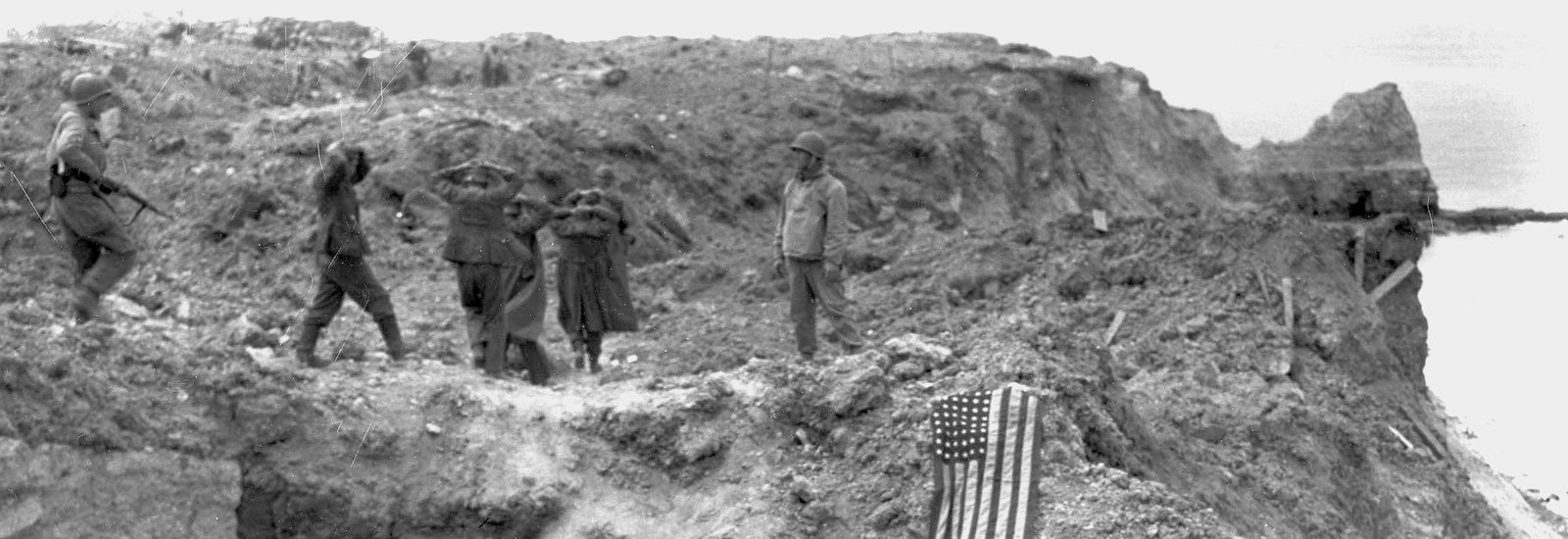
The cratered clifftop at Pointe du Hoc photographed after the assault, June 1944.
The cratered clifftop at Pointe du Hoc after the assault · US Army Signal Corps · NARA · Public domain · Source
Pointe du Hoc

Relieved

A column from Omaha, including the 5th Ranger Battalion and tanks of the 743rd Tank Battalion, reached the point on the morning of 8 June after fighting west along the coast. Of the roughly 225 men who had climbed the cliff, about 90 were still able to fight. The rest were dead, wounded or missing.

Continue in Pointe du Hoc →
Landing craft and vehicles crowd Omaha Beach during the early Normandy build-up after D-Day.
Landing craft and vehicles crowd Omaha Beach during the early Normandy build-up after D-Day. U.S. Coast Guard · Public domain Source
Omaha Beach

The contested beach becomes a supply beach

Within days the shoreline was being reorganised into roads, dumps and landing zones for continuing reinforcement of V Corps. The selected early-June Signal Corps and Coast Guard imagery shows the transformation: landing craft, vehicles and engineering work occupying ground that had been a killing zone on the morning of 6 June.

Continue in Omaha Beach →
Wrecked rolling stock in the severely damaged marshalling yard at Juvisy-sur-Orge after Allied air attacks in 1944.
Bridge B (Fg Off), Royal Air Force official photographer / Imperial War Museums, CL 4170 · Public domain · Source
The Transportation Plan

Tallboys collapse the rail tunnel at Saumur

Lancasters of No. 617 Squadron attacked the railway tunnel near Saumur with the new 12,000-pound Tallboy deep-penetration bomb. The attack blocked a route used by German armour moving toward Normandy. It showed the Transportation Plan continuing after the landings as direct interdiction of reinforcement routes.

Continue in The Transportation Plan →