Skip to content
WW2 Theatres Theatres of the Second World War
Home

World War II calendar

WWII On This Day: June 7

What happened on June 7 during World War II? This date brings together 7 events from 1940, 1942 and 1944, with period photographs and links to the full operations documented across WW2 Theatres.

1940
German mountain troops landing in Norway, April 1940.
Photo: Bagn Bygdesamling – Valdres Folkemuseum, Norway · CC BY-SA 3.0 DE · Source
Operation Weserübung

King Haakon and the Norwegian government leave for Britain

King Haakon VII, Crown Prince Olav and the Norwegian government sailed from Tromsø aboard HMS Devonshire on 7 June. The government carried constitutional authority into exile and retained control over the merchant fleet and Norwegian forces abroad. The departure joined political continuity to the maritime resources already organised through Nortraship. General Otto Ruge remained in Norway to manage the final military arrangements. The mainland campaign was approaching its end while the Norwegian state prepared to continue the war from London.

Continue in Operation Weserübung →
1942
German troops in the ruins of Sevastopol, 1942.
Bundesarchiv Bild 101I-231-0703-27 · CC BY-SA 3.0 DE · Source
Sevastopol and the Crimea

The infantry assault begins

LIV Corps attacked the northern defensive sectors while XXX Corps pressed the eastern and south-eastern approaches. Assault groups combined infantry, engineers, flamethrowers, demolition charges and assault guns against positions already under sustained artillery and air attack. The Soviet defenders still held a connected perimeter and continued receiving limited support from the sea. German progress came through successive fortified localities and ridges rather than one immediate rupture.

Continue in Sevastopol and the Crimea →
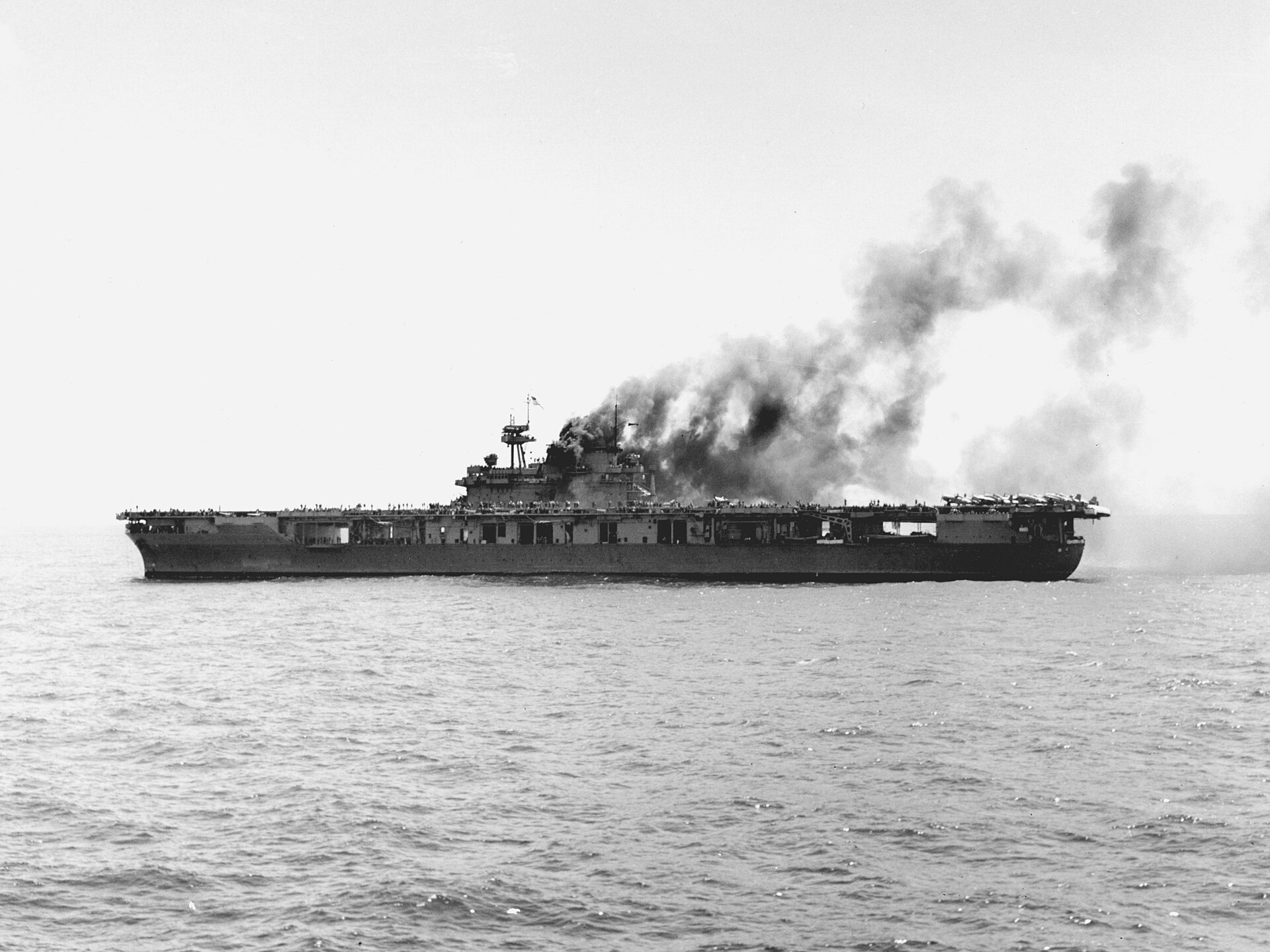
USS Yorktown under attack by Japanese torpedo bombers during the Battle of Midway, 4 June 1942.
USS Yorktown under torpedo attack, 4 June 1942 · US Navy · NARA · Public domain · Source
The Battle of Midway

I-168 finds Yorktown

The submarine I-168 penetrated the destroyer screen and put two torpedoes into Yorktown and one into the destroyer Hammann, lying alongside to supply power to the salvage party. Hammann broke in half and sank in four minutes. Yorktown rolled over and sank the following morning. She had been repaired in seventy-two hours, fought a battle, absorbed five bomb and torpedo hits and stayed afloat for three more days.

Continue in The Battle of Midway →
The Battle of Midway

What it cost

Japan lost four fleet carriers, a heavy cruiser, around 248 aircraft and about 3,057 men. The United States lost one carrier, one destroyer, around 150 aircraft and about 362 men. The four carriers could not be replaced on any timetable that mattered, and neither could the ships' companies of trained mechanics, armourers and deck crews who went down inside them. Japanese aircrew losses, by contrast, were around 110, which is far fewer than the story of Midway usually implies.

Continue in The Battle of Midway →
1944
A Cromwell of 4th County of London Yeomanry leads a column inland from Gold Beach, 7 June 1944.
A Cromwell of 4th County of London Yeomanry leads a column inland from Gold Beach, 7 June 1944. IWM B 5251 · IWM Non-Commercial Licence Source
Operation Overlord

Bayeux taken intact

The 50th Division entered Bayeux unopposed; the garrison had pulled out overnight. It was the first substantial French town liberated and came through undamaged, which made it the natural administrative centre for the British sector. Elsewhere the day went on joining beachheads. Gold and Juno linked. At Omaha the 1st Division pushed the perimeter to a mile and a half. North of Caen the 12th SS Panzer Division arrived and counterattacked the Canadians at Authie and Buron.

Continue in Operation Overlord →
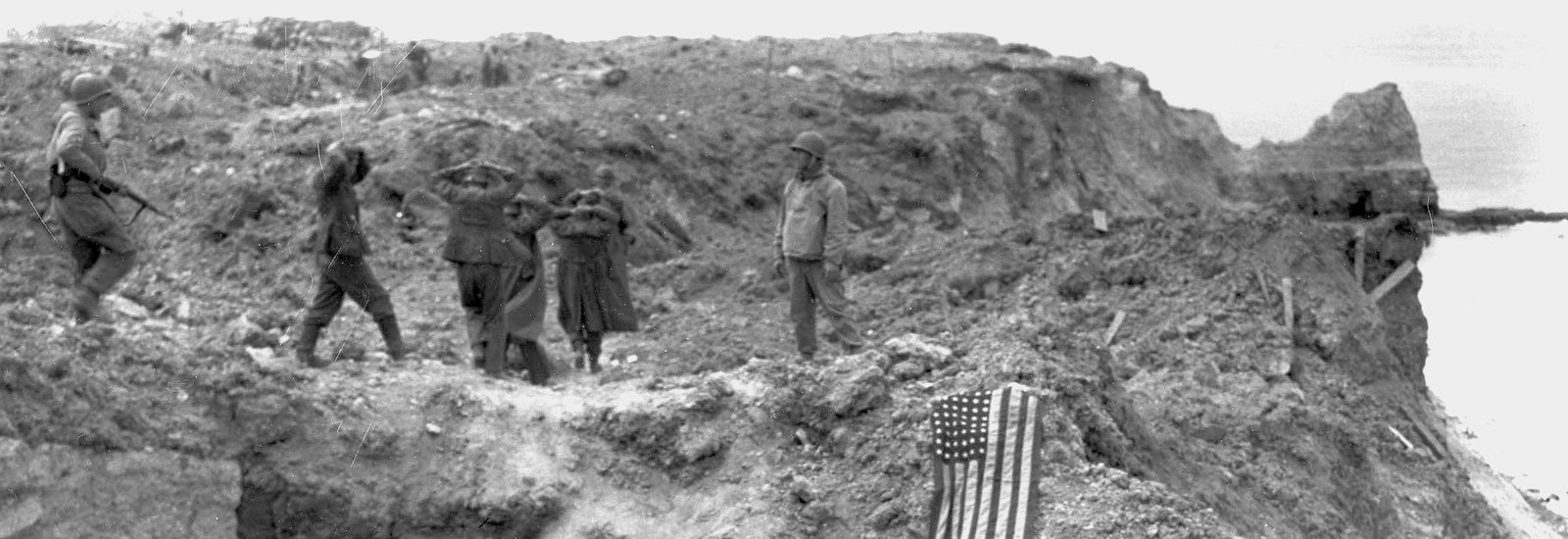
The cratered clifftop at Pointe du Hoc photographed after the assault, June 1944.
The cratered clifftop at Pointe du Hoc after the assault · US Army Signal Corps · NARA · Public domain · Source
Pointe du Hoc

Three attacks in the dark

Three separate night attacks came in against the perimeter. At one point the Rangers were reduced to a position a few hundred yards across, using captured German weapons because their own ammunition had run out. Naval gunfire from the destroyers offshore, called by an observer on the cliff, broke up the attacks repeatedly. Without it the position would almost certainly have gone.

Continue in Pointe du Hoc →
The concrete observation post on the edge of the cliff.
The concrete observation post on the edge of the cliff. Wikimedia Commons · Creative Commons Source
Pointe du Hoc

Nobody knows they are alive

Radio contact was intermittent and for much of two days the command offshore did not know whether anyone was still holding the point. A message asking for reinforcement received the reply that none were available. The wounded were sheltered in the German bunkers. German prisoners were held in the same tunnels as the men guarding them, because there was nowhere else to put anybody.

Continue in Pointe du Hoc →