Skip to content
WW2 Theatres Theatres of the Second World War
Home

World War II calendar

WWII On This Day: June 6

What happened on June 6 during World War II? This date brings together 69 events from 1941, 1942 and 1944, with period photographs and links to the full operations documented across WW2 Theatres.

1941
First page of the German Commissar Order issued before the invasion.
First page of the German Commissar Order issued before the invasion. Oberkommando der Wehrmacht · Public domain (German official work) Source
Operation Barbarossa

Political commissars are excluded from prisoner protection

The Commissar Order instructed German forces to identify Soviet political commissars captured with Red Army units and separate them from other prisoners for execution. Political office became a category for killing outside normal prisoner-of-war procedure. The order moved through the military command system before 22 June. Surviving records show uneven implementation between formations, while the policy itself was explicit and centrally issued. Together with the jurisdiction decree and SS-police arrangements, the Commissar Order linked the military campaign directly to the ideological destruction of the Soviet political system from the opening…

Continue in Operation Barbarossa →
1942
The heavy cruiser Mikuma, wrecked and burning, 6 June 1942.
The heavy cruiser Mikuma, wrecked and burning, 6 June 1942. US Navy 80-G-457861 · NARA · Public domain Source
The Battle of Midway

Mikuma

Two heavy cruisers had collided while manoeuvring to avoid a submarine in the dark. Aircraft from Enterprise and Hornet found them and reduced Mikuma to a burning wreck. She sank that evening; Mogami survived and reached Truk. The photographs taken of Mikuma that afternoon are among the most reproduced images of the Pacific war.

Continue in The Battle of Midway →
1944
The Caen Canal bridge at Bénouville, later named Pegasus Bridge, June 1944.
The Caen Canal bridge at Bénouville, later named Pegasus Bridge, June 1944. IWM B 5288 · IWM Non-Commercial Licence Source
Operation Overlord

Operation Deadstick, the Orne bridges seized

Three Horsa gliders carrying D Company, 2nd Battalion Oxfordshire and Buckinghamshire Light Infantry, released at 5,000 feet and flown in silence, landed within yards of the Caen Canal bridge at Bénouville. Two more came down beside the Orne bridge 400 yards east. Major John Howard's men took both bridges in roughly ten minutes. Holding them denied 21st Panzer Division a direct route into the eastern flank of the landings and gave 6th Airborne a secure line of withdrawal. The canal bridge has been Pegasus Bridge ever since.

Continue in Operation Overlord →
Following three Allied airborne divisional drops, five US, British and Canadian divisions assaulted the Normandy beaches.
Following three Allied airborne divisional drops, five US, British and Canadian divisions assaulted the Normandy beaches. Courtesy West Point Department of History · via US Department of Defense Source
Operation Overlord

US airborne divisions drop behind Utah

The 101st and 82nd Airborne Divisions began dropping across the base of the Cotentin to seize the causeways behind Utah Beach and the crossings of the Merderet and Douve. Cloud broke up the transport formations, flak scattered them further, and the great majority of sticks came down away from their drop zones, some by miles. The dispersal that ruined the plan also worked in the Allies' favour. Reports of parachutists arrived from across the whole peninsula at once, and the German command could form no coherent picture of where the…

Continue in Operation Overlord →
Operation Overlord, 6 June 1944.
Operation Overlord, 6 June 1944. IWM A 23720A · IWM Non-Commercial Licence Source
Operation Overlord

Operations Taxable and Glimmer

Aircraft of 617 and 218 Squadrons flew precise rectangular circuits towards Cap d'Antifer and Boulogne, dropping Window at calculated intervals to generate on German radar the echo of two large convoys advancing at seven knots. Small boats towing radar reflectors supported the illusion below. Coupled with the long-running Fortitude South deception, the effect was to hold Fifteenth Army in the Pas-de-Calais, waiting for a second and larger landing that never came.

Continue in Operation Overlord →
The first gliders down beside the Orne crossings.
The first gliders down beside the Orne crossings. IWM · IWM Non-Commercial Licence Source
Operation Overlord

The Merville Battery is assaulted

Lieutenant Colonel Terence Otway's 9th Parachute Battalion had planned the attack on the casemated battery above Sword Beach in meticulous detail. His battalion arrived so scattered that he attacked with roughly 150 of 600 men, without gliders, mortars, mine detectors or engineers. The position was taken at heavy cost and the guns disabled. German troops later reoccupied it, but it did not fire on the beaches during the landings.

Continue in Operation Overlord →
Horsa gliders under tow by C-47s crossing Utah Beach.
Horsa gliders under tow by C-47s crossing Utah Beach. US Army Air Forces · NARA · Public domain Source
Operation Overlord

First town liberated

The 3rd Battalion, 505th Parachute Infantry Regiment cleared Sainte-Mère-Église and cut the telephone cable running north to Cherbourg. It was the first French town freed in the invasion. The drop over the square had gone badly. A building fire drew the garrison into the open, and men descending into the light were shot as they came down; Private John Steele's parachute caught on the church tower and he hung there feigning death.

Continue in Operation Overlord →
American troops of the 16th Infantry Regiment wade ashore from a Coast Guard landing craft at Easy Red sector, Omaha Beach, on the morning of 6 June 1944.
“Into the Jaws of Death” · CPhoM Robert F. Sargent, US Coast Guard · NARA 26-G-2343 · Public domain · Source
Operation Overlord

Operation Neptune, the bombardment opens

Battleships, monitors, cruisers and destroyers of the Eastern and Western Task Forces opened fire on coastal batteries and beach defences. Close to 7,000 vessels of all types were at sea, the largest amphibious armada ever assembled. The bombardment ran between forty minutes and two hours depending on sector. Against concrete it achieved far less than planners hoped, and at Omaha the defences were substantially intact when the first wave touched down.

Continue in Operation Overlord →
American troops under full equipment on the deck of a Coast Guard assault transport before the landings.
American troops under full equipment on the deck of a Coast Guard assault transport before the landings. US Coast Guard · NARA 196237 · Public domain Source
Operation Overlord

H-Hour at Utah, landing in the wrong place

The 4th Infantry Division came ashore roughly 2,000 yards south of its intended sector, pushed by a strong current after two control craft were lost. The stretch it landed on was more lightly held than the one it had trained for. Brigadier General Theodore Roosevelt Jr., the only general officer in the first wave, reconnoitred forward, judged the error an advantage and redirected the follow-up waves onto the new beach: we'll start the war from right here. Utah cost around 200 casualties on the day.

Continue in Operation Overlord →
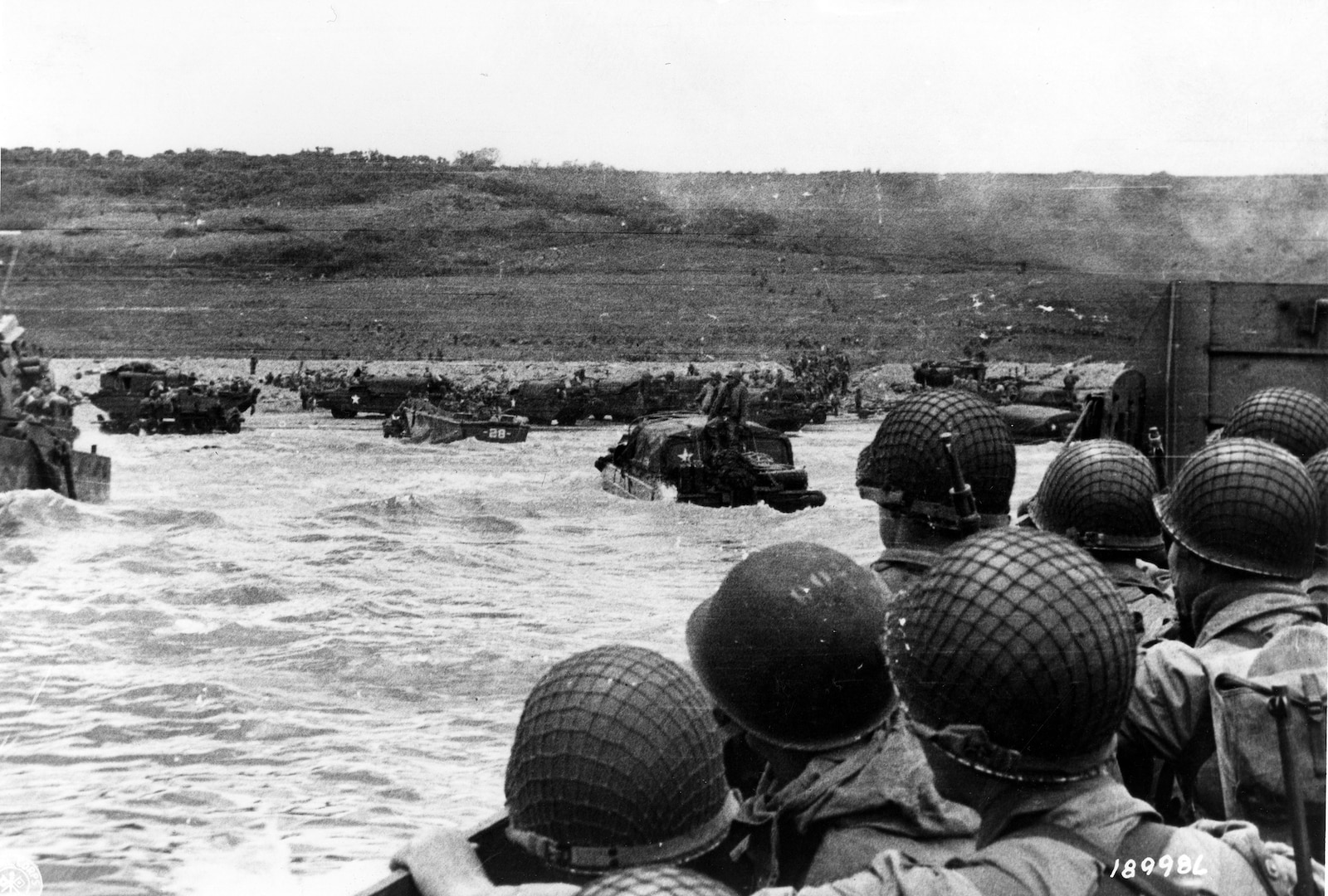
Troops watch activity on Omaha Beach as their LCVP landing craft approaches the shore, 6 June 1944.
Troops watch activity on Omaha Beach as their LCVP landing craft approaches the shore, 6 June 1944. US Army Signal Corps / US National Archives · via US Department of Defense Source
Operation Overlord

H-Hour at Omaha, the assault founders

Almost everything failed at once. Of 32 DD swimming tanks launched by the 741st Tank Battalion, 27 foundered in the swell far offshore. The aerial bombardment fell inland. Landing craft came in off-station, units landed intermixed, and the beach was overlooked along its length by bluffs held by the 352nd Infantry Division, a formation better and more forward-deployed than Allied intelligence had allowed for. The first waves of the 1st and 29th Divisions were pinned at the shingle under interlocking machine-gun and mortar fire. Engineers lost most of their demolition…

Continue in Operation Overlord →
A US Navy destroyer bombarding the coast near Pointe du Hoc, 6 June 1944.
A US Navy destroyer bombarding the coast near Pointe du Hoc, 6 June 1944. US Navy 80-G-352840 · NARA · Public domain Source
Operation Overlord

The Rangers scale Pointe du Hoc

Three companies of the 2nd Ranger Battalion under Lieutenant Colonel James Rudder landed beneath a hundred-foot cliff between Utah and Omaha and climbed it under fire using rocket-fired grapnels and extension ladders borrowed from the London Fire Brigade. The 155 mm guns they had come for had been withdrawn inland; a Ranger patrol found them unguarded in an orchard and destroyed them with thermite. The battalion then held the clifftop against counterattack for two days, reduced from roughly 225 men to about 90 effectives before relief arrived.

Continue in Operation Overlord →
Jig sector, Gold Beach, looking towards Le Hamel, 7 June 1944.
Jig sector, Gold Beach, looking towards Le Hamel, 7 June 1944. IWM ART LD 4461 · IWM Non-Commercial Licence Source
Operation Overlord

H-Hour at Gold

The British 50th (Northumbrian) Division landed an hour after the American beaches, the tide running along the coast having pushed H-Hour eastwards. Hobart's specialised armour came ashore with the assault waves: flail tanks for mines, bridging and fascine vehicles, and the Churchill AVRE with its petard mortar for concrete. The armoured engineering made the difference at the sea wall. By evening 50th Division was three to four miles inland with patrols approaching Bayeux.

Continue in Operation Overlord →
Operation Overlord: the Normandy landings, 6 June 1944.
Operation Overlord: the Normandy landings, 6 June 1944. IWM B 7753 · IWM Non-Commercial Licence Source
Operation Overlord

H-Hour at Juno

The Canadian 3rd Infantry Division landed late, against an offshore reef and a rising tide that carried the leading craft into the beach obstacles rather than short of them. Nearly a third of the landing craft in the first wave were damaged or lost. Once through the seafront villages the division pushed further inland on 6 June than any other Allied formation, reaching the Caen to Bayeux road before halting for the night.

Continue in Operation Overlord →
Vehicles and troops passing through La Brèche as they move inland from Sword Beach, 6 June 1944.
Vehicles and troops passing through La Brèche as they move inland from Sword Beach, 6 June 1944. IWM B 5036 · IWM Non-Commercial Licence Source
Operation Overlord

H-Hour at Sword

The British 3rd Infantry Division landed on the easternmost beach with orders to take Caen on the first day. No. 4 Commando, and 177 men of No. 10 (Inter-Allied) Commando under Commandant Philippe Kieffer, the only French troops in the assault, cleared Ouistreham. Lord Lovat's 1st Special Service Brigade pushed inland to relieve the airborne troops at the Orne bridges, arriving in the early afternoon. Congestion on the beach and the strongpoint at Hillman slowed the advance, and Caen, nine miles away, stayed German.

Continue in Operation Overlord →
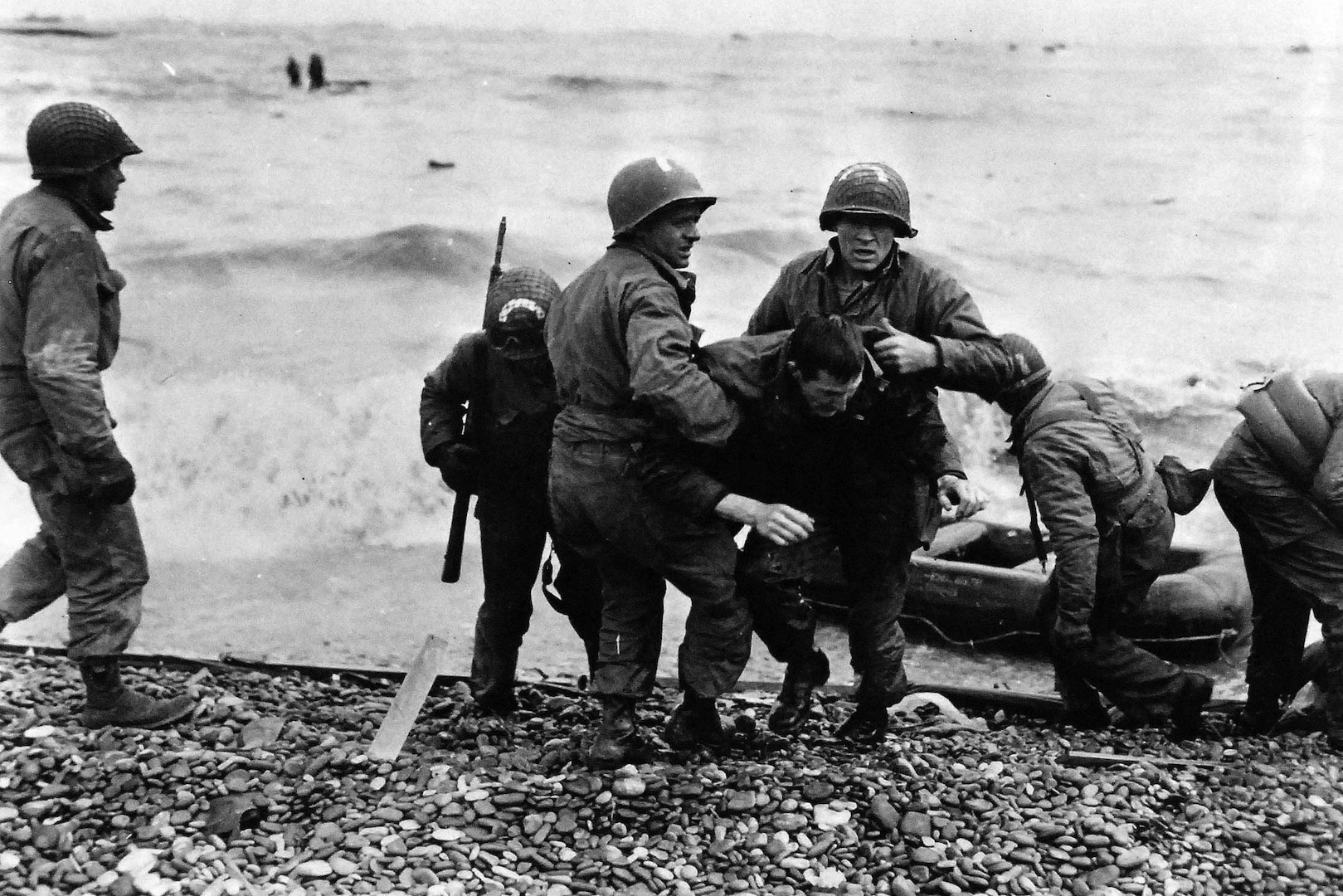
Members of an American landing party carry comrades ashore from a life raft after their landing craft was sunk, 6 June 1944.
Members of an American landing party carry comrades ashore from a life raft after their landing craft was sunk, 6 June 1944. US Army Signal Corps · via US Department of Defense Source
Operation Overlord

Destroyers close the shore at Omaha

With the assault stalled at the shingle and casualties mounting, US and British destroyers ran in until they were nearly scraping their keels, some to within 800 yards, and engaged bunkers and gun positions over open sights on the bluffs. That fire, combined with small parties of infantry and engineers working up the draws on their own initiative under officers including Colonel George Taylor and Brigadier General Norman Cota, broke the deadlock. The first exits were opened before midday.

Continue in Operation Overlord →
Rommel, von Rundstedt, Gause and Zimmermann in conference, Paris, December 1943.
Rommel, von Rundstedt, Gause and Zimmermann in conference, Paris, December 1943. Bundesarchiv Bild 101I-718-0149-12A · CC BY-SA 3.0 DE Source
Operation Overlord

The panzer reserves stay locked

The armoured reserve in France was divided between Rommel's Army Group B, Rundstedt's OB West, and an OKW reserve that only Hitler could release. Hitler was asleep at the Berghof and his staff would not wake him. Rundstedt had already ordered 12th SS Panzer Division and Panzer Lehr towards the coast on his own authority, and was overruled. Formal release came only in the afternoon, by which time both faced a daylight approach march under total Allied air superiority. Rommel, driving back from Germany, did not reach his headquarters until…

Continue in Operation Overlord →
A Panther with accompanying infantry, northern France, summer 1944.
A Panther with accompanying infantry, northern France, summer 1944. Bundesarchiv Bild 101I-301-1955-15 · CC BY-SA 3.0 DE Source
Operation Overlord

21st Panzer counterattacks to the sea

The only substantial German armoured counterattack of the day drove north through the gap between Sword and Juno. A battlegroup of 21st Panzer Division reached the coast at Lion-sur-Mer in the late afternoon, the only German unit to reach the sea on 6 June. At about 21:00 the gliders of Operation Mallard passed low overhead, bringing in 6th Airlanding Brigade. To the German commander on the ground it looked like an airborne landing across his rear, and the battlegroup withdrew rather than risk being cut off.

Continue in Operation Overlord →
Operation Overlord

End of the first day

Around 156,000 men were ashore. Allied casualties on the day are usually estimated at about 10,000, of whom some 4,400 were killed; more than 2,000 of the total fell at Omaha alone. None of the day's principal objectives had been met. Caen, Bayeux and Carentan were all still German. The five beachheads were separate, none as deep as planned, the largest around six miles inland. Every beach had held, the lodgement existed, and the Allies could reinforce it faster than the Germans could concentrate against it by road.

Continue in Operation Overlord →
Three Horsa gliders on the landing ground beside the Caen Canal bridge at Bénouville, photographed in July 1944.
The three Horsa gliders of the coup de main force beside the canal bridge, 12 July 1944 · Imperial War Museums · IWM Non-Commercial Licence · Source
Operation Deadstick

Cast off

The tugs released at about seven thousand feet over the coast. From that moment the gliders were silent, and the only navigation was a stopwatch, a compass, and timed turns read out by the second pilot with a torch strapped to his finger. Staff Sergeant Jim Wallwork flew the leading glider. There is no going around in a Horsa: the approach is made once, and whatever field is underneath at the end of it is the field you land in.

Continue in Operation Deadstick →
Three of the Horsa gliders that carried the coup de main force, beside the canal bridge, 12 July 1944.
Three of the Horsa gliders that carried the coup de main force, beside the canal bridge, 12 July 1944. Imperial War Museums · IWM Non-Commercial Licence Source
Operation Deadstick

Chalk 91 stops twenty-two yards from the bridge

Wallwork and John Ainsworth brought the leading glider down in a field ringed with anti-landing poles, used the arrester parachute to stop it, and came to rest with the nose in the wire twenty-two yards from the bridge. Both pilots were thrown through the cockpit and Wallwork was briefly knocked out. Leigh-Mallory later called it one of the outstanding flying achievements of the war. Two more gliders came down within a minute behind it.

Continue in Operation Deadstick →
Operation Deadstick

The first man killed

Lance Corporal Fred Greenhalgh, a Bren gunner in the third glider, was thrown out as it came down and drowned in a pond beside the landing ground. He had not fired a shot and the Germans did not yet know anyone was there. He is generally reckoned the first Allied serviceman to die on D-Day. He was 24, and had joined the Ox and Bucks in 1942.

Continue in Operation Deadstick →
The Caen Canal bridge at Bénouville in 1944, with Horsa gliders visible beyond it.
The Caen Canal bridge at Bénouville in 1944, with Horsa gliders visible beyond it. Imperial War Museums · IWM Non-Commercial Licence Source
Operation Deadstick

Across the bridge

Lieutenant Den Brotheridge led his platoon over the bridge at a run, throwing a grenade into the machine gun pit on the far side. He was hit in the neck crossing the road and died of his wounds shortly afterwards. He is generally reckoned the first Allied soldier killed by enemy fire on D-Day. His daughter was born a fortnight later.

Continue in Operation Deadstick →
Operation Deadstick

The river bridge, taken without a shot

Two of the three gliders for the Orne bridge landed close to it. Lieutenant Tod Sweeney's platoon crossed and found the bridge undefended: the guard had gone. It was taken without a casualty on either side. The third glider was seven miles away and had no idea any of this was happening.

Continue in Operation Deadstick →
Operation Deadstick

The charges are not in the bridge

Royal Engineers went under the bridge with wire cutters expecting to race a firing party. They found the demolition chambers empty. The charges were in a shed nearby, not yet fitted, because the garrison commander had judged an attack unlikely and preferred not to leave live explosive on a working bridge. That decision, made by a German officer weeks earlier for reasons of routine safety, is why both bridges survived the night.

Continue in Operation Deadstick →
Operation Deadstick

Ham and Jam

Howard's signaller sent the two code words that meant both bridges were captured and intact: Ham for the canal, Jam for the river. It had taken ten minutes from the first glider touching down. The signal was repeated for hours because nobody was certain it had been received. It had. It was the first news reaching England that the invasion had begun.

Continue in Operation Deadstick →
The Café Gondrée beside the canal bridge, held to be the first house in France liberated.
The Café Gondrée beside the canal bridge, held to be the first house in France liberated. Wikimedia Commons · Creative Commons Source
Operation Deadstick

The first house in France

The café at the western end of the bridge was run by Georges and Thérèse Gondrée, who had been passing information to the resistance. Thérèse spoke German and had listened to the garrison talking in the bar. The family was in the cellar with their two daughters when British voices arrived above them. It became the aid post. Georges Gondrée dug up ninety-eight bottles of champagne he had buried in the garden in 1940 and opened them for the wounded. Their daughter Arlette, four years old that night, still runs…

Continue in Operation Deadstick →
Operation Deadstick

The fourth glider, seven miles away

Glider number four had been released on the wrong bearing and came down beside a bridge over the River Dives, seven miles east. Lieutenant Hooper's platoon believed for some time that they were at the right place. They fought their way back west over the following days. Their absence meant the river bridge was taken by two platoons instead of three, which turned out not to matter because there was nobody defending it.

Continue in Operation Deadstick →
Operation Deadstick

The parachute drop, scattered

The 7th Parachute Battalion dropped to reinforce the bridges and came down badly scattered across flooded ground and hedgerow. Of about six hundred men, roughly two hundred had reached the bridges within two hours. They took over the defence of Bénouville and Le Port on the west bank while Howard's company held the bridges themselves. The rest of the battalion arrived through the night in ones and twos.

Continue in Operation Deadstick →
Operation Deadstick

The first armour comes down the road

Two German tanks moved up from Bénouville towards the canal bridge. Sergeant Wagger Thornton stopped the leading one with a PIAT at about thirty yards. Its ammunition cooked off and it burned in the road for hours, blocking it. The noise and the fire convinced the Germans that something much larger than a company was holding the crossing. No further armoured attempt was made on the bridge that night.

Continue in Operation Deadstick →
Men of the 16th Infantry Regiment wading ashore from a landing craft at Omaha Beach, 6 June 1944.
“Into the Jaws of Death” · CPhoM Robert F. Sargent, US Coast Guard · NARA 26-G-2343 · Public domain · Source
Omaha Beach

Low water exposes the obstacle belt

The assault was timed around low water so demolition teams could see and attack the rows of stakes, ramps, gates and steel hedgehogs. The price was distance. Assault troops would have to cross several hundred yards of wet sand before reaching the shingle or sea wall, while the rising tide steadily reduced the time available to clear lanes for following craft.

Continue in Omaha Beach →
Omaha Beach

The naval bombardment opens

Battleships, cruisers, destroyers and smaller fire-support craft opened on the coastal positions before H-Hour. The bombardment damaged some positions but did not neutralise the resistance nests covering the five exits. As infantry later stalled, destroyers would abandon prearranged fire patterns and move much closer to engage visible targets directly.

Continue in Omaha Beach →
Omaha Beach

Heavy bombing falls behind the beach defences

Eighth Air Force heavy bombers crossed the coast through cloud with release procedures designed to avoid dropping short onto the approaching landing craft. The result at Omaha was poor. Bombs fell mainly inland and the coastal strongpoints survived to meet the assault. Naval histories note that the beach itself received essentially none of the cratering the infantry had expected to use as cover.

Continue in Omaha Beach →
Omaha Beach

The 741st Tank Battalion's DD launch becomes a disaster

The 741st Tank Battalion launched its swimming Shermans far offshore into rough water. Twenty-seven of twenty-nine DD tanks in the swimming group sank before reaching the beach. The 743rd Tank Battalion's landing craft made a different judgement and carried most of its DD tanks much closer to shore. Those surviving tanks gave the western assault a firepower reserve the 741st sector largely lost at sea.

Continue in Omaha Beach →
U.S. troops in an LCVP approach Omaha Beach on 6 June 1944.
U.S. troops in an LCVP approach Omaha Beach on 6 June 1944. U.S. Army Signal Corps, SC 320901 · Public domain Source
Omaha Beach

Landing craft make the final run

LCVPs and larger landing craft moved through smoke, shell splashes and strong lateral current toward assigned beach sectors. Many boats arrived east of their intended positions. Units therefore landed opposite unfamiliar terrain, frequently separated from supporting tanks, engineers or neighbouring companies.

Continue in Omaha Beach →
Men from the U.S. 1st Infantry Division wade from an LCVP toward Omaha Beach on 6 June 1944.
Men from the U.S. 1st Infantry Division wade from an LCVP toward Omaha Beach on 6 June 1944. CPhoM Robert F. Sargent, U.S. Coast Guard / NARA, 26-G-2343 · Public domain Source
Omaha Beach

H-Hour

The first infantry wave reached Omaha. German machine guns, mortars and artillery fired across the tidal flat while many assault companies landed in the wrong sector. The image attached here, Robert F. Sargent's 'Into the Jaws of Death,' records men of the 1st Infantry Division leaving an LCVP and wading toward the beach on 6 June.

Continue in Omaha Beach →
A converted cable ship laying pipeline across the English Channel, 1944.
Pipeline laying in the Channel, 1944 ·
Operation PLUTO

The invasion is fuelled without PLUTO

Packaged petrol crossed the beaches in jerricans and drums, while coastal tankers and ship-to-shore systems supplied bulk storage as the lodgement developed. No PLUTO line was operating. The marine pipeline had been removed from the initial assault plan and was expected to support a more established beachhead.

Continue in Operation PLUTO →
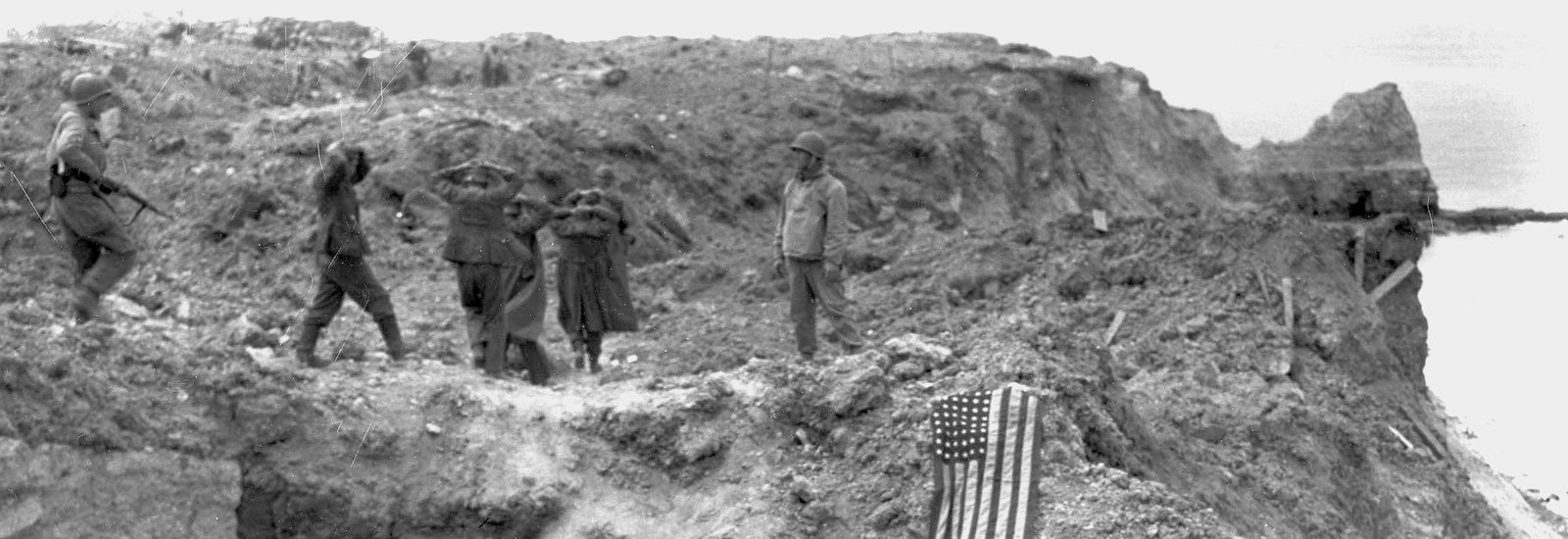
The cratered clifftop at Pointe du Hoc photographed after the assault, June 1944.
The cratered clifftop at Pointe du Hoc after the assault · US Army Signal Corps · NARA · Public domain · Source
Pointe du Hoc

The wrong headland

The guide craft steered for Pointe de la Percée, three miles east, and the flotilla ran along the coast under fire before turning back west. About forty minutes were lost. One landing craft was swamped and sank on the way, and a supply craft was lost with most of the spare ammunition. The force that eventually reached the cliff was smaller than the one that had set out.

Continue in Pointe du Hoc →
Wrecked rolling stock in the severely damaged marshalling yard at Juvisy-sur-Orge after Allied air attacks in 1944.
Bridge B (Fg Off), Royal Air Force official photographer / Imperial War Museums, CL 4170 · Public domain · Source
The Transportation Plan

The test is whether German reinforcement can reach Normandy

By D-Day, Allied headquarters rated 51 of 80 northern rail centres Category A. Army Air Forces accounting put the bomb tonnage on the rail-centre system above 71,000 tons. German military movement had not stopped. Trains moved slowly, used detours and increasingly travelled at night. The battlefield was harder to reinforce quickly, which was the operational result Eisenhower had required.

Continue in The Transportation Plan →
Omaha Beach

A Company, 116th Infantry is shattered at Dog Green

A Company landed in front of the Vierville exit and immediately came under concentrated fire from positions covering Dog Green. The company suffered catastrophic losses within minutes and ceased to function as the coherent assault unit envisaged in the plan. Other western companies were scattered or pushed east, deepening the breakdown of regimental control.

Continue in Omaha Beach →
An LCVP from USS Samuel Chase approaches Omaha on 6 June; the obstacle belt is visible ahead of the craft.
An LCVP from USS Samuel Chase approaches Omaha on 6 June; the obstacle belt is visible ahead of the craft. Robert F. Sargent, U.S. Coast Guard / NHHC, 26-G-2342 · Public domain Source
Omaha Beach

The demolition teams enter the obstacles

Sixteen Army engineer and naval demolition groups were assigned lanes through the obstacle belt. Landing errors, missing equipment and direct fire broke up many teams before they could assemble their charges. Only five initial gaps were opened, and the rising tide soon hid obstacles that had been visible at dawn. Naval Combat Demolition Units suffered 31 killed and 60 wounded among 175 personnel at Omaha.

Continue in Omaha Beach →
Omaha Beach

The eastern assault is also broken into fragments

The 16th Infantry's assault battalions landed across Easy and Fox sectors under the same drift and fire that hit the western beach. Losses were severe, but surviving groups were closer to several routes up the bluff and began pushing through wire and minefields earlier than the beach-wide crisis reports suggested.

Continue in Omaha Beach →
Wounded soldiers of the 3rd Battalion, 16th Infantry Regiment shelter at the base of the cliffs at Omaha on 6 June 1944.
Wounded soldiers of the 3rd Battalion, 16th Infantry Regiment shelter at the base of the cliffs at Omaha on 6 June 1944. Taylor, U.S. Army Signal Corps / National Archives · Public domain Source
Omaha Beach

Survivors collect behind the first cover

Across much of Omaha the shingle, sea wall and base of the bluffs became improvised assembly areas. Men from different companies and even regiments mixed together after crossing the open beach. The cover was temporary rather than safe. Mortar and artillery fire reached it, heavy weapons had been lost in the surf, and vehicles could not simply drive over the shingle.

Continue in Omaha Beach →
Omaha Beach

The second wave lands into the wreckage

Follow-on infantry, engineers, weapons and vehicles arrived before the first wave had opened the exits. Craft piled into a beach already crowded with wreckage, casualties and units out of position. The reinforcement was essential, but it also made control harder. The assault timetable had become a traffic problem under fire rather than a sequence of intact formations passing inland.

Continue in Omaha Beach →
Rangers on the cliff face, using ladder sections and hand lines.
Rangers on the cliff face, using ladder sections and hand lines. US Army Signal Corps · NARA · Public domain Source
Pointe du Hoc

Rockets, ropes and ladders

The Rangers landed on a strip of shingle a few yards wide and fired rocket-propelled grapnels up the cliff. Many fell short because the wet ropes were heavier than in training. The fire brigade ladders bogged in the shingle and could not be raised properly. Men climbed on the lines that held, on ladder sections held against the chalk, and in places on the cliff itself. Germans above cut ropes and dropped grenades over the edge.

Continue in Pointe du Hoc →
Pointe du Hoc

Satterlee and Talybont close the cliff

The destroyer USS Satterlee and the British destroyer HMS Talybont ran in close and fired directly at the clifftop, driving the defenders back from the edge at the moment the Rangers were most exposed on the ropes. Naval gunfire at that range and that angle is dangerous to the people it is supporting. It was asked for and it was given, and it is the reason the climb succeeded.

Continue in Pointe du Hoc →
The ground at Pointe du Hoc, left as the bombardment made it.
The ground at Pointe du Hoc, left as the bombardment made it. Wikimedia Commons · Creative Commons Source
Pointe du Hoc

On top, in five minutes

The first men were over the edge within five minutes of landing. The ground they found was cratered almost beyond recognition by weeks of bombing and that morning's shelling, which broke up the German defence as effectively as it broke up the ground. Small parties moved between craters towards the casemates. The garrison fought from bunkers and tunnels rather than in the open.

Continue in Pointe du Hoc →
Omaha Beach

Small groups begin getting above the beach

The picture was already becoming uneven. While large parts of the assault remained pinned, small parties on the eastern and central sectors found paths through wire, mines and thinly held slopes between resistance nests. These penetrations were too small to look decisive from offshore, but they began turning the problem around: once men were on the heights, the strongpoints could be approached from directions they were not designed to dominate.

Continue in Omaha Beach →
One of the casemates, built for a gun that had been moved inland in April.
One of the casemates, built for a gun that had been moved inland in April. Wikimedia Commons · Creative Commons Source
Pointe du Hoc

The guns are not there

The casemates were reached and found empty. In place of the 155 mm guns stood telegraph poles, set at an angle to look like barrels from the air. The position had been taken at cost, against an objective that did not exist on it. What the Rangers did next is the reason this action is not simply a mistake.

Continue in Pointe du Hoc →
Pointe du Hoc

The signal goes out late

Rudder sent Praise the Lord from the clifftop. By then Force C had waited past its deadline and turned for Omaha, where it landed and had to fight its way along the coast. Rudder was left with about 225 men instead of the roughly 500 the plan had allowed. He was wounded twice during the day and kept command.

Continue in Pointe du Hoc →
Omaha Beach

The tanks that reached shore keep firing

The DD disaster did not mean Omaha had no tanks. Shermans landed by craft or survived the swim in other sectors and fought from the beach, firing at embrasures, houses and suspected strongpoints. Their crews had little room to manoeuvre before exits opened, but tank fire joined naval gunfire and infantry weapons in suppressing positions that the pre-assault bombardment had left intact.

Continue in Omaha Beach →
Pointe du Hoc

Patrols reach the coast road

Small parties pushed half a mile inland through hedgerow to the coastal road, the lateral route by which German reinforcement would move between Omaha and the Cotentin, and set up blocking positions across it. Cutting that road was the second objective of the operation and it is the one usually forgotten.

Continue in Pointe du Hoc →
Omaha Beach

Offshore headquarters sees a beach in crisis

Reports reaching senior commanders described closed exits, damaged landing craft and units pinned near the water. Follow-on movement was checked while beach control tried to prevent more vehicles from being fed into blocked sectors. Bradley considered delaying or diverting later forces if Omaha could not be made usable. That was a contingency for reinforcement, not a decision to evacuate the men already fighting ashore.

Continue in Omaha Beach →
Omaha Beach

Taylor pushes the 16th Infantry inland

Colonel George Taylor reached the crowded beach and ordered men away from the cover they had found and toward the bluffs. His famous statement about the dead and those about to die survives in variant wording. The operational meaning is clearer than the exact quotation: remaining at the waterline was more dangerous than attacking uphill.

Continue in Omaha Beach →
Omaha Beach

Cota and the Rangers move through the wire

Brigadier General Norman Cota helped organise men at Dog White and directed Rangers and infantry toward breaches in the wire. The phrase 'Rangers, lead the way' became the regiment's motto. More important on the ground was the example: stop waiting for the planned exit to open, make a breach and climb the bluff.

Continue in Omaha Beach →
Omaha Beach

Spalding, Dawson and other small-unit leaders find the way up

Lieutenant John Spalding, Captain Joseph Dawson and other junior leaders took mixed groups through gaps and up the bluff line in the eastern sector. Their routes were not the vehicle draws marked as the assault objectives. They were infantry paths through terrain that had been less heavily fortified because German defence planning expected vehicles to use the valleys.

Continue in Omaha Beach →
Operation Deadstick

Gunboats and snipers

German gunboats came up the canal from Ouistreham and were engaged from the bridge; one was disabled and its crew taken. Snipers worked from the church tower at Le Port and from the houses, and mortar fire fell on the bridges through the morning. Staff Sergeant Geoff Barkway, who had flown the third glider, was mortally wounded and treated in the café cellar. He lost an arm and died later of his wounds.

Continue in Operation Deadstick →
Pointe du Hoc

Two sergeants find the guns

First Sergeant Leonard Lomell and Staff Sergeant Jack Kuhn, following a track marked by wheel ruts, found five of the six guns in a hedged orchard, camouflaged, loaded, aimed at Utah Beach, with ammunition stacked and nobody guarding them. Lomell destroyed the traversing mechanisms and sights with two thermite grenades and smashed the sights of the rest with his rifle butt. A second patrol arrived minutes later and finished the job. The battery was out of action before it had fired on the beaches.

Continue in Pointe du Hoc →
Hamilcar gliders of 6th Airlanding Brigade arrive on Drop Zone 'N' near Ranville on 6 June 1944, bringing Tetrarch tanks. The scale of Allied airborne operations illustrates the freedom of movement created by air superiority over Normandy.
Hamilcar gliders of 6th Airlanding Brigade arrive on Drop Zone 'N' near Ranville on 6 June 1944, bringing Tetrarch tanks. The scale of Allied airborne operations illustrates the freedom of movement created by air superiority over Normandy. Christie (Sgt), No. 5 Army Film & Photographic Unit / Imperial War Museums, B 5198 · Public domain Source
Big Week and Air Superiority

Air superiority measured over Normandy

On 6 June Allied air forces flew 12,015 sorties in support of the invasion and the wider air plan. The captured German wartime study records 319 Luftwaffe sorties for both day and night operations. Josef Priller and Heinz Wodarczyk's low pass over the beaches in two Fw 190s became famous because it compressed the imbalance into a memorable scene. It should not be mistaken for the whole German effort: fighter, reconnaissance and other Luftwaffe missions were flown elsewhere during the day. Nor can the ratio be credited to Big Week…

Continue in Big Week and Air Superiority →
Omaha Beach

Destroyers close to direct-fire range

U.S. destroyers moved to roughly 800–1,000 yards from the beach, in some cases inside waters considered dangerously shallow for the ships. With shore fire-control parties disrupted, crews engaged targets they could identify visually: gun flashes, embrasures, houses and positions firing on the beach. Naval History and Heritage Command treats this close fire as a critical contribution to recovering Omaha.

Continue in Omaha Beach →
Omaha Beach

The attack changes direction

Instead of driving directly up the fortified vehicle exits, infantry groups climbed between them and spread along the crest. This bypassed the strongest frontal fire. Strongpoints that had dominated the beach could now be isolated or attacked from above and behind while surviving tanks and destroyers continued firing from seaward.

Continue in Omaha Beach →
Omaha Beach

Fighting reaches the villages behind the beach

Elements of the 16th Infantry reached the outskirts of Colleville while other penetrations pushed toward Saint-Laurent and Vierville. The parties were understrength and often lacked normal artillery, mortar and radio support, but their presence inland proved the beach defence had been penetrated even though the planned exits were still not fully open.

Continue in Omaha Beach →
Omaha Beach

Resistance nests are attacked from the rear

American groups on the heights began working along the bluff line and down toward strongpoints that had been nearly impossible to attack frontally from the sand. The German system had been built to cover the beach and draws with overlapping fire. Once penetrations appeared behind it, individual resistance nests became increasingly isolated.

Continue in Omaha Beach →
Omaha Beach

The exits begin becoming vehicle routes

Infantry attacking from inland and engineers working from the beach began opening parts of the draw system. Mines, walls, wreckage and direct fire still restricted movement. Tank-dozers and engineer equipment widened passages enough for vehicles to leave the sand. The beach could now begin functioning as a route inland rather than only as a firing line.

Continue in Omaha Beach →
Operation Deadstick

The commandos arrive, behind a piper

1st Special Service Brigade came up from Sword Beach under Lord Lovat, with Bill Millin playing the bagpipes at Lovat's instruction and in defiance of standing orders against pipers in action. They crossed the bridge under sniper fire. Lovat is said to have apologised to Howard for being a few minutes late. The company had held both bridges for about twelve and a half hours.

Continue in Operation Deadstick →
Pointe du Hoc

Counterattacks begin

Elements of the 916th Grenadier Regiment moved up from the south and attacked the blocking positions on the road through the afternoon and into the night. The Rangers were short of ammunition, had lost their supply craft on the run in, and had no artillery of their own. The road position was held into the evening and then given up. The survivors fell back onto a shrinking perimeter around the point.

Continue in Pointe du Hoc →
Omaha Beach

Landing traffic starts to recover

As lanes and exits became usable, beach-control parties pushed more infantry, ammunition, guns and vehicles ashore. The original timetable had been lost and the beach remained under fire in places, but the logistical direction of the battle had changed: reinforcements were now feeding a lodgement rather than accumulating behind a sealed obstacle line.

Continue in Omaha Beach →
Omaha Beach

A shallow beachhead replaces the morning crisis

American positions were still fragmented and far short of the planned D-Day objective line, but German coastal strongpoints no longer controlled the entire landing area. The most important change was continuity. Troops, tanks and supplies could keep coming ashore, while units on the heights could hold ground through the night.

Continue in Omaha Beach →
Operation Deadstick

The evening lift

Operation Mallard brought in around 250 gliders in daylight over the landing zones beyond the Orne, carrying the rest of the airlanding brigade with anti-tank guns and transport. The men on the bridges watched it come in over their heads. Several described it as the moment they were certain the invasion had worked. The eastern flank was now held in strength.

Continue in Operation Deadstick →
Omaha Beach

Omaha survives D-Day

About 34,000 U.S. troops had landed at Omaha by the end of 6 June. The lodgement was shallower than planned, the exits and roads were congested and major inland objectives remained untaken. The beachhead nevertheless held and could be reinforced. That distinction is the outcome of the day: the assault plan failed in several of its opening mechanisms, while the landing itself succeeded.

Continue in Omaha Beach →