Skip to content
WW2 Theatres Theatres of the Second World War
Home

World War II calendar

WWII On This Day: June 5

What happened on June 5 during World War II? This date brings together 9 events from 1940, 1941, 1942 and 1944, with period photographs and links to the full operations documented across WW2 Theatres.

1940
German troops in northern France during the campaign of 1940.
Bundesarchiv Bild 101I-299-1808-10A · CC BY-SA 3.0 DE · Source
Battle of France 1940

Germany opens the second offensive against France

Fall Rot opened on 5 June against the French positions along the Somme and Aisne after the northern pocket had been eliminated and German formations had been redeployed south. Weygand organised defence in depth around towns, woods and strongpoints, using remaining infantry, armour and artillery to make penetrations costly and to avoid the rigid linear collapse seen after the Meuse crossings. German superiority in operational reserves and mobility gradually widened local breaches. The French army now fought on a shorter front with fewer formations, while the government and civilian population…

Continue in Battle of France 1940 →
1941
Victims of the Chongqing air-raid shelter disaster after the prolonged Japanese raid of 5 June 1941.
Victims of the Chongqing air-raid shelter disaster after the prolonged Japanese raid of 5 June 1941. National Archives and Records Administration, NAID 535558 · Usage unrestricted Source
The Bombing of Cities

The Chongqing air-raid shelter disaster

A prolonged Japanese night raid on 5 June 1941 drove large numbers of civilians into Chongqing's air-raid tunnels. Several shelter sections became dangerously overcrowded while people remained underground for hours. Chongqing's civil-defence authorities later commemorated a disaster in which suffocation and crushing caused roughly 2,500 casualties. The event shows that air-raid deaths could be produced by shelter conditions and civil-defence failure as well as by direct bomb impact. The disaster occurred more than three years into the bombing campaign and illustrates the cumulative strain placed on a city that had…

Continue in The Bombing of Cities →
1942
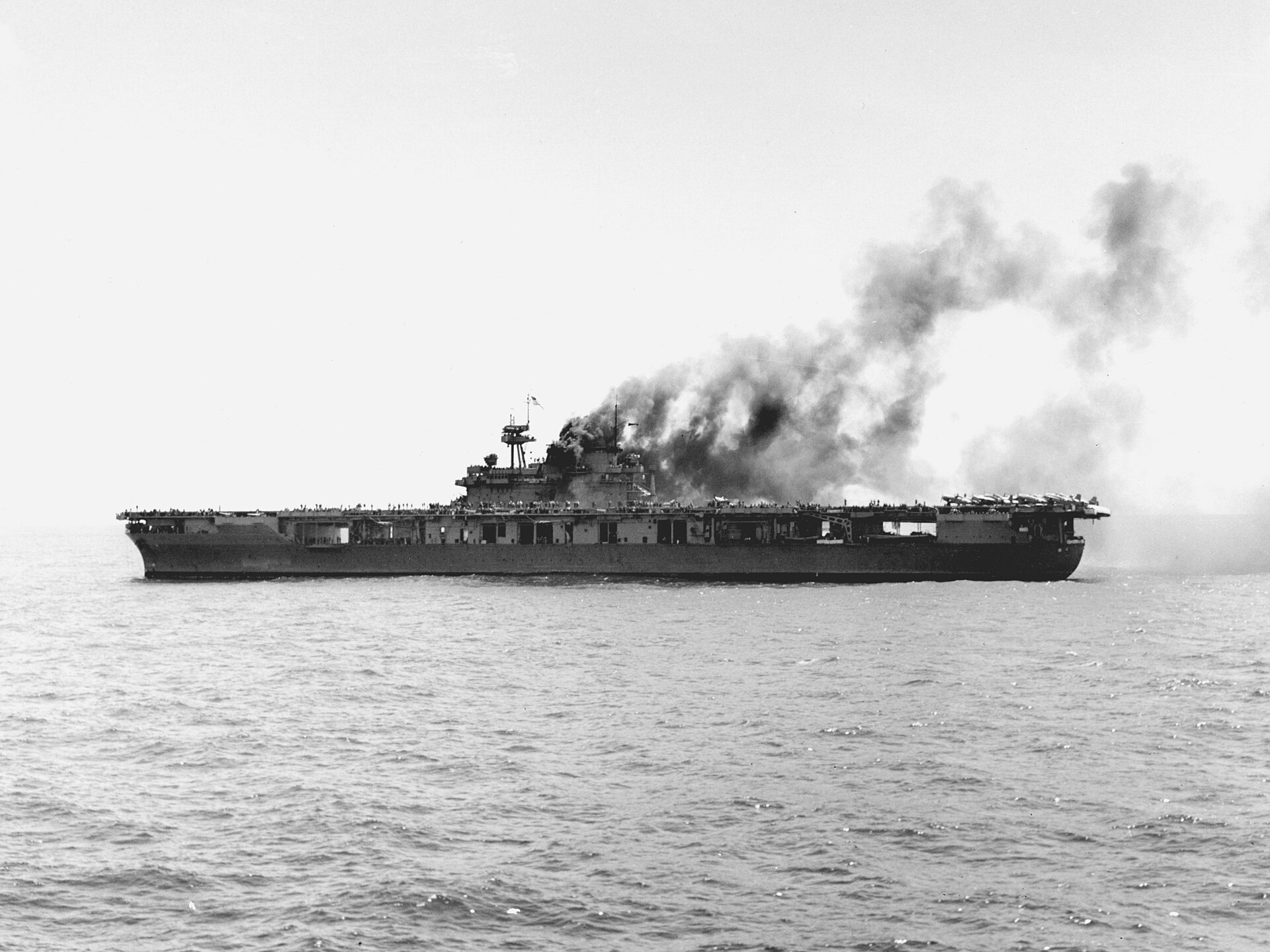
USS Yorktown under attack by Japanese torpedo bombers during the Battle of Midway, 4 June 1942.
USS Yorktown under torpedo attack, 4 June 1942 · US Navy · NARA · Public domain · Source
The Battle of Midway

Yamamoto cancels the operation

Yamamoto briefly considered pressing on with a night surface action, then accepted that with no carriers and no air cover a battleship force in daylight within range of Midway was a liability. The occupation was cancelled and the fleet turned west. Akagi and Hiryū were scuttled by Japanese destroyers that morning. Kaga and Sōryū had already gone down.

Continue in The Battle of Midway →
The Battle of Midway

Spruance declines the night pursuit

Spruance turned east during the night rather than chase a defeated but numerically superior surface fleet into the dark, where Japanese night gunnery and torpedoes would have been decisive. It was criticised at the time as excessive caution. It is now generally read as the correct decision by a commander who understood exactly what he had won and had no intention of handing any of it back.

Continue in The Battle of Midway →
1944
Eisenhower giving the Order of the Day to airborne troops before embarkation.
Eisenhower giving the Order of the Day to airborne troops before embarkation. US Army Signal Corps · NARA 531217 · Public domain Source
Operation Overlord

“OK, we'll go.”

Stagg confirmed the break. After polling his commanders and sitting for a long moment in silence, Eisenhower gave the order for 6 June. It was his alone to make and could not be delegated. The same weather that forced the postponement had convinced the German command that no landing was possible. Reconnaissance was reduced, the Seventh Army's alert state relaxed, and a map exercise for senior officers set for Rennes on the morning of the 6th. Rommel left for Germany to see his wife on her birthday and to press…

Continue in Operation Overlord →
Eisenhower with Lieutenant Wallace C. Strobel and men of Company E, 502nd PIR, Greenham Common, 5 June 1944.
Eisenhower with Lieutenant Wallace C. Strobel and men of Company E, 502nd PIR, Greenham Common, 5 June 1944. US Army Signal Corps SC 194399 · Public domain Source
Operation Overlord

Eisenhower visits the 502nd Parachute Infantry

Eisenhower drove to Greenham Common to see off Company E, 502nd Parachute Infantry Regiment, 101st Airborne Division. Leigh-Mallory had predicted airborne casualties as high as seventy per cent and asked in writing that the drop be cancelled; Eisenhower overruled him and recorded his reasons. Earlier that day he had written a note accepting sole responsibility should the landings fail, and put it in his wallet. He misdated it 5 July.

Continue in Operation Overlord →
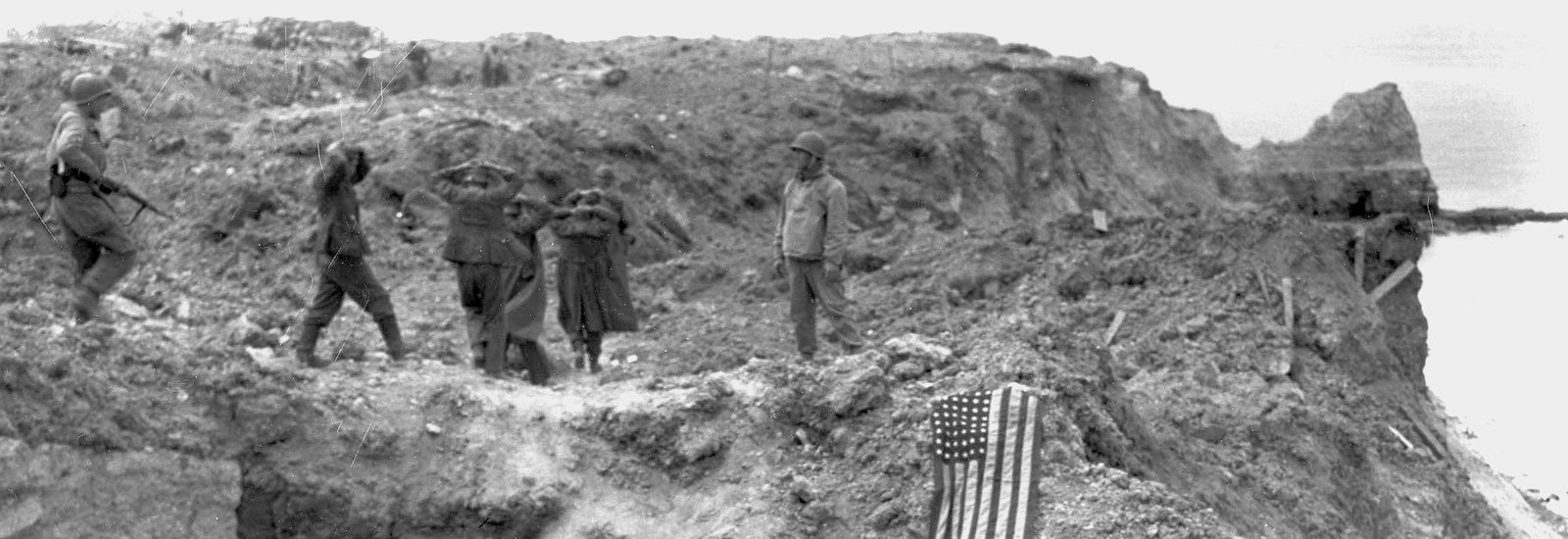
The cratered clifftop at Pointe du Hoc photographed after the assault, June 1944.
The cratered clifftop at Pointe du Hoc after the assault · US Army Signal Corps · NARA · Public domain · Source
Pointe du Hoc

Praise the Lord

Rudder was to take three companies up the cliff and signal the code word Praise the Lord on success. If it came by 07:00, the eight companies of Force C waiting offshore would follow him up. If it did not, Force C would land at Omaha and come the four miles overland. The whole shape of the two days that followed is decided by which of those two things happened.

Continue in Pointe du Hoc →
Men of the 16th Infantry Regiment wading ashore from a landing craft at Omaha Beach, 6 June 1944.
“Into the Jaws of Death” · CPhoM Robert F. Sargent, US Coast Guard · NARA 26-G-2343 · Public domain · Source
Omaha Beach

Force O makes the Channel crossing

The Omaha assault force moved south through rough Channel water after the invasion had already been postponed twenty-four hours for weather. For the infantry the last stage meant transferring from transports to landing craft before dawn. Seasickness, spray and the rough water that would later overwhelm many DD tanks were already degrading the assault before the coast came into view.

Continue in Omaha Beach →
An Airspeed Horsa, the seventy-foot glider that carried thirty men and could not go around a second time.
An Airspeed Horsa, the seventy-foot glider that carried thirty men and could not go around a second time. Imperial War Museums · IWM Non-Commercial Licence Source
Operation Deadstick

Six gliders take off

Six Airspeed Horsas lifted off behind Halifax tugs, carrying 181 men: D Company of the 2nd Oxfordshire and Buckinghamshire Light Infantry, two platoons of B Company, and thirty Royal Engineers to deal with the demolitions. Three were for the canal bridge and three for the river bridge, four hundred yards apart. Each man carried up to nine grenades and four Bren magazines, because nobody expected resupply before daylight.

Continue in Operation Deadstick →