Skip to content
WW2 Theatres Theatres of the Second World War
Home

World War II calendar

WWII On This Day: June 4

What happened on June 4 during World War II? This date brings together 23 events from 1940, 1942 and 1944, with period photographs and links to the full operations documented across WW2 Theatres.

1940
German troops in northern France during the campaign of 1940.
Bundesarchiv Bild 101I-299-1808-10A · CC BY-SA 3.0 DE · Source
Battle of France 1940

The final organised Dunkirk evacuation leaves

The last organised naval lift from Dunkirk departed during the early hours of 4 June after French troops had filled the final scheduled embarkations. German forces moved into the remaining bridgehead later that morning and captured defenders who had stayed behind as the perimeter collapsed. The beach and port were left with vehicles, guns, stores and damaged vessels. Dynamo preserved more than 338,000 trained personnel while stripping the evacuated formations of most heavy equipment. France still fielded armies south of the Somme and Aisne, where the next German offensive opened…

Continue in Battle of France 1940 →
British troops rescued in a ship at Dunkirk (France, 1940).
Divide and Conquer (Why We Fight #3) directed by Frank Capra
Dunkirk: Operation Dynamo

HMS Shikari leaves with the final organised lift

Shikari embarked 383 French troops and was the last ship to leave Dunkirk during the organised evacuation. Other small groups still attempted to escape, but the Admiralty ended Dynamo after the final vessels cleared the harbour.

Continue in Dunkirk: Operation Dynamo →
Dunkirk: Operation Dynamo

The remaining defenders surrender

German forces entered the remaining bridgehead after the evacuation ended. French troops who had not reached the ships were captured. Operation Dynamo had removed 338,226 troops. The evacuation preserved a large body of trained personnel, but the Allied campaign in France continued south of the Somme.

Continue in Dunkirk: Operation Dynamo →
German mountain troops landing in Norway, April 1940.
Photo: Bagn Bygdesamling – Valdres Folkemuseum, Norway · CC BY-SA 3.0 DE · Source
Operation Weserübung

Operation Alphabet removes the Allied force from Narvik

The Allied evacuation from the Narvik area began on 4 June under Operation Alphabet. Troops, aircraft and selected equipment moved toward embarkation points around Harstad and the northern fjords. Weather from 2 to 6 June reduced German aerial observation and helped conceal the scale of the withdrawal. Norwegian forces continued holding the land front while the Allied contingent moved to the ships. About twenty-five thousand Allied personnel were evacuated from northern Norway. The departure ended the combined offensive and left the Norwegian command facing the German force with a rapidly…

Continue in Operation Weserübung →
1942
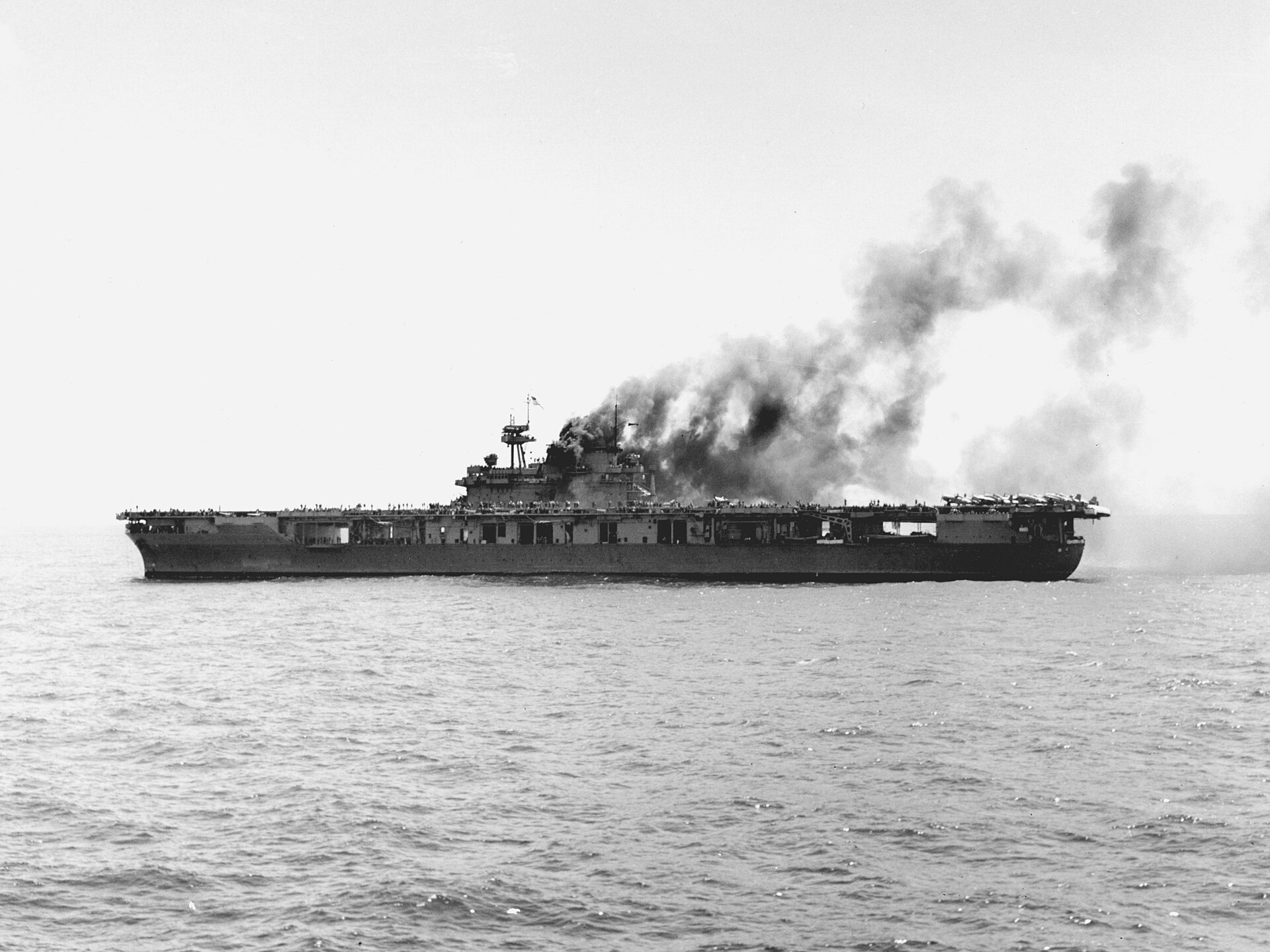
USS Yorktown under attack by Japanese torpedo bombers during the Battle of Midway, 4 June 1942.
USS Yorktown under torpedo attack, 4 June 1942 · US Navy · NARA · Public domain · Source
The Battle of Midway

The strike launches, and a scout is late

One hundred and eight aircraft left the four carriers for Midway. At the same time seven scouting aircraft went out to search the sectors to the east, where the Americans would be if they were anywhere. The cruiser Tone's number four aircraft was delayed about half an hour by a catapult problem. Its sector was the one that contained the American carriers.

Continue in The Battle of Midway →
Midway Atoll, two islets inside a reef, twelve hundred miles from Hawaii.
Midway Atoll, two islets inside a reef, twelve hundred miles from Hawaii. US Fish and Wildlife Service · Public domain Source
The Battle of Midway

Midway is bombed

The strike hit the atoll, destroying installations and shooting down most of the obsolete Marine fighters sent up against it. The runway was left usable, which was the one thing that mattered. The strike leader signalled that a second attack would be necessary. That message set in motion everything that followed.

Continue in The Battle of Midway →
The Battle of Midway

Midway's aircraft attack

Every flyable aircraft on Midway went at the Japanese carriers in a series of uncoordinated attacks: Marine dive bombers, Army B-26s carrying torpedoes, B-17s bombing from high level. They lost heavily and did not score a single hit. They did convince Nagumo that Midway remained a live threat, which reinforced his inclination to hit it again.

Continue in The Battle of Midway →
The Battle of Midway

Nagumo orders the reserve rearmed

The reserve strike aircraft had been held ready with torpedoes and armour-piercing bombs in case American ships appeared. With no ships reported and Midway needing a second blow, Nagumo ordered them rearmed with land attack bombs. It was a reasonable decision on the information he had. It also meant that when American ships were reported thirteen minutes later, his reserve was in the middle of a weapons change.

Continue in The Battle of Midway →
The Battle of Midway

Ten ships, no carrier mentioned

The late scout reported ten American ships to the east. It gave no composition, and Nagumo spent the next fifty minutes not knowing whether he was facing cruisers or carriers. At 08:20 the same aircraft added that the force appeared to include a carrier. By then his flight decks were occupied with a rearming reserve and an inbound strike that needed landing.

Continue in The Battle of Midway →
The Battle of Midway

The decks are cleared to recover

Nagumo chose to land the returning Midway strike before launching anything at the American ships, rather than send a partial and unescorted attack. The alternative was to leave a hundred aircraft to ditch in the sea. This is the decision the whole battle is usually hung on. It was defensible, and it meant the carriers spent the next ninety minutes with their decks full of recovering aircraft while three torpedo squadrons came at them.

Continue in The Battle of Midway →
TBD Devastator torpedo bombers of Torpedo Squadron 6 aboard Enterprise, 1942.
TBD Devastator torpedo bombers of Torpedo Squadron 6 aboard Enterprise, 1942. US Navy · NARA · Public domain Source
The Battle of Midway

Torpedo Squadron 8

Fifteen TBD Devastators from Hornet found the carriers without fighter escort and attacked. Every aircraft was shot down. Of thirty crew, one survived: Ensign George Gay, who spent the rest of the day in the water under a seat cushion watching the battle. The Devastator was slow, short-ranged and carried a torpedo that frequently failed. The crews knew all of this before they took off.

Continue in The Battle of Midway →
The Battle of Midway

Torpedo Squadron 6

Fourteen aircraft from Enterprise attacked next. Ten were shot down. No hits. The Japanese combat air patrol was now fully engaged at sea level, chasing torpedo bombers around the fleet and burning fuel and ammunition.

Continue in The Battle of Midway →
The Battle of Midway

Torpedo Squadron 3

Twelve aircraft from Yorktown made the third attack in forty minutes. Ten were lost. Again no hits. Three squadrons had now attacked, forty-one aircraft had been committed, and the score against four carriers was nothing. Their contribution was not the torpedoes. It was that the entire Japanese fighter force was down at wave height, out of position, at the moment the sky above the fleet mattered.

Continue in The Battle of Midway →
The Battle of Midway

McClusky follows a destroyer

Lieutenant Commander Wade McClusky, leading Enterprise's dive bombers, reached the expected position and found empty ocean. Low on fuel, he chose to continue searching rather than turn back, spotted the destroyer Arashi hurrying north after depth-charging a submarine, and followed her wake. She led him to the carriers. Nimitz later wrote that this decision decided the battle and the fate of the Pacific Fleet.

Continue in The Battle of Midway →
SBD Dauntless dive bombers over the burning cruiser Mikuma, 6 June 1942.
SBD Dauntless dive bombers over the burning cruiser Mikuma, 6 June 1942. US Navy · NARA · Public domain Source
The Battle of Midway

Kaga

McClusky's Dauntlesses fell on Kaga out of a clear sky with no fighters above her. Four bombs hit, one on the bridge killing the captain and most of the command staff, others among fuelled and armed aircraft on the hangar deck. She burned for nine hours and sank that evening with around 811 of her crew.

Continue in The Battle of Midway →
The Battle of Midway

Sōryū

Yorktown's dive bombers under Lieutenant Commander Maxwell Leslie arrived at almost the same minute from a different bearing, having navigated to the fleet independently. Three bombs hit Sōryū and she was ablaze within minutes. That two groups launched from different carriers, flying different routes, arrived within three minutes of each other was not planned by anyone.

Continue in The Battle of Midway →
The Battle of Midway

Akagi

A single bomb from a section of McClusky's group hit Akagi near the middle lift, among armed aircraft. A second was a near miss that jammed her rudder. The flagship of the Pearl Harbor strike was out of the battle within minutes and scuttled the following morning. Between 10:22 and 10:26, three of the four Japanese fleet carriers received fatal damage.

Continue in The Battle of Midway →
The Battle of Midway

The five minutes that did not happen

The famous account has the Japanese carriers minutes from launching a fully armed counterstrike when the bombs arrived, so that the battle turned on five minutes. It comes from a 1955 memoir and it dominated the English language literature for fifty years. The Japanese records show otherwise. No strike was spotted on deck at the time of the attack, the earliest possible launch was around 10:30 and probably later, and the carriers were destroyed not because of a hair's breadth of timing but because their fighters were out of position…

Continue in The Battle of Midway →
USS Yorktown takes a torpedo hit from a Hiryū strike aircraft, afternoon of 4 June 1942.
USS Yorktown takes a torpedo hit from a Hiryū strike aircraft, afternoon of 4 June 1942. US Navy · NARA · Public domain Source
The Battle of Midway

Hiryū strikes back

Hiryū, undamaged and now alone, launched eighteen dive bombers under Rear Admiral Yamaguchi. They found Yorktown, and three bombs got through, stopping her engines and leaving her dead in the water. Damage control had her making twenty knots again within two hours, which is why the second Japanese strike, arriving at 14:30, believed it was attacking a second undamaged carrier.

Continue in The Battle of Midway →
The Battle of Midway

Two torpedoes

Hiryū's second strike, ten torpedo bombers, put two torpedoes into Yorktown's port side. She lost power, took on a heavy list and was abandoned that evening. She did not sink. She was still afloat three days later, under tow, when a submarine found her.

Continue in The Battle of Midway →
Hiryū burning and abandoned on the morning of 5 June 1942, photographed from a Japanese aircraft.
Hiryū burning and abandoned on the morning of 5 June 1942, photographed from a Japanese aircraft. Imperial Japanese Navy · Public domain Source
The Battle of Midway

Hiryū

Enterprise launched a mixed group including Yorktown's orphaned dive bombers. They found Hiryū in the late afternoon and hit her four times forward, wrecking the flight deck and starting fires that could not be contained. Rear Admiral Tamon Yamaguchi, the most aggressive carrier commander in the Japanese navy and widely expected to command the fleet one day, chose to remain aboard. He was lost with his ship.

Continue in The Battle of Midway →
1944
Landing craft assembled at Southampton for Operation Overlord.
Landing craft assembled at Southampton for Operation Overlord. IWM · IWM Non-Commercial Licence Source
Operation Overlord

Eisenhower postpones by 24 hours

At the pre-dawn conference Eisenhower accepted the forecast and ordered a 24-hour postponement. Ships already at sea were recalled. Some convoys were turned in the open Channel and brought back into port without breaking radio silence or being spotted from the French coast. A longer postponement would have been far costlier. The tidal and lunar conditions would not recur until 19 June, and troops could not be held sealed aboard their craft for a fortnight without the secret escaping.

Continue in Operation Overlord →
The general depot at Ashchurch, stocked with supplies for Overlord.
The general depot at Ashchurch, stocked with supplies for Overlord. US Army · Public domain Source
Operation Overlord

Stagg identifies a break in the weather

With rain driving against the library windows, Stagg told the conference that a ridge of high pressure would follow the depression across the Channel, giving improved conditions from late on 5 June through the 6th before the weather closed in again. It was narrow and heavily qualified. Montgomery pressed to go; Tedder and Leigh-Mallory doubted the cloud base would permit air support. Eisenhower gave a provisional order to proceed and set final confirmation for the morning.

Continue in Operation Overlord →