On 22 April 1945, a concert took place at the Schauspielhaus on Berlin’s Gendarmenmarkt. Soviet troops had entered the city’s eastern districts, artillery was striking the capital, and the German command was still ordering resistance. The concert belonged to a small series held in the theatre during the closing weeks of the war. The Konzerthaus Berlin, which now occupies the restored building, identifies performances on 20 and 22 April and records excerpts from Puccini’s Tosca and Rossini’s The Barber of Seville.
By the end of the fighting the Schauspielhaus was a burned-out shell. The auditorium and much of its archive had vanished. Those final performances, separated from the destruction by only a short interval, have acquired the character of a last concert before the fall of Berlin. The surviving evidence gives a more demanding history: a damaged state theatre continued a reduced programme under a dictatorship that had ordered other stages to close, while the people of Berlin faced bombardment, shortages and an approaching ground battle.
Berlin, 22 April 1945
The Soviet offensive against Berlin began on 16 April, when the 1st Belorussian Front attacked from the Oder and the 1st Ukrainian Front advanced across the Neisse farther south. At the Seelow Heights, east of the capital, the defenders attempted to hold the principal approach roads. Soviet forces broke through after costly fighting and moved toward the city. From 20 April, Soviet artillery could reach Berlin; on 21 April troops crossed its eastern limits. During 22 April the fighting spread through outer districts while German leaders attempted to hold together a defence that was losing both territory and communications.
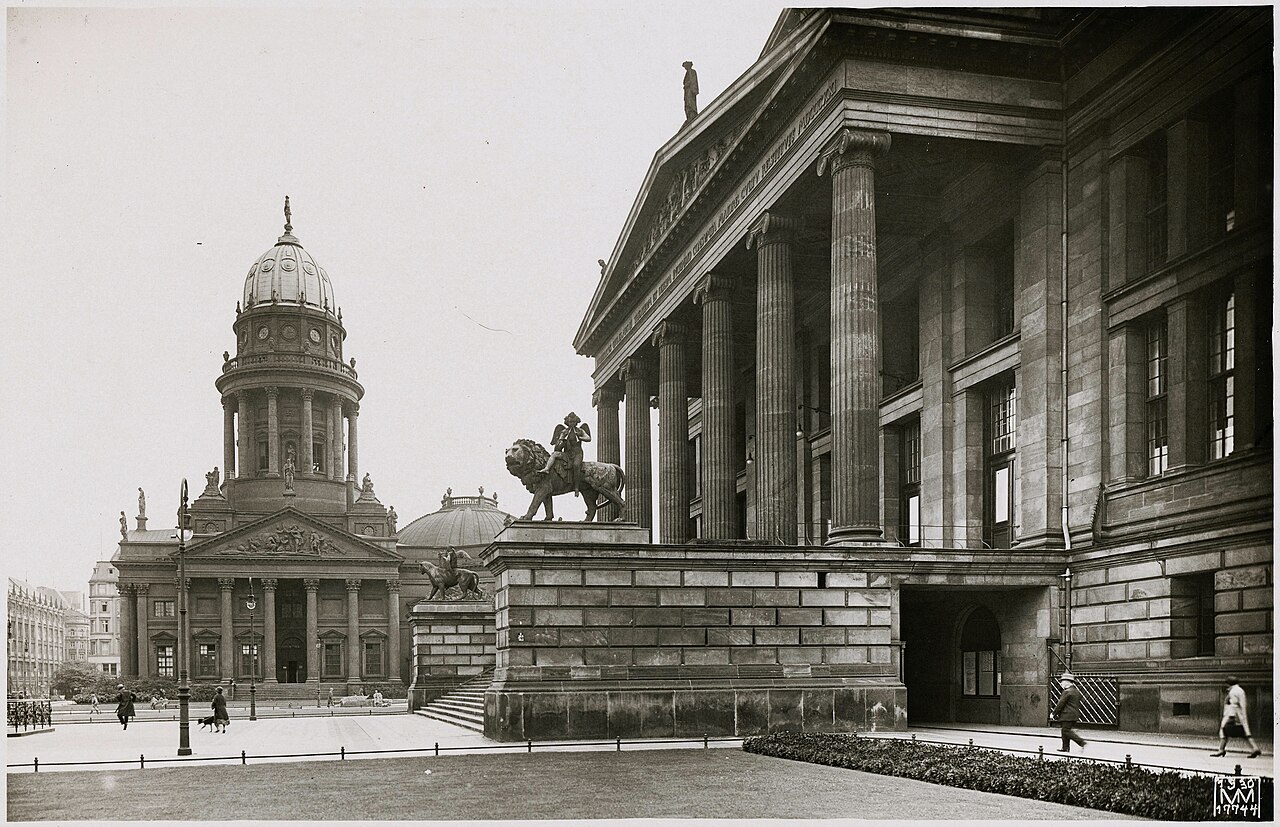
Gendarmenmarkt lay well inside the city, between the French and German churches and a short distance south of Unter den Linden. A concert there on the 22nd therefore took place before the main battle had reached the square itself, but with a shrinking belt of defended streets between the centre and the advancing Red Army. Residents who had already endured years of air raids now faced the prospect of fighting in their neighbourhoods. Public transport, supplies and ordinary movement were increasingly uncertain. For the military sequence, the Battle of Berlin 1945 follows the Soviet entry, encirclement and final German surrender.
The contrast between the fighting and the concert is stark enough without reconstructed dialogue or invented scenes in the audience. The published institutional record supplies the date and some of the music, but it gives no dependable attendance figure, complete list of performers or description of the atmosphere inside the room. Whether the audience could hear particular guns, how long the concert lasted, and how the musicians left the building remain unanswered questions. The few details that survive are more valuable when their limits are respected.
What Was Performed at the Schauspielhaus?
The Konzerthaus Berlin’s historical exhibition identifies 20 and 22 April as the dates of the final concerts. It names excerpts from Tosca and The Barber of Seville, without supplying a complete programme for each evening. Theatre historian Ruth Freydank, writing in Berlinische Monatsschrift, records a somewhat fuller succession of performances. According to her account, musicians from the Staatskapelle gave an opera concert on the evening of 15 April; another opera concert took place at the Schauspielhaus on 19 April; a chamber concert followed on 20 April; and the final concert was held on 22 April.
The distinction between these sources is useful. The institution’s exhibition preserves the final dates and repertoire examples. Freydank places those dates within a continuing programme of opera excerpts, instrumental music and readings that had survived the closure of regular theatrical performances. Taken together, they show a series of shrinking cultural activities rather than a specially organised farewell. There is no secure basis for assigning the two named operas to particular performers on the last evening or for describing an intentional final gesture by the organisers.
One practical explanation for the form of these late performances lies in the building itself. A concert or literary reading could be mounted with fewer personnel and simpler technical arrangements than a staged drama requiring scenery, lighting, costume departments and long rehearsals. Even so, bringing musicians and listeners together in April 1945 required a usable part of the building and enough transport, power and local security for an event to proceed. As those conditions disappeared in one district after another, public musical life contracted unevenly across Berlin.
The Theatre That Had Stood on Gendarmenmarkt Since 1821
The Schauspielhaus had been one of Berlin’s principal stages for more than a century. Karl Friedrich Schinkel designed it after the earlier Nationaltheater on the site burned in 1817. The new royal theatre opened on 26 May 1821, its monumental façade standing between the two domed churches that define Gendarmenmarkt. A month later Carl Maria von Weber’s Der Freischütz received its premiere there. Drama, opera and orchestral music became part of the building’s public identity long before its twentieth-century history.
That association with public life extended beyond performance. During the revolution of 1848, the Prussian National Assembly met in the theatre, placing a parliamentary gathering inside a building designed for the royal stage. After the First World War, the Schauspielhaus became the Prussian State Theatre. Under Leopold Jessner, productions during the Weimar Republic employed stark settings and politically charged interpretations of classical plays. Berlin audiences encountered arguments about power and authority on the same stage where earlier generations had seen court theatre.

Under National Socialism the institution’s place in Berlin culture changed through appointments, censorship and political control. Franz Ulbrich and the Nazi dramatist Hanns Johst assumed responsibility for the Schauspielhaus in 1933. In 1934 Hermann Göring appointed Gustaf Gründgens to head the Prussian State Theatre. Gründgens maintained a prominent ensemble and staged acclaimed productions, including Faust, while occupying a position granted by the Nazi state. His ability to assist certain colleagues existed alongside the privileges and compromises of his office.
The same administration that enabled performances excluded artists and authors for political and racial reasons. Repertoire, employment and the movement of cultural personnel were matters of state policy. These conditions form part of the setting of the April concerts. Their continuation tells us that a particular institution was still functioning; the motives of performers and audience members cannot be recovered from that fact alone.
From Regular Theatre to Readings and Concerts
Air attacks steadily reduced what the Schauspielhaus could stage. Bombing in 1943 destroyed its south wing, including the concert hall. Further damage in 1944 left parts of the complex unusable, though repairs permitted some performances to continue. The institution survived by adapting its programme to the spaces and resources still available. Buildings across central Berlin were suffering similar damage, and theatres increasingly worked with reduced staff and unreliable supplies of materials, gas and electricity.
Gründgens’s last production at the theatre was Schiller’s The Robbers, staged on 29 June 1944. The larger interruption came soon afterwards. Joseph Goebbels’s measures for total war required German theatres to close from 1 September 1944, freeing employees for the armed forces and war industries. The order effectively ended Berlin’s normal theatre season. Certain concerts and readings nevertheless continued under exceptional arrangements, especially at institutions that retained musicians or usable rooms.
Freydank describes scenes from Goethe’s Faust, Schiller’s The Robbers and Shakespeare’s Hamlet being read at the Schauspielhaus after regular productions ceased. Concerts resumed more systematically in February 1945. That sequence explains how the building could host music during the Battle of Berlin even though theatres had formally closed seven months earlier. The April performances represented the remnant of an institution pared down by bombing, mobilisation and political orders.
The continuation had political significance without revealing a single political intention. Nazi authorities had long treated cultural activity as evidence of national endurance. Performers also had professional obligations and working relationships that predated the dictatorship. Listeners might seek familiar music, shelter from anxiety or a brief change from wartime routines. The sources at hand identify neither an act of collective defiance nor a unified audience sentiment. Such claims would require diaries, correspondence or testimony tied to those particular concerts.
The Square Outside the Theatre
By the spring of 1945 Gendarmenmarkt looked very different from the spacious civic square photographed before the war. Bomb-damaged façades overlooked a city struggling to feed its inhabitants. The Konzerthaus’s own historical exhibition records that parts of the square were cultivated for food. Photographs of the wartime and immediate postwar period show how the ground around its major buildings was used and altered. The square that had once served as a setting for promenades and ceremonies was also being pressed into the work of survival.
The crisis was the outcome of years of air war followed by a land offensive. Damaged transport and utilities constrained the movement of food and fuel. Civilians spent nights in shelters and cellars, collected water and moved between neighbourhoods under the threat of attack. People arriving at a concert in central Berlin brought those conditions with them, whatever their individual reasons for attending. For the wider destruction of housing and urban infrastructure, the site’s Bombing of Cities history provides the longer wartime frame.
On 25 April Soviet forces completed the encirclement of Berlin. The main struggle then concentrated inside the shrinking defensive perimeter. German authorities continued issuing orders even as units were cut off, and civilians became trapped among fighting positions, damaged buildings and improvised barricades. Hitler died on 30 April. The city surrendered on 2 May. Those dates are the known military boundaries of the last Schauspielhaus concerts: the final performance preceded encirclement by three days and the surrender by ten.
The approach of the fighting also helps explain why the archive is fragmentary. The theatre’s final programme took place amid a breakdown of administration, communications and preservation. Records that could have established exact performers, audiences and repertoire were at risk both during the battle and in the fire that followed. What survives is a partial record of cultural life inside a much more extensively documented military catastrophe.
The Berlin Philharmonic’s Last Concert Was on 16 April
Berlin’s best-known orchestra has a separate final wartime concert in its history. The Berliner Philharmoniker identifies 16 April 1945 as its last performance before Soviet troops captured the capital. By then the orchestra’s former Philharmonie hall had been destroyed, and the musicians had performed at substitute venues while continuing some official concerts for the military and armaments industry. They also faced possible mobilisation into the Volkssturm, the regime’s final militia.
The Philharmonic performance coincided with the opening of the Soviet offensive east of Berlin. The Schauspielhaus concerts continued later that week, after the enemy advance reached the city itself. The difference reflects the way artistic life ceased across the capital. Individual orchestras, ensembles and venues continued only while their particular circumstances allowed. Berlin had no single concert at which its cultural life formally ended.
The two histories have often been pulled together in accounts of a final musical performance before Berlin’s fall. Keeping their dates and institutions separate restores the actual sequence. The Philharmonic’s last wartime concert took place on 16 April; the Schauspielhaus on Gendarmenmarkt held its final documented concert on 22 April. The latter belonged to a damaged state theatre rather than to the Philharmonic’s own institutional programme.
The Fire That Destroyed the Schauspielhaus
The final concert was followed by the destruction of the building’s remaining interior. The theatre had already suffered major bomb damage, but the decisive loss came in a fire during the last phase of the war. The auditorium burned, and irreplaceable parts of the collections and archives were destroyed. Thick exterior walls survived. After the fighting, the recognisable façade stood above ruined interior spaces on a devastated Gendarmenmarkt.
The origin of that fire requires care. A historical exhibition published by Konzerthaus Berlin attributes an act of arson in May 1945 to SS units. An archival overview from the Prussian State Archives describes a deliberately set fire and the resulting destruction of collections, without identifying the perpetrators. The Konzerthaus’s current public chronology says the cause of the devastating fire can no longer be traced. These accounts support the destruction and loss of the collections securely, while leaving responsibility for the final blaze less securely established than the exhibition’s categorical wording suggests.
The uncertainty matters partly because destruction had occurred in stages. The southern wing was lost in bombing in 1943. Subsequent damage and repairs altered the available performance space. Street fighting and the fire of 1945 completed the ruin. A single photograph of the gutted building records the result of that process, while the documentary history shows how its usefulness had already contracted long before the final concert.
The fire also destroyed evidence of the institution itself. Production records, programmes and other materials might have clarified its last wartime months. The loss is especially acute for April 1945, when published institutional histories preserve the dates of performances but leave much of their human detail unidentified. The surviving account can name the final day; it cannot supply a precise reconstruction of everything that happened inside the hall.

Music Returned to Gendarmenmarkt Before the Building Did
In the first years after the war the ruined theatre remained a conspicuous part of the square. The destruction was still present in the lives of nearby residents, who passed the remains of public buildings while reconstruction proceeded unevenly across Berlin. Photographs from the late 1940s show children playing on rubble at Gendarmenmarkt. Their setting was a postwar city, with food and housing shortages continuing after the end of military operations.

Public music returned to the square before the Schauspielhaus was rebuilt. On 18 August 1948 the Soviet Alexandrov Ensemble performed on Gendarmenmarkt. The Konzerthaus’s account gives an audience of around 35,000, gathered among the ruined theatre and churches to hear Russian and German songs. In three years the political setting had changed completely. Berlin was under Allied occupation, and the square lay in the Soviet sector. Music again gathered a crowd, now under the authority of the power whose army had captured the city.
The theatre remained a shell for decades. Plans for reconstruction moved slowly until the East German authorities undertook a major programme for the square in the 1970s. Work on the Schauspielhaus began in 1977 under an architectural team including Ehrhardt Gißke, Klaus Just and Manfred Prasser. The exterior was reconstructed with reference to Schinkel’s design, while the interior was redesigned for concerts. The building’s original theatrical spaces were replaced by new halls suited to orchestral performance.
On 1 October 1984 the Berlin Symphony Orchestra inaugurated the rebuilt Schauspielhaus. The programme included Weber’s Freischütz overture, recalling the opera first performed in Schinkel’s original building in 1821. In 1994 the institution adopted the name Konzerthaus Berlin. The present concert hall preserves the site and architectural identity of the Schauspielhaus, but the auditorium in which people gathered in April 1945 was lost in the war.

Its last concerts survive chiefly as dates in institutional histories: 20 April, 22 April, a few named excerpts, and the report of related performances in the days before them. Around those sparse entries stands a better-documented history of administrative control, air raids, the September 1944 closure order and the Soviet advance into Berlin. On 22 April the city still contained a functioning fragment of its old theatrical life. Within days the battle ended that fragment, and the fire destroyed much of the evidence it had left behind.
Sources
- Konzerthaus Berlin, History of the Konzerthaus Berlin up to 1945 — final concert dates, repertoire excerpts and exhibition account of the fire.
- Konzerthaus Berlin, History — wartime damage, qualified fire attribution and reconstruction.
- Ruth Freydank, Glanz und Elend der Theatermetropole, Berlinische Monatsschrift — theatrical administration, closure and late-April concert sequence.
- Geheimes Staatsarchiv Preußischer Kulturbesitz, inventory introduction to Prussian theatre administration — the closure, residual concerts and loss of archival collections.
- Bundesarchiv, Lagekarte zur Schlacht um Berlin — Soviet offensive and artillery reaching Berlin in April 1945.
- Museum Berlin-Karlshorst, The German Surrender in May 1945 — Soviet entry into Berlin and the city’s surrender.
- Berliner Philharmoniker, Times of Crisis — the orchestra’s separate final wartime concert on 16 April.
- Konzerthaus Berlin, Then and Now — the ruins and rebuilding of the venue as a concert hall.