Hill 493 was a real place in the Hürtgen fighting, but the battle attached to the name in Call of Duty: WWII belongs to a different chronology. The game sets its Hill 493 mission on 14 November 1944 and follows soldiers of the U.S. 1st Infantry Division as they climb through German machine-gun positions, destroy artillery and fight a Tiger II. The U.S. Army’s own operational history places the capture of the real Hill 493 almost three months later, on 7 February 1945, outside the village of Schmidt.
That difference is more interesting than a simple game-versus-history correction. The mission pulls together several genuine parts of the Hürtgen campaign: the 1st Infantry Division’s November fighting, the forest’s bunkers and mines, the disastrous earlier struggle for Schmidt, and the kind of hill assault associated with the 2nd Ranger Battalion at Hill 400 in December. Hill 493 itself belonged to the final American drive through Schmidt toward the Roer dams.
The result is a convincing Hürtgen Forest atmosphere built from events that happened at different places and on different dates. The archival story of Hill 493 is shorter than the game version, but it connects directly to one of the most important operational problems on the Western Front: German control of dams that could flood the Roer River and delay the Allied advance into Germany.
The Hill 493 Most People Know Comes From Call of Duty
Call of Duty: WWII introduced Hill 493 to a much larger audience than any wartime map or regimental history ever did. In the campaign, the mission follows “Death Factory” on 14 November 1944. The player, as Ronald “Red” Daniels, moves uphill with Lieutenant Turner’s platoon after Sergeant Pierson has gone forward with other men. The assault passes machine-gun positions and a bunker, reaches German artillery, and ends with an encounter against a Tiger II.
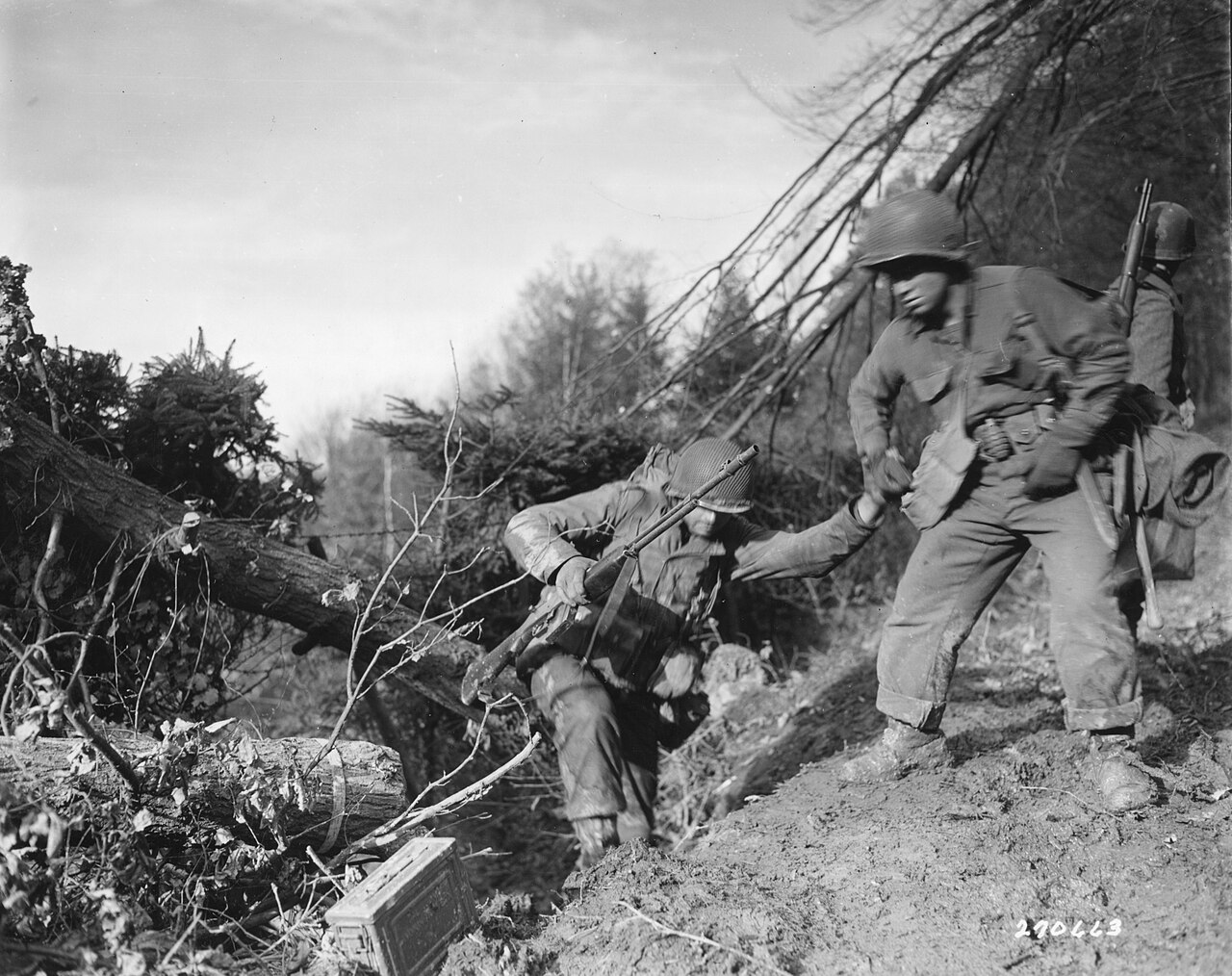
The game identifies the unit as part of the 1st Infantry Division and places the action in the Hürtgen Forest. Both choices have a historical foundation. The 1st Infantry Division really did fight in the Hürtgen sector in November 1944. Its records describe dense woods, mud, mines, fortified towns, tree bursts from German artillery and terrain that restricted support weapons. Those conditions are among the strongest historical elements in the mission.
The date is where the reconstruction begins to separate from the record. The 1st Infantry Division moved into the Stolberg area on 10 November. Heavy rain delayed its planned offensive until 16 November. On 14 November—the date shown in the game—the division was preparing for the attack rather than storming the real Hill 493 near Schmidt.
Elsewhere in the Hürtgen, however, 14 November was a real transition date. The 2nd Ranger Battalion entered the forest that day to relieve elements of the battered 28th Infantry Division in the Vossenack sector. That does not make the game’s Hill 493 assault a Ranger battle. It shows how closely the fictional mission sits beside several real episodes without matching any one of them.
Schmidt Had Already Become a Dangerous Objective
The ground around Hill 493 makes more sense when the earlier battle for Schmidt is included. On 2 November 1944, the 28th Infantry Division opened an attack through the Hürtgen. The 112th Infantry Regiment pushed through Vossenack and crossed the steep Kall valley toward Schmidt. American troops entered the village on 3 November, an early success that soon exposed how difficult the position was to sustain.

The supply route ran across the Kall trail, a narrow, twisting track descending into a ravine and climbing toward Kommerscheidt and Schmidt. Mud, mines, wrecked vehicles and German fire made movement difficult. Tanks could not simply flow forward behind the infantry. Communications broke down, units became separated, and the weather limited air support.
German forces counterattacked on 4 November with armour and infantry. Schmidt was lost. Fighting continued around Kommerscheidt and Vossenack while engineers struggled to keep the Kall route open. By 8 November the exposed American force east of the Kall was withdrawing. The 28th Division suffered more than 6,000 battle and non-battle casualties during and immediately after the operation, according to the U.S. Army’s detailed study of the battle.
This November defeat explains why names such as Schmidt, Kommerscheidt and the Kall valley recur in accounts of the Hürtgen. The Americans had reached Schmidt once and had been driven out. When troops returned in February 1945, they were crossing ground already marked by abandoned positions, shell holes and the memory of the earlier battle.
Our full Aachen and the Hürtgen Forest campaign follows the fighting from the West Wall and Aachen through Schmidt and the eventual capture of the Roer dam system.
Hill 400 and Hill 493 Were Different Battles
Another source of confusion is Hill 400, the Burgberg above Bergstein. It was a separate height several kilometres from Schmidt and became the scene of one of the best-known Ranger actions of the campaign.
On the night of 6–7 December 1944, the 2nd Ranger Battalion moved into Bergstein. At dawn, Companies D, E and F assaulted Hill 400. The position gave German observers a commanding view over the Roer valley, making it valuable as an artillery observation point. The Rangers captured the summit and then held it through repeated German counterattacks and intense artillery and mortar fire. The battalion’s wartime medical history records five counterattacks during roughly forty hours on the hill.
The resemblance to the kind of dramatic hill assault shown in the game has encouraged the two names to be mixed together in later retellings. They belong to separate actions. Hill 400 was the Ranger objective at Bergstein on 7 December 1944. Hill 493 was west of Schmidt and appears in the U.S. Army account of the 78th Infantry Division’s attack on 7 February 1945.
By the time the Rangers fought for Hill 400, the 1st Infantry Division’s November offensive had already ended and the wider campaign was about to be interrupted by the German Ardennes offensive. The Battle of the Bulge, beginning on 16 December, shifted formations and attention away from the Roer dam problem for several weeks.
The Real Hill 493 Stood on the Approach to Schmidt
In February 1945, Hill 493 mattered because of the road. The official U.S. Army history describes Schmidt as lying on the eastern slopes of a high mass of ground. The practical approach from the southwest followed a crest road through more than a mile of dense evergreen forest. Once the road emerged from the trees, it crossed open fields, climbed Hill 493 and then descended into Schmidt.
That geography gave the hill tactical importance without turning it into an isolated fortress. A force holding the crest could observe and fire on movement toward the village. A force taking it gained a position from which infantry and tanks could attempt the exposed crossing into Schmidt. Behind the village lay the routes toward Hasenfeld and the Schwammenauel dam.
The dam had become the larger objective. Allied armies wanted to cross the Roer and continue toward the Rhine, but the reservoir system upstream gave the Germans the ability to manipulate the river. Releasing water could raise the Roer, increase its current and turn a planned crossing into a dangerous engineering problem. First Army could not treat the dams as a secondary feature once that threat was understood.

In late January, the U.S. 78th Infantry Division renewed the push in the Monschau corridor. The division’s immediate attacks cleared positions that would support the drive on Schmidt and the dams. On 5 February the 309th Infantry began moving through the West Wall pillbox belt toward Schmidt. Mines, road craters and poor routes slowed supporting weapons. Progress in the woods remained difficult even when German resistance was light.
The 310th Infantry Took Hill 493 on 7 February 1945
The attack that put Hill 493 into the official history began badly. On 6 February the 310th Infantry Regiment was pushed into a hurried night attack through unfamiliar woods. German troops allowed part of the leading force to move through their positions before opening fire on the following elements. Confusion spread, reports exaggerated the scale of the German counterattack, and the regiment ended the day having barely moved beyond its line of departure.
Major General Edwin P. Parker, commanding the 78th Division, committed all three infantry regiments on 7 February. The 309th would advance toward Kommerscheidt. The 311th would move from Woffelsbach toward Schmidt. The 310th was ordered along the main road to take Hill 493.
A half-hour artillery preparation opened the attack. The German 272nd Volksgrenadier Division had already pulled much of its force back during the night, leaving a smaller rear guard in the forward positions. That withdrawal changes the character of the real Hill 493 action considerably. The U.S. Army history does not describe a prolonged uphill battle against layer after layer of bunkers on the crest.
Men of the 310th, accompanied by tanks of the 744th Tank Battalion, advanced along the road and occupied Hill 493 by midmorning. The hill then became the jumping-off point for the next movement. A battalion of the 311th Infantry and a company of tanks came down the same road toward Schmidt and prepared to cross the open ground beyond the crest.
The leading tank had barely crossed Hill 493 when three armour-piercing rounds struck it and set it on fire. The other tanks pulled back toward the woods. The infantry reorganised and continued on foot under covering fire. By late afternoon American troops had reached the first houses of Schmidt, where fighting continued into the next day.
That sequence is the clearest surviving official account of the real Hill 493. There is armour, antitank fire, infantry moving under cover and a dangerous crest. There is no documented Tiger II duel at the hill in this account, and no stand-alone battle resembling the game mission. The German weapon that destroyed the leading American tank is identified through its armour-piercing fire, not as a Tiger II.
Why Hill 493 Mattered: The Roer Dams Were Behind It
Hill 493 was valuable because it sat inside a chain of objectives. The Americans needed Schmidt to open the way toward Hasenfeld and the Schwammenauel dam. The dam mattered because the downstream Roer stood between Allied forces and the next phase of the advance. Terrain that looks minor on a theatre map could therefore determine whether armour, bridging equipment and entire divisions could move on schedule.
On 8 February the 310th Infantry continued through Schmidt toward Hasenfeld while other elements of the division manoeuvred toward the dam. The operation was linked with attacks by neighbouring formations against the Urft and other parts of the reservoir system. German defenders could no longer hold the area indefinitely, but they still had time to interfere with the water controls.
Before losing the system, German troops opened or damaged outlets in a way that released water into the Roer. The resulting flood delayed the major Allied river crossing downstream. The dams were captured, yet the operational problem they represented did not disappear with the last German troops on the ground.
This is why Hill 493 makes little sense as an isolated heroic episode. It was one crest in the final phase of a campaign shaped by roads, wooded ridges, villages, fortified belts and water control. Taking the hill helped open Schmidt. Taking Schmidt helped open the route to the dam. Capturing the dam removed German control of the structure, but only after the river had already been affected.
What Call of Duty Gets Right About the Hürtgen
The mission’s chronology is compressed, but its physical language comes from the real campaign. Infantry in the Hürtgen repeatedly fought at short range through woods that restricted observation. Mines and wire canalised movement. German pillboxes and field positions covered roads and clearings. Artillery bursting in the trees sent fragments downward and made forest cover dangerous rather than reassuring.

Vehicles were forced onto a small number of usable routes, where mud, wrecks and mines could stop movement even before enemy fire did. Wounded men had to be carried over ground that ambulances could not reach. Rain, cold and exhaustion produced thousands of non-battle casualties alongside the killed and wounded. The 1st Infantry Division’s own medical records show how rapidly casualty admissions rose once its 16 November offensive began.
The game also gets something important right by making the forest feel disorienting. Companies could lose contact with neighbouring units over surprisingly short distances. A road bend, ravine or belt of trees could hide the next position completely. Commanders often knew less about the enemy a few hundred yards ahead than a modern player looking at a tactical map would expect.
Those conditions explain why the Hürtgen campaign has produced so many memorable small-unit stories. They also make it easy for later retellings to merge them. A bunker assault from one sector, a Ranger hill fight from another, a tank engagement from a third and the name of a real height can be assembled into a scene that feels historically precise even when the chronology no longer matches the records.
Game Mission and Historical Record
| Detail | Call of Duty: WWII | Historical record |
|---|---|---|
| Date | 14 November 1944 | Hill 493 was occupied by U.S. troops on 7 February 1945 |
| Main U.S. formation | 1st Infantry Division | 310th Infantry Regiment, 78th Infantry Division, with tanks of the 744th Tank Battalion |
| Location | Hürtgen Forest hill objective | High ground on the main road immediately west of Schmidt |
| Purpose | Assault the hill and destroy German positions and artillery | Secure the crest, support the renewed capture of Schmidt and open the route toward the Roer dams |
| German tank | A Tiger II forms a major part of the mission | The official account records German antitank fire knocking out a leading U.S. tank after it crossed the crest; it does not identify a Tiger II at Hill 493 |
| Famous Ranger hill battle | Often associated with the same Hürtgen imagery | Hill 400 at Bergstein was a separate 2nd Ranger Battalion action on 7 December 1944 |
Three Dates Explain the Real Story of Hill 493
The cleanest way to separate the history is to keep three dates in order.
14 November 1944: the date used by Call of Duty: WWII. The 1st Infantry Division was in the region preparing for an offensive that began on 16 November. The 2nd Ranger Battalion entered the Hürtgen that day to relieve troops in the Vossenack sector. The real Hill 493 action recorded outside Schmidt had not yet occurred.
7 December 1944: the 2nd Ranger Battalion attacked Hill 400 above Bergstein and held it against repeated counterattacks. This is the campaign’s famous Ranger hill fight and should not be renamed Hill 493.
7 February 1945: the 310th Infantry Regiment of the 78th Infantry Division, accompanied by tanks of the 744th Tank Battalion, occupied Hill 493 outside Schmidt by midmorning. Later that day, the 311th Infantry used the road and crest to support its move into Schmidt. The division then pushed toward the Schwammenauel dam.
The distinction does not make the game’s Hürtgen sequence worthless as history. It shows what historical fiction often does well and where it becomes unreliable. The uniforms, terrain, weapons and atmosphere can create a powerful sense of place while the narrative quietly moves units, dates and actions to serve a single character-driven campaign.
For the actual sequence, Hill 493 belongs near the end of the Aachen and the Hürtgen Forest campaign, after the Battle of the Bulge had interrupted operations and before Allied forces resumed their advance toward the Rhine. The wider sequence can be followed through our Western Front chronology.
Hill 493 carries a different kind of significance from the mission that made its name familiar. Its story is about the difficult recovery of ground lost three months earlier, the use of a wooded crest to reopen Schmidt, and a larger race for the dams controlling the Roer. The hill did not need a fictional tank duel to matter. Its position in the landscape was enough.
Sources and Further Reading
- Charles B. MacDonald, The Last Offensive, U.S. Army Center of Military History, especially Chapter IV, “The Roer River Dams.”
- Charles B. MacDonald and Sidney T. Mathews, Three Battles: Arnaville, Altuzzo, and Schmidt, U.S. Army Center of Military History.
- U.S. Army Medical Department, 1st Infantry Division history of the Hürtgen Forest fighting.
- U.S. Army Medical Department, 2nd Ranger Battalion wartime history.
- Call of Duty: WWII, “Death Factory” and “Hill 493,” Sledgehammer Games / Activision, 2017.
- WW2 Theatres, Aachen and the Hürtgen Forest.