The Battle of Britain and the Blitz are often folded into one story about Britain under German air attack in 1940. The dates overlap, many of the same aircraft appear in both, and London became a target while the Battle of Britain was still underway. That makes the confusion understandable.
The difference comes down to purpose, targets, and the kind of war being fought. During the Battle of Britain, Germany was trying to defeat RAF Fighter Command and gain control of the skies. Air superiority was considered essential before any serious attempt to invade southern England. During the Blitz, the Luftwaffe carried out sustained bombing against London and other British cities, ports, transport networks, and industrial centres. Civilian life became a central part of the battlefield.
| Question | Battle of Britain | The Blitz |
|---|---|---|
| When? | 10 July to 31 October 1940, using the official British dates | 7 September 1940 to May 1941 |
| Main German aim | Break RAF Fighter Command and gain air superiority | Damage cities, ports, industry, transport, supplies, and morale |
| Main targets | Shipping, airfields, radar, aircraft production, fighter defences, later London | London, docks, industrial cities, ports, railways, factories, and urban areas |
| British defence | Fighter Command, radar, Observer Corps, sector control, anti-aircraft guns | Night fighters, anti-aircraft guns, barrage balloons, shelters, fire services, civil defence |
| Where they overlap | 7 September to 31 October 1940 | |
What was the Battle of Britain?
The Battle of Britain grew directly from the collapse of France in June 1940. Britain remained at war after the evacuation from Dunkirk and the French armistice. Germany now faced the English Channel, with British territory beyond it and no negotiated settlement in sight.
Any invasion of southern England would have placed German troops and shipping under attack from the Royal Navy and RAF. The Luftwaffe therefore received a crucial task. It had to weaken or destroy Britain’s fighter defence and secure enough control of the air for an invasion to become possible.
The campaign developed in stages. Early attacks focused heavily on shipping in the Channel and coastal targets. By August, German raids increasingly struck RAF airfields, sector stations, radar sites, and aircraft-related facilities. Fighter Command was forced into repeated battles over southern England.
Britain’s defence depended on much more than Spitfires meeting Messerschmitts in open sky. Radar stations detected incoming formations. The Observer Corps tracked aircraft once they crossed the coast. Information moved through filter rooms and command centres. Sector stations then directed squadrons toward specific raids.
This system allowed Air Chief Marshal Hugh Dowding and his commanders to use limited fighter strength efficiently. Pilots could stay on the ground until needed. Squadrons could be sent toward real raids instead of wasting fuel on constant patrols.

The Hurricane carried much of Fighter Command’s fighting strength, while the Spitfire became its best-known symbol. Both faced Bf 109 fighters, Bf 110s, and German bombers. Damaged aircraft had to be repaired, airfields restored, ammunition supplied, and pilots kept flying.
Late August and early September created a genuine crisis. Several airfields and sector stations suffered heavy damage, while trained replacement pilots were scarce. German commanders still underestimated Fighter Command’s remaining strength.
What was the Blitz?
The Blitz was the sustained bombing of British towns and cities from September 1940 into May 1941. London was the first great focus. Other ports and industrial centres then came under repeated attack.
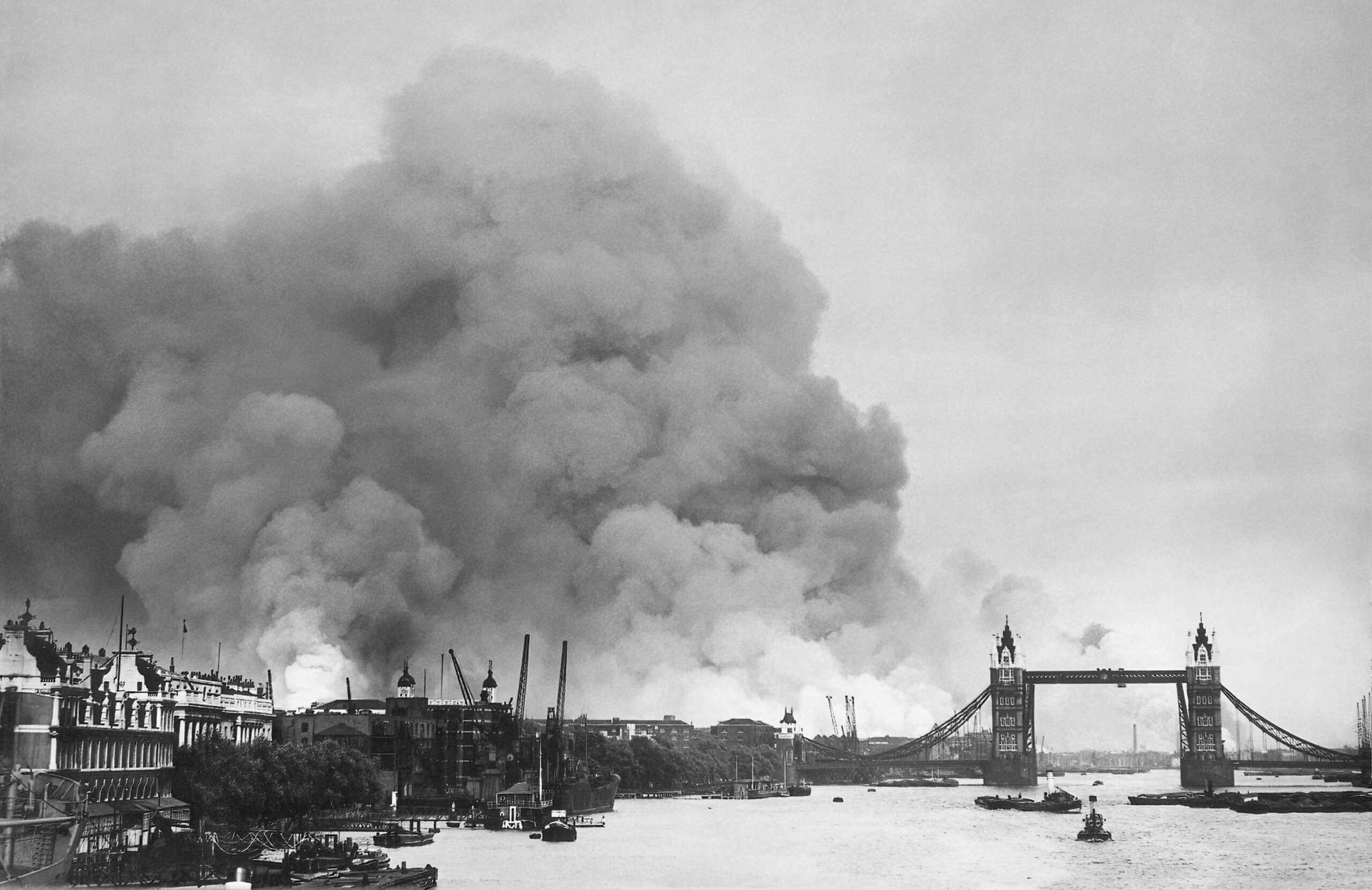
On 7 September 1940, large German formations attacked London’s docks and the surrounding East End. The Imperial War Museums records 430 people killed and around 1,600 injured that day. London then endured 57 consecutive nights of bombing.
The campaign soon reached far beyond the capital. Coventry suffered a devastating raid on 14 and 15 November. Birmingham, Bristol, Liverpool, Plymouth, Southampton, Manchester, Sheffield, Portsmouth, and other centres were attacked. Clydebank in Scotland was also hit heavily in March 1941.
German objectives varied by place and period. Ports, factories, railways, and warehouses supported Britain’s war effort. Urban bombing also placed direct pressure on civilians and national morale.
The Blitz therefore became a different kind of experience. The Battle of Britain is remembered through squadrons, radar rooms, airfields, contrails, and fighter combat. The Blitz is remembered through sirens, shelters, burning streets, rescue work, damaged homes, and nights spent underground.
By spring 1941, more than 40,000 people had been killed during the Blitz, according to the Imperial War Museums. The heaviest final attack on London came on the night of 10 and 11 May 1941. The Luftwaffe then shifted major resources eastward as Germany prepared to attack the Soviet Union.
Why are the Battle of Britain and the Blitz so often confused?
The confusion starts with the calendar. The Blitz began on 7 September. The official Battle of Britain did not end until 31 October. That creates an overlap of nearly two months.
The second reason is visual. The same German bomber types appear across both campaigns. Heinkel He 111s, Dornier Do 17s, and Junkers Ju 88s attacked British targets during the Battle of Britain and continued operating during the Blitz. Bf 109s also remained important during the daylight fighting over London.
Popular histories often move from Dunkirk to the Battle of Britain and directly into the Blitz. The events follow so closely that the boundary can disappear.
Historians still separate them because their main strategic problems differed. The Battle of Britain centred on air superiority and Fighter Command. The Blitz centred on sustained bombing of cities and the war economy.
Richard Overy has described them as separate campaigns within a longer German air offensive against Britain. That wider campaign is mapped in the Air War theatre. That framing explains both the connection and the distinction. There was continuity in aircraft, crews, bases, and German pressure. The operational emphasis changed as the summer campaign moved into autumn and winter.
Why does 7 September 1940 belong to both stories?
September 7 is the key date for understanding the overlap. The Luftwaffe launched a major attack on London that afternoon, concentrating heavily on the docks and East End. Fires continued into the night.
For the Blitz, the date is the beginning. For the Battle of Britain, it marks the start of a new phase. The RAF Museum dates its fourth phase from 7 September to 2 October, when large day and night attacks were directed against London.
German commanders believed Fighter Command had been weakened far more than it actually had. They hoped attacks on the capital would force remaining RAF fighters into battle and create another chance to destroy them.
That expectation failed. Fighter Command kept putting substantial numbers of aircraft into the sky. On 15 September, two major German attacks on London met strong RAF resistance. The date later became known as Battle of Britain Day.
Think of 7 September as the hinge. The fight for air superiority was still active, while the sustained bombing of London had begun. The Battle of Britain and the Blitz were now overlapping campaigns.

Did Germany start the Blitz because it had already lost the Battle of Britain?
The timing is more complicated. The Blitz began before the official end of the Battle of Britain. German leaders had not yet accepted the summer air campaign as finished on 7 September.
They still hoped Fighter Command could be forced into a decisive battle over London. They also wanted to hit docks, transport, industry, and the political centre of the country. The attack on London therefore served several purposes at once.
By late September, the invasion problem was becoming clearer. Germany had failed to gain the level of air superiority required for Operation Sea Lion. Hitler postponed the invasion on 17 September. Fighter Command remained capable of defending the airspace over southern England.
German tactics then continued to evolve. Large daylight bomber formations became harder to sustain against RAF resistance. Day raids increasingly relied on fighter-bombers, while heavy bombing shifted toward night operations.
By October, the Battle of Britain was moving toward its official end. The Blitz was expanding into the larger campaign people now associate with London at night and attacks on industrial cities.
Calling the Blitz a simple consequence of defeat misses this overlap. The bombing of cities began while the outcome of the daylight air battle was still being tested. The Luftwaffe then carried that bombing forward after its original invasion-related objective had failed.
Did the Luftwaffe simply stop attacking RAF airfields and start bombing civilians?
That familiar version is too clean. German target selection changed, yet the categories were never completely separate. London contained docks, railways, warehouses, factories, government offices, and dense residential districts. An attack on a strategic target could kill large numbers of civilians within the same raid.
RAF targets also remained relevant after 7 September. The Luftwaffe still wanted to reduce Fighter Command’s ability to interfere with German bombing. Aircraft factories and military facilities continued to matter.
The change did bring some relief to the most heavily pressured fighter stations in south-east England. That mattered to Fighter Command. It also forced RAF squadrons to defend London against large formations.
The idea that Fighter Command was hours from destruction before Germany suddenly abandoned a winning strategy goes further than the evidence supports. British units were under severe strain. German fighter and bomber forces were also taking heavy losses, and German intelligence repeatedly underestimated RAF strength.
Airfields could often be repaired quickly. Grass surfaces were difficult to close for long. Sector control facilities were more vulnerable, but the Luftwaffe did not fully understand how central those nodes were to the British system.
The German switch toward London changed the pressure on Fighter Command. It did not turn a certain German victory into defeat overnight.
Was the Battle of Britain only a fight between pilots?
The pilots were the most visible part of the battle, and their losses were severe. Their success depended on a large defensive machine across Britain.
Radar operators warned of incoming raids. Observer Corps posts reported aircraft movement inland. WAAF personnel worked in plotting rooms, telephone exchanges, radar sites, and sector stations. Ground crews rearmed and refuelled fighters. Engineers repaired damaged aircraft and airfields.
Anti-aircraft units, searchlight crews, barrage balloon operators, firefighters, police, medical staff, and civil defence organisations all contributed to the wider defence. The air battle and the home front were already connected before the Blitz became the dominant experience.
The RAF also drew on pilots from across the Commonwealth, occupied Europe, and other countries. Polish, Czechoslovak, Canadian, New Zealand, Australian, South African, Belgian, French, and other airmen fought alongside British pilots.
_Squadron_RAF_with_one_of_their_Hawker_Hurricanes,_October_1940._CH1535.jpg)
No. 303 Polish Squadron became one of the best-known examples. Its pilots entered the battle with combat experience gained in Poland and France. Their role also shows why the phrase “Britain stood alone” needs careful handling. Britain faced Germany without another major European ally fighting on the Western Front, yet its defence included people and resources from many countries.
How did civilians experience the difference?
For civilians, the boundary between campaigns could feel less clear than it does on a historian’s timeline. Air raid warnings, anti-aircraft fire, bomb damage, and aircraft overhead appeared before September. Coastal towns and communities near airfields had already experienced attacks.
The Blitz changed the scale and rhythm of danger. Night bombing made sleep uncertain for months. Families moved between homes and shelters. Underground stations, basements, public shelters, railway arches, and Anderson shelters became part of daily life.
Incendiary bombs could start hundreds of fires across a city. Fire watchers and fire brigades worked during raids while high explosives continued to fall.
London suffered most frequently, although the national story is much wider. Coventry, Liverpool, Plymouth, Birmingham, Bristol, Belfast, Clydebank, and many other places carried their own Blitz histories.

The familiar image of the Blitz as a story of universal calm also needs caution. People showed endurance, helped neighbours, fought fires, and kept services running. They also experienced fear, exhaustion, homelessness, bereavement, anger, and confusion. Some shelters were overcrowded. Bombing affected working-class districts particularly hard in several cities.
“Blitz spirit” became a powerful national phrase, but the real civilian experience was more uneven and more difficult than the slogan suggests.
When did the Battle of Britain end, and when did the Blitz end?
Britain officially recognises 31 October 1940 as the end of the Battle of Britain. The date marks the close of the period in which Fighter Command fought the Luftwaffe’s main daylight effort for air superiority over Britain.
Air attacks did not stop on 1 November. The war in the air continued, and the Blitz was already well established. German bombers increasingly operated at night, where British fighter interception was much more difficult during late 1940.
The Blitz continued through the winter and into spring 1941. The most destructive raid on London came on 10 and 11 May 1941. German aircraft dropped hundreds of tons of high explosive and tens of thousands of incendiaries. More than 1,400 people were killed in that raid.
After May, the sustained campaign declined sharply. Germany was preparing Operation Barbarossa against the Soviet Union and moved major Luftwaffe resources east. Britain continued to suffer German air attacks later in the war, including renewed bombing and the V-1 and V-2 campaigns of 1944 and 1945.
Which campaign mattered more strategically?
The question works better when the two campaigns are judged by their different objectives.
The Battle of Britain had an immediate military result. Germany failed to defeat Fighter Command or gain the air superiority needed for a credible invasion attempt in 1940. Britain remained a secure base for continued war against Germany.
The Blitz caused immense destruction and civilian loss. It damaged ports, factories, transport, housing, and urban infrastructure. It failed to force Britain out of the war or destroy its ability to continue fighting.
The strategic connection still matters. Germany entered the Battle of Britain seeking a way to remove Britain as an active enemy. The Luftwaffe failed to secure the skies, then continued the offensive against cities and economic targets.
By May 1941, Fighter Command remained operational, the government stayed in the war, and British industry still functioned despite serious damage. German military attention was shifting toward the Soviet Union.
So, are the Battle of Britain and the Blitz the same?
The Battle of Britain and the Blitz should be understood as connected campaigns with a substantial overlap. Their official timelines cross from 7 September through 31 October 1940.
The Battle of Britain was primarily a contest for air superiority. Fighter Command’s survival blocked Germany from achieving the control of the skies required for an invasion. The Blitz was a sustained bombing campaign against London and other British cities, ports, industries, and transport networks.
September 1940 sits in the middle of both stories. RAF fighters were still meeting German formations by day while Londoners were beginning weeks of repeated bombing. The German air offensive had changed shape before the earlier campaign had formally ended.
The Opening Campaigns timeline places the Battle of Britain after the Fall of France, while the Air War timeline follows the Blitz into the wider bombing campaign. Keeping the names separate makes the chronology easier to understand. It also shows how quickly the war moved from a struggle over airfields and fighter strength into a prolonged assault on Britain’s cities and civilian population.
Frequently asked questions
Which came first, the Battle of Britain or the Blitz?
The Battle of Britain came first. Its official British dates begin on 10 July 1940. The Blitz began on 7 September 1940, while the Battle of Britain was still underway.
Was the Blitz part of the Battle of Britain?
The opening phase of the Blitz overlapped with the final weeks of the Battle of Britain. Historians usually treat the two as separate campaigns because their main aims and methods differed.
Did the Battle of Britain continue after London was bombed?
It did. Large attacks on London began on 7 September 1940. The official Battle of Britain continued until 31 October, with major daylight fighting still taking place in September.
Why did Germany bomb London during the Battle of Britain?
German leaders wanted to hit docks, transport, industry, government, and morale. They also expected attacks on London to draw RAF fighters into another large battle.
Did the Blitz end German bombing of Britain?
German bombing continued after May 1941 at lower intensity. Britain later faced renewed raids, the V-1 flying bomb, and V-2 rocket attacks.
Sources and further reading
- Imperial War Museums: Battle of Britain
- Imperial War Museums: The Blitz Around Britain
- Imperial War Museums: 8 Things You Need to Know About the Battle of Britain
- RAF Museum: Introduction to the Phases of the Battle of Britain
- RAF Museum: Battle of Britain Phase Four
- RAF Museum: The Blitz, The Hardest Night
- Richard Overy, Oxford Bibliographies: Battle of Britain and the Blitz
- The National Archives: Home Front 1939–1945