
The Mediterranean, North Africa and Italy
10 June 1940 to 2 May 1945 · North Africa, the central Mediterranean and Italy · Eleven campaign and operation pages
Italy entered the war in June 1940, opening a struggle over Egypt, Malta and the shipping routes to Libya. British and Commonwealth forces fought successive campaigns across Cyrenaica; the Anglo-American landings in Morocco and Algeria in November 1942 opened a second Allied front in North Africa. The defeat of Axis forces in Tunisia was followed by Allied landings in Sicily and mainland Italy. German defences across rivers, mountain passes and narrow valleys slowed the advance north until the surrender in May 1945.
S. J. Beadell, Royal Navy official photographer · Imperial War Museums A 6333 · Public domain (UK Government)
- SPAN
- 10 Jun 1940 to 2 May 1945From Italy’s entry into the war to the surrender of Axis forces in Italy
- OPERATION COMPASS
- About 130,000 prisonersItalian and Libyan troops captured during the British offensive of December 1940 to February 1941
- OPERATION PEDESTAL
- 5 of 14 merchant shipsReached Malta in August 1942; about 30,000 tons of cargo arrived, including fuel carried by the damaged tanker Ohio
- TUNISIA, MAY 1943
- About a quarter-million Axis prisonersPublished totals vary by counting boundary, commonly ranging from roughly 240,000 to 275,000
- ITALIAN CAMPAIGN
- About 313,000 Allied casualtiesAgainst about 336,000 German casualties in the National Army Museum accounting; totals vary by definition and date range
How Mediterranean Ports and Airfields Controlled the Campaigns
Ports, shipping and airfields determined how far armies could moveFighting in Egypt, Libya, Malta, Tunisia, Sicily and Italy depended on the same sea routes, ports and airfields. Britain’s position in Egypt protected the Suez Canal and routes toward the Middle East; Malta lay across the sea lanes between Italy and Libya; the ports of Alexandria, Tobruk, Benghazi and Tripoli determined how much fuel, ammunition and food could reach armies in the desert. Airfields on both shores extended or restricted naval movement, while every advance inland lengthened the attacker’s road haul from the nearest usable port.
That logistics geometry helped produce the repeated swings across Cyrenaica. An army advancing west from Egypt moved farther from Alexandria while its opponent fell back toward Benghazi or Tripoli; the same relationship reversed when the Axis advanced east. Tactical victories therefore had to be converted into ports, road capacity and protected shipping before they could be sustained. Malta’s aircraft and submarines threatened Axis traffic, while Axis bombing and naval pressure tried to suppress the island and starve it of fuel and food.
The strategic balance changed in late 1942. The Eighth Army broke the Axis position at El Alamein while Anglo-American forces landed in Morocco and Algeria. German and Italian forces rushed into Tunisia and prolonged the campaign for six months, but by May 1943 the Axis had lost North Africa and the Allies possessed bases from Morocco to Egypt. Sicily followed in July, placing the Italian government under direct military pressure and opening the route to the mainland.
Italy turned the problem from desert mobility into attrition across mountains, rivers and narrow coastal corridors. German forces built successive defensive systems from the Volturno and Gustav lines to the Gothic Line, using terrain to trade space for time. Allied air and naval superiority made amphibious moves such as Salerno and Anzio possible, but neither removed the need to fight through defended ground. The campaign continued until the surrender signed at Caserta took effect on 2 May 1945.
How the War Moved from Libya to Tunisia and Italy
The Mediterranean campaigns from June 1940 to May 1945The Mediterranean fighting began with the defence of Malta and the opposing armies moving between Egypt and Libya. Operation Compass drove Italian forces across Cyrenaica during the winter of 1940–41. Rommel’s arrival transformed the desert war, and the siege of Tobruk, Operation Crusader and the Gazala offensive repeatedly shifted the front as each army approached the limits of its transport and supply. The Eighth Army defeated Rommel’s forces at El Alamein in November 1942 while Anglo-American troops landed in Morocco and Algeria. Both advances converged on the Axis position in Tunisia.
The Allied capture of Tunisia in May 1943 secured the southern Mediterranean approaches. The invasion of Sicily followed in July, and landings at Salerno in September brought the campaign onto the Italian mainland. German forces defended successive mountain and river positions; battles at Monte Cassino and Anzio were followed by fighting north of Rome towards the Gothic Line. From bases in Italy, Allied aircrews also flew missions into occupied Yugoslavia, including the rescue of downed personnel in Operation Halyard. The war in Italy ended with the surrender effective on 2 May 1945.
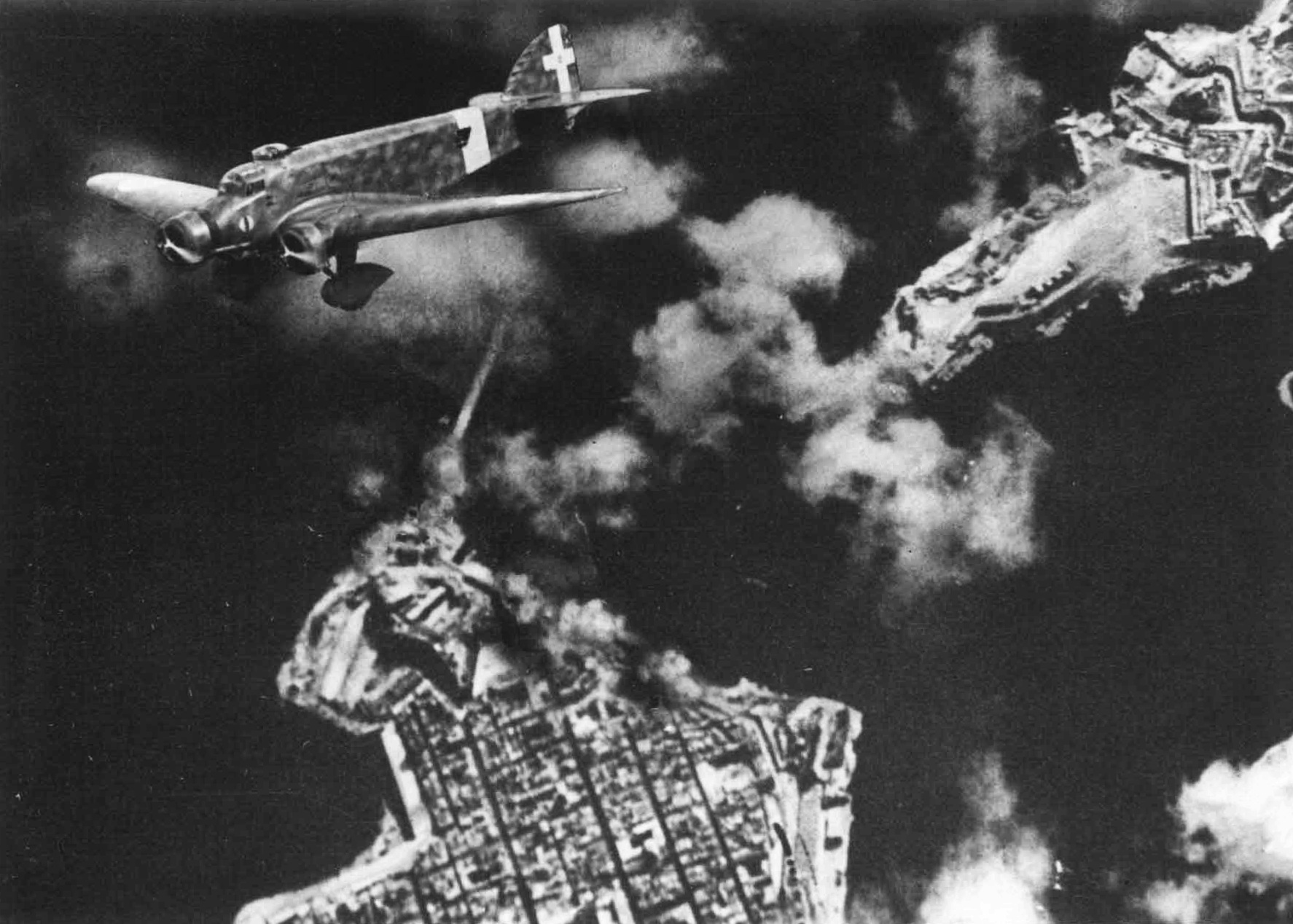
Malta: Air Siege and Convoy War
Italy entered the war on 10 June 1940, and Malta was attacked from the following day. The island’s Grand Harbour, dockyard and airfields sat across the routes between Italy and Libya, giving British aircraft, submarines and surface forces a base from which to threaten Axis supply traffic. The same position left Malta dependent on convoys for food, fuel, ammunition and replacement aircraft.
Axis pressure peaked in 1942 as bombing and attacks on shipping reduced stocks to critical levels. Operation Pedestal in August sent fourteen merchant ships toward the island; five reached Malta, including the damaged tanker Ohio, delivering about 30,000 tons of cargo. Pedestal prevented an immediate supply collapse, while the successful Stoneage convoy in November and the changing air situation after El Alamein ended the period of acute isolation.

Operation Compass
Operation Compass opened on 9 December 1940 as a limited British attack against Italian fortified camps around Sidi Barrani. The camps were separated by wide gaps, and the Western Desert Force used surprise, armour and mobile columns to break into them before the Italian command could create a continuous defence.
The local success became a pursuit through Bardia, Tobruk and across Cyrenaica to Beda Fomm. Roughly 130,000 Italian and Libyan troops were captured. The advance stopped around El Agheila as transport and supply were stretched and British forces were diverted to Greece; German intervention in Libya followed in early 1941.

Tobruk and Operation Crusader
Rommel’s first counter-offensive began in late March 1941 and rapidly recovered most of Cyrenaica, but Tobruk remained an Allied-held port behind the Axis front. Its garrison forced Axis traffic onto longer road routes around the perimeter and was sustained by repeated Royal Navy supply runs across the Mediterranean.
British attempts to relieve the port in Operations Brevity and Battleaxe failed. Operation Crusader opened on 18 November with the aim of defeating Axis armour and reopening contact with Tobruk. Weeks of confused armoured fighting and infantry attacks eventually forced the Axis army to withdraw toward El Agheila, relieving the eight-month siege while exposing continuing British difficulties in coordinating armour, infantry and anti-tank fire.

Gazala and the Fall of Tobruk
The Axis offensive at Gazala began on 26 May 1942 with mobile forces sweeping around the southern end of the British minefields and fortified boxes. Fighting around Bir Hakeim and the area later called the Cauldron left Rommel temporarily dependent on a narrow supply corridor through the mine belt, while British commanders struggled to concentrate their armoured strength against it.
By mid-June the British armoured force had been badly reduced and the Gazala position could no longer be held. Tobruk was isolated and fell on 21 June with roughly 33,000 prisoners. The Axis advance continued into Egypt, but every mile east lengthened its supply route from Libyan ports and brought the army closer to the narrow defensive position at El Alamein.

El Alamein
The Second Battle of El Alamein opened at 21:40 on 23 October 1942 with a massed Eighth Army artillery bombardment, followed by an infantry attack through the Axis mine belts. The Mediterranean coast and the Qattara Depression fixed the limits of the battlefield; infantry and engineers had to create the passages through which British armour could move.
Montgomery continued the assault after the first tank corridors became congested. Australian attacks near the railway drew Axis reserves north while a New Zealand-led force opened Operation Supercharge on 1–2 November. On 4 November the German and Italian defence broke and Rommel ordered withdrawal, beginning the Eighth Army’s pursuit towards Libya.

Torch and Tunisia
Operation Torch put British and American forces ashore in French Morocco and Algeria on 8 November 1942. Allied planners could not know in advance how Vichy French commanders would respond; fighting ended after local political agreements, while German and Italian forces moved quickly into Tunisia and reached the approaches to Tunis before the Allies could secure the city.
The winter exposed weaknesses in Allied command, training and supply, most visibly during the fighting around Kasserine. By spring 1943 the Eighth Army was pressing from the east while the British First Army and U.S. II Corps attacked from the west. Tunis and Bizerte fell on 7 May, and the remaining Axis formations surrendered over the following days. Roughly a quarter-million prisoners were taken, with published totals varying according to the forces and dates counted.

Operation Husky, Sicily
Operation Husky landed British, Canadian and American armies across southern and southeastern Sicily on 10 July 1943. Bad weather disrupted parts of the airborne plan, but the beachheads held and Allied naval and air power sustained the advance inland. The invasion placed Axis territory under direct ground attack and forced the German command to prepare both the defence and evacuation of the island.
Mussolini was removed from office on 25 July while the campaign was still being fought. German and Italian forces then conducted an organised withdrawal across the Strait of Messina, evacuating more than 100,000 troops before resistance on Sicily ended on 17 August. The new Italian government had already opened secret armistice negotiations with the Allies.

The Armistice and the Landings in Italy
British forces crossed from Sicily into Calabria on 3 September 1943, the same day Italian representatives signed the armistice at Cassibile. Its public announcement on 8 September triggered a rapid German move to disarm Italian formations and occupy key positions. The main Allied landing at Salerno followed on 9 September, with a separate British landing at Taranto.
German counterattacks came close to splitting the Salerno beachhead before naval gunfire, air support and arriving reinforcements restored the position. The Allied armies then joined with the forces advancing from Calabria and entered Naples on 1 October. German troops withdrew toward prepared defensive lines farther north, establishing the pattern that would dominate the remainder of the Italian campaign.

Cassino and Anzio
The first Allied attacks against the Gustav Line began in January 1944 around the Garigliano, Rapido and Cassino sectors. The mountains channelled movement into a small number of valleys and roads that German artillery and infantry could cover. Operation Shingle landed at Anzio on 22 January to turn the position from the coast, but rapid German reinforcement contained the beachhead before it could sever the main routes south of Rome.
Four major battles developed around Cassino while the Anzio force remained under pressure. Before 15 February, German combat positions were concentrated around the monastery while the abbey itself remained outside the defensive works; the Allied bombing reduced it to ruins that later became part of the battlefield. Operation Diadem in May finally broke the Gustav Line, the Anzio force broke out, and Allied troops entered Rome on 4 June.

Operation Halyard
On the night of 2 August 1944 an OSS team parachuted into the Pranjani area to organise the evacuation of Allied airmen who had been shot down over occupied Yugoslavia. Villagers and forces loyal to Draža Mihailović had sheltered many of the airmen, while the Fifteenth Air Force could reach the area from bases in southern Italy. Improvised strips were enlarged for C-47 transports, and the first large evacuations flew to Bari on 9–10 August.
The mission shifted between rescue sites as the military and civil-war situation in Yugoslavia changed, with later flights using strips at Koceljeva and Boljanić. The final Halyard flights left on 27 December. U.S. Air Force commemorative accounts describe more than 500 Allied airmen rescued in the wider effort; narrower mission and loading accounts use lower totals. The rescue belongs within the wider Yugoslav war and the contested wartime record of the Chetnik movement.

The Gothic Line and the End in Italy
The Allied attack on the Gothic Line began in late August 1944, with the Eighth Army striking toward the Adriatic sector while the Fifth Army attacked through the central Apennines. Initial breaches forced German withdrawals, but mountain roads, prepared positions, rain and the cumulative losses of the Italian campaign prevented a rapid advance into the Po Valley before winter.
The front stabilised through the winter as both sides operated with reduced resources and Allied formations had also been transferred to the invasion of southern France. A renewed offensive in April 1945 broke the remaining German defensive system, crossed the Po and opened the northern plain. The surrender signed at Caserta took effect on 2 May, ending organised Axis resistance in Italy.
Coming soonWar Diaries, Naval Losses and Mediterranean Campaign Histories
British, American, German and Italian operational records, with wartime photographs of ships, troops and civiliansThe British official histories by Playfair, Molony and their collaborators trace command decisions and logistical problems through the North African and Italian campaigns. U.S. Army studies provide detailed records of Torch, Tunisia, Sicily and the advance through Italy. German documents at the Bundesarchiv and Italian Army records preserve the defensive orders, supply returns and formation histories needed to reconstruct the Axis side of the operations.
Naval logs and convoy records establish the costs and timing of moving supplies between European and North African ports. Air operations and civilian conditions appear in records held by Imperial War Museums, Heritage Malta and other archives. Dated photographs identify particular vehicles, places and events, while surviving war diaries and official accounts explain the decisions that those photographs alone cannot establish.
- The Mediterranean and Middle East, United Kingdom Military Series, six volumes, Playfair, Molony and othersHMSO
- Northwest Africa: Seizing the Initiative in the West, George F. Howe, 1957US Army Center of Military History
- Sicily and the Surrender of Italy, and Salerno to Cassino, Garland, Smyth and BlumensonUS Army Center of Military History
- German records of the Mediterranean theatre and Heeresgruppe CBundesarchiv, Militärarchiv Freiburg
- Italian army operational recordsUfficio Storico dello Stato Maggiore dell'Esercito, Rome
- The siege of Malta, island records and the George CrossNational War Museum, Valletta
- The Commonwealth war dead of North Africa and ItalyCommonwealth War Graves Commission
- Photographic and film record of the Mediterranean campaignsImperial War Museums
- The Monte Cassino abbey and the bombing of 15 February 1944Abbey of Montecassino archive
- Openly licensed photographic material of the Mediterranean theatreWikimedia Commons
- The Italian CampaignNational Army Museum
- Operation Husky: The Largest Amphibious Invasion of the Second World WarImperial War Museums
- Operation Halyard commemorative and historical recordU.S. Air Forces in Europe – Air Forces Africa
- Operation Pedestal: Malta convoy commemorationUK Government / Ministry of Defence
- Salerno to Cassino, Martin BlumensonUS Army Center of Military History
- Cassino to the Alps, Ernest F. Fisher Jr.US Army Center of Military History
Operation chronologyDates, locations and sourced event summaries
| Date | Event | Location | Summary |
|---|---|---|---|
| 10 June 1940 to 20 November 1942 · 01 | Malta: Air Siege and Convoy War | Malta | Italy entered the war on 10 June 1940, and Malta was attacked from the following day. The island’s Grand Harbour, dockyard and airfields sat across the routes between Italy and Libya, giving British aircraft, submarines and surface forces a base from which to threaten Axis supply traffic. The same position left Malta dependent on convoys for food, fuel, ammunition and replacement aircraft. |
| 9 December 1940 to 9 February 1941 · 02 | Operation Compass | Egypt and Cyrenaica | Operation Compass opened on 9 December 1940 as a limited British attack against Italian fortified camps around Sidi Barrani. The camps were separated by wide gaps, and the Western Desert Force used surprise, armour and mobile columns to break into them before the Italian command could create a continuous defence. |
| 24 March to December 1941 · 03 | Tobruk and Operation Crusader | Cyrenaica and Tobruk | Rommel’s first counter-offensive began in late March 1941 and rapidly recovered most of Cyrenaica, but Tobruk remained an Allied-held port behind the Axis front. Its garrison forced Axis traffic onto longer road routes around the perimeter and was sustained by repeated Royal Navy supply runs across the Mediterranean. |
| 26 May to 21 June 1942 · 04 | Gazala and the Fall of Tobruk | Gazala and Tobruk | The Axis offensive at Gazala began on 26 May 1942 with mobile forces sweeping around the southern end of the British minefields and fortified boxes. Fighting around Bir Hakeim and the area later called the Cauldron left Rommel temporarily dependent on a narrow supply corridor through the mine belt, while British commanders struggled to concentrate their armoured strength against it. |
| 23 October to 4 November 1942 · 05 | El Alamein | El Alamein | The Second Battle of El Alamein opened at 21:40 on 23 October 1942 with a massed Eighth Army artillery bombardment, followed by an infantry attack through the Axis mine belts. The Mediterranean coast and the Qattara Depression fixed the limits of the battlefield; infantry and engineers had to create the passages through which British armour could move. |
| 8 November 1942 to 13 May 1943 · 06 | Torch and Tunisia | Morocco, Algeria and Tunisia | Operation Torch put British and American forces ashore in French Morocco and Algeria on 8 November 1942. Allied planners could not know in advance how Vichy French commanders would respond; fighting ended after local political agreements, while German and Italian forces moved quickly into Tunisia and reached the approaches to Tunis before the Allies could secure the city. |
| 10 July to 17 August 1943 · 07 | Operation Husky, Sicily | Sicily | Operation Husky landed British, Canadian and American armies across southern and southeastern Sicily on 10 July 1943. Bad weather disrupted parts of the airborne plan, but the beachheads held and Allied naval and air power sustained the advance inland. The invasion placed Axis territory under direct ground attack and forced the German command to prepare both the defence and evacuation of the island. |
| 3 September to 6 October 1943 · 08 | The Armistice and the Landings in Italy | Salerno and southern Italy | British forces crossed from Sicily into Calabria on 3 September 1943, the same day Italian representatives signed the armistice at Cassibile. Its public announcement on 8 September triggered a rapid German move to disarm Italian formations and occupy key positions. The main Allied landing at Salerno followed on 9 September, with a separate British landing at Taranto. |
| 17 January to 4 June 1944 · 09 | Cassino and Anzio | Cassino, Anzio and the approaches to Rome | The first Allied attacks against the Gustav Line began in January 1944 around the Garigliano, Rapido and Cassino sectors. The mountains channelled movement into a small number of valleys and roads that German artillery and infantry could cover. Operation Shingle landed at Anzio on 22 January to turn the position from the coast, but rapid German reinforcement contained the beachhead before it could sever the main routes south of Rome. |
| 2 August to 27 December 1944 · 10 | Operation Halyard | Serbia and eastern Bosnia | On the night of 2 August 1944 an OSS team parachuted into the Pranjani area to organise the evacuation of Allied airmen who had been shot down over occupied Yugoslavia. Villagers and forces loyal to Draža Mihailović had sheltered many of the airmen, while the Fifteenth Air Force could reach the area from bases in southern Italy. Improvised strips were enlarged for C-47 transports, and the first large evacuations flew to Bari on 9–10 August. |
| 25 August 1944 to 2 May 1945 · 11 | The Gothic Line and the End in Italy | The northern Apennines and Po Valley | The Allied attack on the Gothic Line began in late August 1944, with the Eighth Army striking toward the Adriatic sector while the Fifth Army attacked through the central Apennines. Initial breaches forced German withdrawals, but mountain roads, prepared positions, rain and the cumulative losses of the Italian campaign prevented a rapid advance into the Po Valley before winter. |
Image rights. British official photographs used on this page are public-domain UK Government works where their Wikimedia Commons file records identify expired Crown Copyright. Bundesarchiv photographs retain the licence stated on their file records. The Operation Halyard photograph follows the public-domain status stated on its Commons record. Map lines and arrows are deliberately generalised from official histories to show operational direction and front position; broad territorial-control polygons are omitted where theatre-level sources do not support that precision.