Skip to content
WW2 Theatres Theatres of the Second World War
Home

World War II calendar

WWII On This Day: May 27

What happened on May 27 during World War II? This date brings together 10 events from 1940, 1941, 1942 and 1944, with period photographs and links to the full operations documented across WW2 Theatres.

1940
British troops rescued in a ship at Dunkirk (France, 1940).
Divide and Conquer (Why We Fight #3) directed by Frank Capra
Dunkirk: Operation Dynamo

William Tennant finds the harbour damaged but usable

Captain William Tennant arrived to control embarkation at Dunkirk. Bombing and wrecks had made the normal harbour facilities unreliable. The beaches could be used only through boats and shallow-draft craft. Tennant reported that the outer harbour arms and beaches were the available options and requested every suitable craft.

Continue in Dunkirk: Operation Dynamo →
Dunkirk: Operation Dynamo

Luftwaffe attacks damage the port and town

German aircraft attacked the harbour, railway facilities, shipping and troops moving toward the coast. Fires and smoke spread through the town. The damage interrupted embarkation and made movement harder, but smoke and cloud could also obscure ships and beaches during later attacks.

Continue in Dunkirk: Operation Dynamo →
Dunkirk: Operation Dynamo

The Cassel garrison holds the southern approach

British units around Cassel and nearby villages delayed German forces advancing toward the Dunkirk perimeter. The position became isolated. Much of the garrison was killed or captured, but the fighting protected withdrawal routes used by other formations moving north.

Continue in Dunkirk: Operation Dynamo →
Dunkirk: Operation Dynamo

The first day removes 7,669 troops

The first full evacuation effort produced a modest total because harbour use had been disrupted and the small-craft system was not yet in place. Most of those evacuated had embarked in ships that entered the harbour. The result showed that beach evacuation alone would be too slow.

Continue in Dunkirk: Operation Dynamo →
1941
German paratroopers descending on Crete during Operation Merkur in May 1941.
Bundesarchiv Bild 141-0864 · CC BY-SA 3.0 DE · Source
Battle of Crete

The 42nd Street counterattack checks the German pursuit

As Australian and New Zealand units withdrew from the Suda area on 27 May, troops near the road known as 42nd Street counterattacked the advancing 141st Mountain Regiment. The action involved men of the Australian 2/7th Battalion, the 28th (Māori) Battalion and other nearby units. The charge drove German troops back and inflicted substantial casualties, interrupting the immediate pursuit. Its purpose was local and urgent: create enough space for the withdrawing columns to continue toward Stilos rather than hold the battlefield indefinitely. The counterattack helped protect the movement south while…

Continue in Battle of Crete →
HMS Rodney firing on the burning Bismarck during the final action on 27 May 1941.
HMS Rodney firing on the burning Bismarck during the final action on 27 May 1941. Imperial War Museums MH 15931 · Public domain Source
The Bismarck Chase

Bismarck is disabled and sunk

King George V and Rodney opened fire on the crippled Bismarck in the morning, joined by cruisers. Heavy gunfire progressively destroyed the German ship's command positions, turrets and ability to return effective fire. Tovey broke off the battleship action as fuel became a concern, and Dorsetshire closed to fire torpedoes. Bismarck sank at about 10:40. German survivors also reported scuttling charges had been set, so the final loss resulted from a ship already devastated by gunfire, torpedo damage and deliberate flooding measures rather than a single clean sinking blow. Dorsetshire…

Continue in The Bismarck Chase →
1942
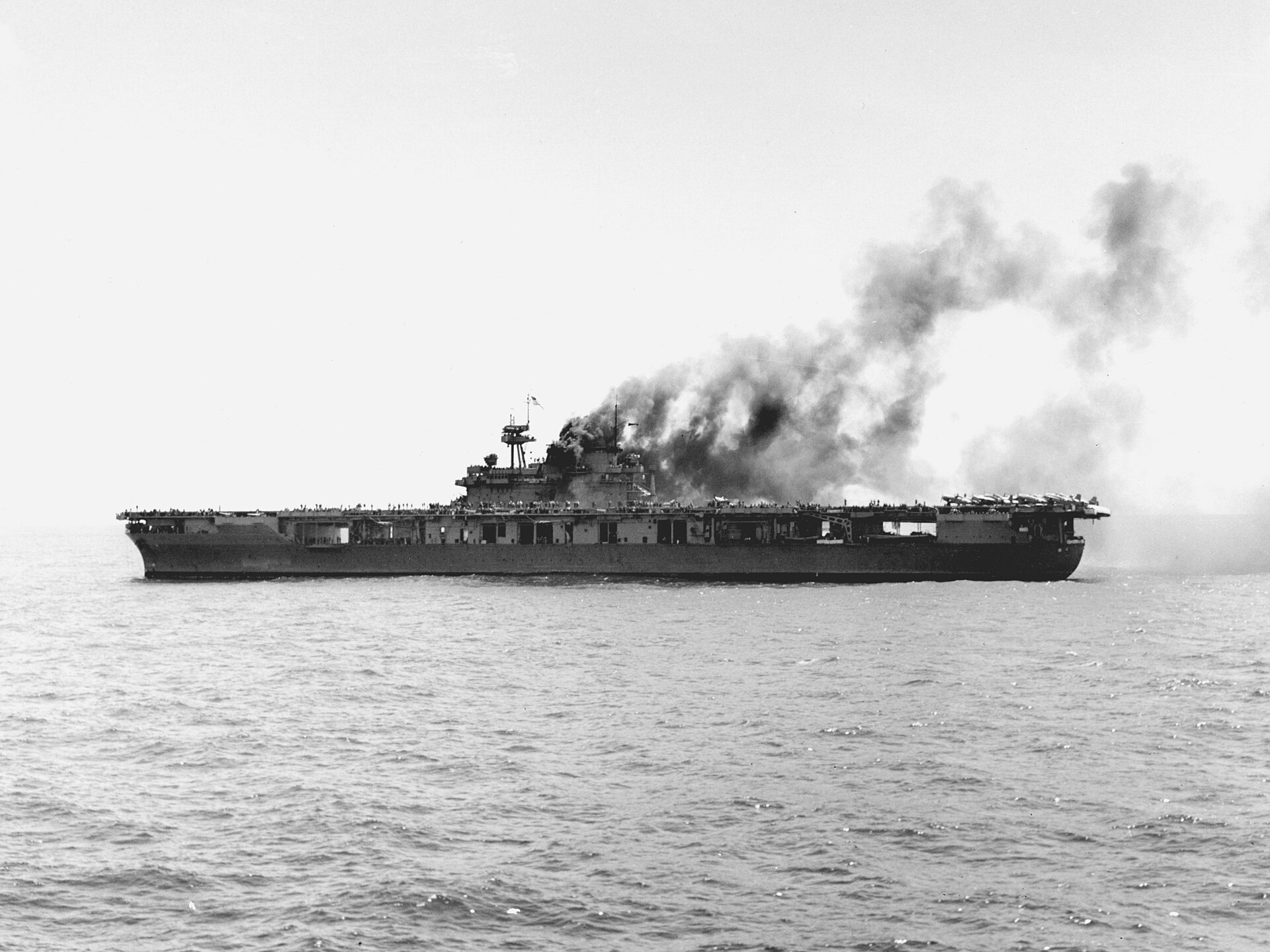
Yorktown in Dry Dock Number One at Pearl Harbor, repaired in seventy-two hours.
Yorktown in Dry Dock Number One at Pearl Harbor, repaired in seventy-two hours. US Navy · NARA · Public domain Source
The Battle of Midway

Yorktown in seventy-two hours

Yorktown came into Pearl Harbor down by the stern and leaking oil after Coral Sea, with damage the yard estimated at three months. She was dry-docked, patched, shored and back at sea in seventy-two hours with fourteen hundred workmen still aboard as she sailed. The Japanese plan counted two American carriers in the Pacific. Yorktown made three, and she carried the dive bombers that killed Sōryū and Hiryū.

Continue in The Battle of Midway →
USS Yorktown under attack by Japanese torpedo bombers during the Battle of Midway, 4 June 1942.
USS Yorktown under torpedo attack, 4 June 1942 · US Navy · NARA · Public domain · Source
The Battle of Midway

Kidō Butai sails

The First Air Fleet left Hiroshima Bay with Akagi, Kaga, Sōryū and Hiryū. Two of the six carriers that had struck Pearl Harbor were absent, one damaged and one short of aircrew after Coral Sea, so the strike force went to sea at two thirds strength. Behind it, several hundred miles back and unable to influence anything, came Yamamoto with the battleships. Ahead and to the north went a separate operation against the Aleutians. The fleet was divided across a thousand miles in support of nothing.

Continue in The Battle of Midway →
Reinhard Heydrich’s damaged Mercedes at the assassination site in Prague, 27 May 1942.
Reinhard Heydrich’s damaged Mercedes at the assassination site in Prague, 27 May 1942. Bundesarchiv Bild 146-1972-039-44 / unknown photographer · Public domain Source
Reprisal and Massacre

Heydrich is attacked in Prague

Czechoslovak agents Jozef Gabčík and Jan Kubiš attacked Reinhard Heydrich’s car in Prague on 27 May 1942. Heydrich died on 4 June, and German security authorities launched an intensive search accompanied by arrests, executions and collective pressure. Lidice entered the investigation through a chain of suspicion involving a private letter and family connections. The evidence never established that the village had supported Operation Anthropoid, yet the village was chosen for a retaliation intended to be publicly understood. The reprisals widened before the attackers were found. The occupation regime used executions,…

Continue in Reprisal and Massacre →
1944
Wrecked rolling stock in the severely damaged marshalling yard at Juvisy-sur-Orge after Allied air attacks in 1944.
Bridge B (Fg Off), Royal Air Force official photographer / Imperial War Museums, CL 4170 · Public domain · Source
The Transportation Plan

Marseille exposes the human cost of the wider rail offensive

American heavy bombers attacked the Marseille railway system during the late-May Transportation Plan offensive in southern France. French research cited by Foucrier records 1,752 people killed and nearly 4,500 total casualties. The raid belongs beside the operational results because civilian deaths were part of the plan's political argument from the beginning.

Continue in The Transportation Plan →