Skip to content
WW2 Theatres Theatres of the Second World War
Home

World War II calendar

WWII On This Day: May 26

What happened on May 26 during World War II? This date brings together 9 events from 1940, 1941 and 1942, with period photographs and links to the full operations documented across WW2 Theatres.

1940
Western Campaign, France, Calais. Soldier in front of a destroyed motor vehicle (truck)
Western Campaign, France, Calais. Soldier in front of a destroyed motor vehicle (truck) Bundesarchiv Bild 101I-383-0337-18 · CC BY-SA 3.0 DE Source
Dunkirk: Operation Dynamo

The Calais garrison continues fighting

British and French troops at Calais were ordered to continue the defence rather than evacuate. The garrison surrendered later on 26 May after fighting inside the town and citadel. The defence occupied German units and protected the coastal approaches for a limited period, but it should not be treated as the single action that made Dunkirk possible.

Continue in Dunkirk: Operation Dynamo →
German troops in northern France during the campaign of 1940.
Bundesarchiv Bild 101I-299-1808-10A · CC BY-SA 3.0 DE · Source
Battle of France 1940

Operation Dynamo begins

Operation Dynamo began on the evening of 26 May under Vice-Admiral Bertram Ramsay, moving troops from Dunkirk harbour and the beaches while British and French formations held the surrounding perimeter. Destroyers, transports, merchant vessels and smaller craft entered a system of routes across the Channel. The harbour moles soon handled a large share of embarkation because they allowed ships to take troops directly alongside. The evacuation became a combined land-sea-air operation whose survival depended on the perimeter, port, shipping and fighter cover functioning together. By 4 June 338,226 Allied personnel…

Continue in Battle of France 1940 →
British troops rescued in a ship at Dunkirk (France, 1940).
Divide and Conquer (Why We Fight #3) directed by Frank Capra
Dunkirk: Operation Dynamo

Operation Dynamo is ordered

The Admiralty ordered the evacuation to begin under Ramsay's direction. Destroyers, transports, minesweepers and other vessels were assigned to Dunkirk. The first planning assumption had been that only a fraction of the trapped force might be removed. The actual number would depend on how long the perimeter and embarkation points could be held.

Continue in Dunkirk: Operation Dynamo →
1941
The German battleship Bismarck in Grimstadfjord near Bergen on 21 May 1941, photographed from Prinz Eugen before the Atlantic breakout.
Naval History and Heritage Command · Public domain
The Bismarck Chase

A Catalina finds Bismarck again

A Catalina flying from Northern Ireland sighted Bismarck and restored firm contact. The battleship was still moving toward the French coast, close enough that a few more hours of uninterrupted progress might have carried her beyond the reach of the heavy ships pursuing from the north. The sighting made Force H decisive. Somerville's Ark Royal could put torpedo aircraft across Bismarck's route while Tovey's battleships closed from farther away. The first Ark Royal strike mistakenly attacked the shadowing cruiser Sheffield; defective magnetic pistols helped prevent a British disaster.

Continue in The Bismarck Chase →
German paratroopers descending on Crete during Operation Merkur in May 1941.
Bundesarchiv Bild 141-0864 · CC BY-SA 3.0 DE · Source
Battle of Crete

Freyberg reports that the western defence cannot continue

By 26 May the western Creforce position was being compressed around Canea and Suda Bay. Units had fought for nearly a week with diminishing ammunition, food and transport, while German aircraft restricted daylight movement and the flow of mountain troops through Maleme continued. Freyberg reported to Middle East Command that the force could no longer maintain the defence and requested authority to evacuate. The decision reflected the collapse of the western operational position rather than the local situation at Rethymno or Heraklion, where isolated defenders still held their airfields. Evacuation…

Continue in Battle of Crete →
The Bismarck Chase

Ark Royal's Swordfish cripple Bismarck's steering

Fifteen Swordfish from Ark Royal attacked in gale conditions at dusk. Torpedoes struck Bismarck, and one hit damaged the stern and jammed the rudders so that the battleship could no longer hold a controlled course toward France. The aircrews did not sink Bismarck. They changed the geometry of the pursuit. A ship that had been outrunning the British heavy units was now circling and making only limited progress while destroyers and battleships converged during the night.

Continue in The Bismarck Chase →
1942
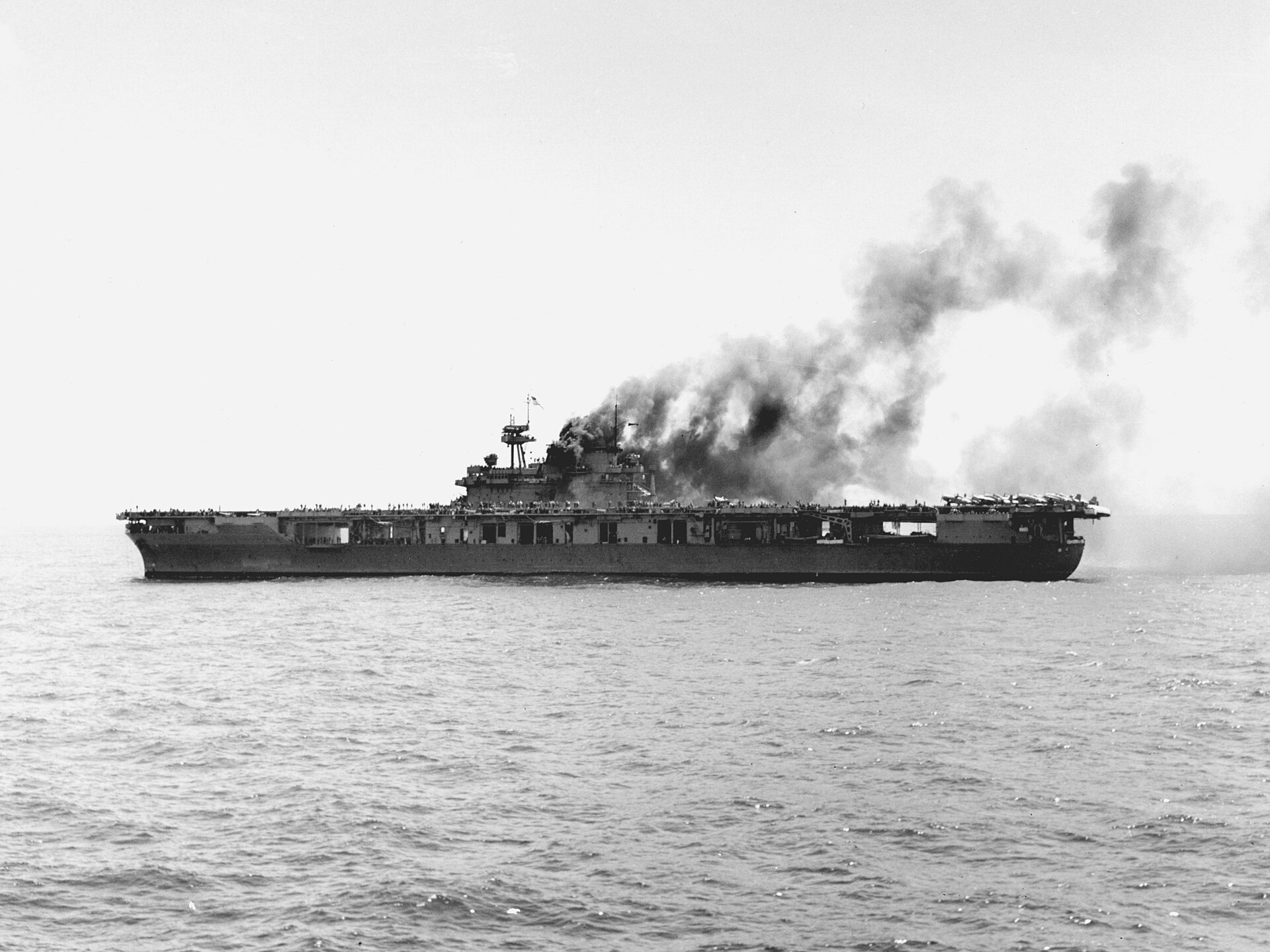
USS Yorktown under attack by Japanese torpedo bombers during the Battle of Midway, 4 June 1942.
USS Yorktown under torpedo attack, 4 June 1942 · US Navy · NARA · Public domain · Source
The Battle of Midway

Nimitz sets the ambush

Nimitz accepted HYPO's estimate against contrary advice from Washington and ordered his carriers to a position north-east of Midway that the Japanese plan assumed would be empty. It was designated Point Luck. The decision rested entirely on trusting a partial decrypt. If the estimate had been wrong, the Pacific Fleet's remaining carriers would have been out of position with the west coast of the United States behind them.

Continue in The Battle of Midway →
Searchlights and anti-aircraft tracer over Cologne during Operation Millennium, 30–31 May 1942.
Royal Air Force official photographer · Imperial War Museums C 2615 · Public domain
Area Bombing Begins

Operation Millennium assembles a force Bomber Command does not normally possess

Harris proposed concentrating approximately one thousand aircraft against a single city in a short period. The tactical objective was to overload the German night-defence system; the institutional objective was to demonstrate what a much larger Bomber Command might achieve if the government continued to fund its expansion. The normal operational force was nowhere near one thousand bombers. Harris therefore drew aircraft from Operational Training Units and conversion flights, using instructors and advanced pupils alongside front-line crews. The plan risked disrupting the organisation that produced replacement crews, which meant the force…

Continue in Area Bombing Begins →
Lieutenant-General Arthur Percival and the British surrender party walking to the Ford Motor Factory in Singapore on 15 February 1942.
British official photographer / Imperial War Museums HU 2781 · UK Government public domain · Source
The Fall of the Southern Empires

The Burma Retreat Ends

The U.S. Army campaign history dates the withdrawal of the last organized Allied forces from Burma to 26 May. British, Indian and Chinese formations had escaped by different routes after Rangoon, central Burma and Lashio were lost in succession. The date closes the southern offensive as a coherent campaign arc. Japan now held the principal resource zone, Singapore and the pre-war Dutch base system, the main American base complex in the Philippines and the Burma communications route to China. The victories had created a new strategic map. They had also…

Continue in The Fall of the Southern Empires →