Skip to content
WW2 Theatres Theatres of the Second World War
Home

World War II calendar

WWII On This Day: May 10

What happened on May 10 during World War II? This date brings together 8 events from 1940, 1941, 1942 and 1944, with period photographs and links to the full operations documented across WW2 Theatres.

1940
German troops in northern France during the campaign of 1940.
Bundesarchiv Bild 101I-299-1808-10A · CC BY-SA 3.0 DE · Source
Battle of France 1940

Glider troops land on Fort Eben-Emael

German assault engineers landed DFS 230 gliders on the roof of Fort Eben-Emael before dawn on 10 May and attacked observation posts, gun positions and cupolas with shaped charges and demolition weapons. The assault suppressed important fortress weapons while German troops seized Albert Canal bridges nearby. Belgian forces fought through the day as the attackers expanded their hold on the surface works. The fortress surrendered on 11 May after German ground forces reached the area. The operation opened routes across the canal and demonstrated how a small specialist force could…

Continue in Battle of France 1940 →
Battle of France 1940

Germany invades the Netherlands, Belgium and Luxembourg

Germany opened the western offensive on 10 May across the Netherlands, Belgium and Luxembourg, combining ground attack with airborne and air-landed operations against bridges, airfields and command points. Army Group B drove into the Low Countries while Army Group A entered Luxembourg and the Ardennes. The northern assault immediately triggered the Allied advance planned before the campaign. Airborne fighting around The Hague, Rotterdam, Moerdijk and other objectives added a vertical dimension to the opening battle. The decisive land concentration, meanwhile, continued moving through the Ardennes toward the Meuse.

Continue in Battle of France 1940 →
Battle of France 1940

The Allied armies advance toward the Dyle

The British Expeditionary Force and French First Army Group moved into Belgium on 10 May to occupy the Dyle position and join Belgian forces on a shorter defensive front. French Seventh Army drove farther north toward Breda and the Dutch front. The movement committed a major mobile formation to the northern edge of the coalition deployment while the German main armoured mass approached the Meuse farther south. The advance unfolded according to pre-war planning and the political need to fight on Belgian territory. Its danger emerged only after the central…

Continue in Battle of France 1940 →
German mountain troops landing in Norway, April 1940.
Photo: Bagn Bygdesamling – Valdres Folkemuseum, Norway · CC BY-SA 3.0 DE · Source
Operation Weserübung

Churchill forms a coalition government

Neville Chamberlain resigned on 10 May as German forces opened their offensive in the Low Countries and France. King George VI asked Winston Churchill to form a government. Churchill had served as First Lord of the Admiralty during the Norwegian campaign and carried responsibility for major elements of British naval policy there. His accession emerged from the parliamentary crisis created by the campaign and the broader need for a national coalition. The new coalition took office as the strategic centre of the war shifted abruptly toward France. That shift would…

Continue in Operation Weserübung →
1941
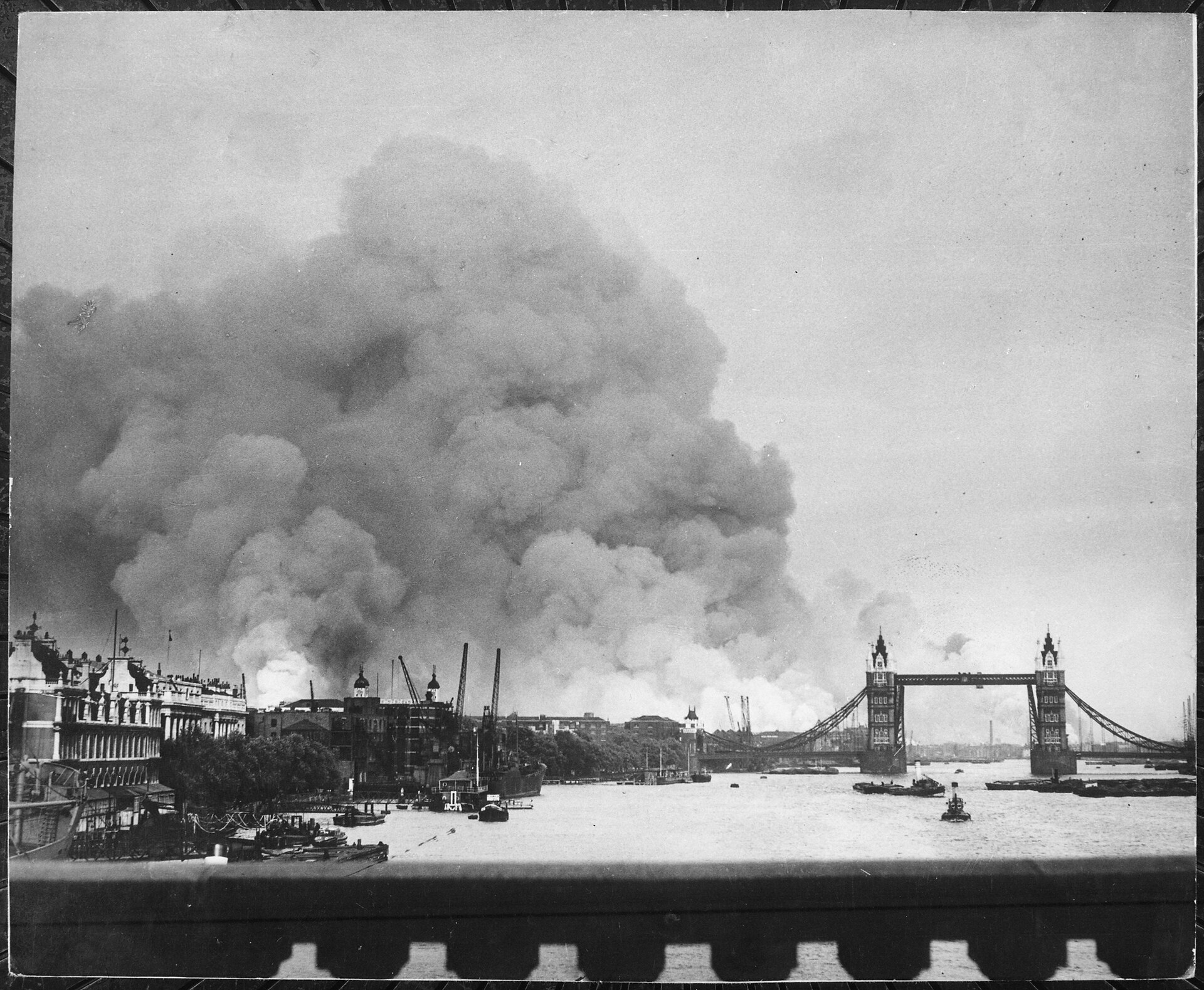
London, 7th September 1940 · London's dock area. Tower Bridge stands out against a background of smoke and fires. New York Times Paris Bureau Collection.
U.S. National Archives and Records Administration (NARA 541917) · Public domain
The Blitz

The last great raid

On the night of 10–11 May 507 bombers attacked London in the heaviest final raid of the main Blitz. High explosive and incendiaries struck Westminster, the City, transport systems and residential districts. Imperial War Museums records 1,436 civilians killed. The House of Commons chamber was destroyed, Westminster Abbey and the British Museum were damaged, and large fires burned across central London. Nothing in the raid itself told Londoners that the sustained campaign was ending. The destruction was consistent with an offensive that had repeatedly returned to the capital. Only afterwards…

Continue in The Blitz →
1942
A converted cable ship laying pipeline across the English Channel, 1944.
Pipeline laying in the Channel, 1944 ·
Operation PLUTO

Short HAIS prototypes are tested

Short cable-pipe sections were manufactured, coiled aboard a cable vessel and tested in tidal water. The trials confirmed that a lead tube could survive handling when protected by cable-style armouring and maintained under internal pressure.

Continue in Operation PLUTO →
1944
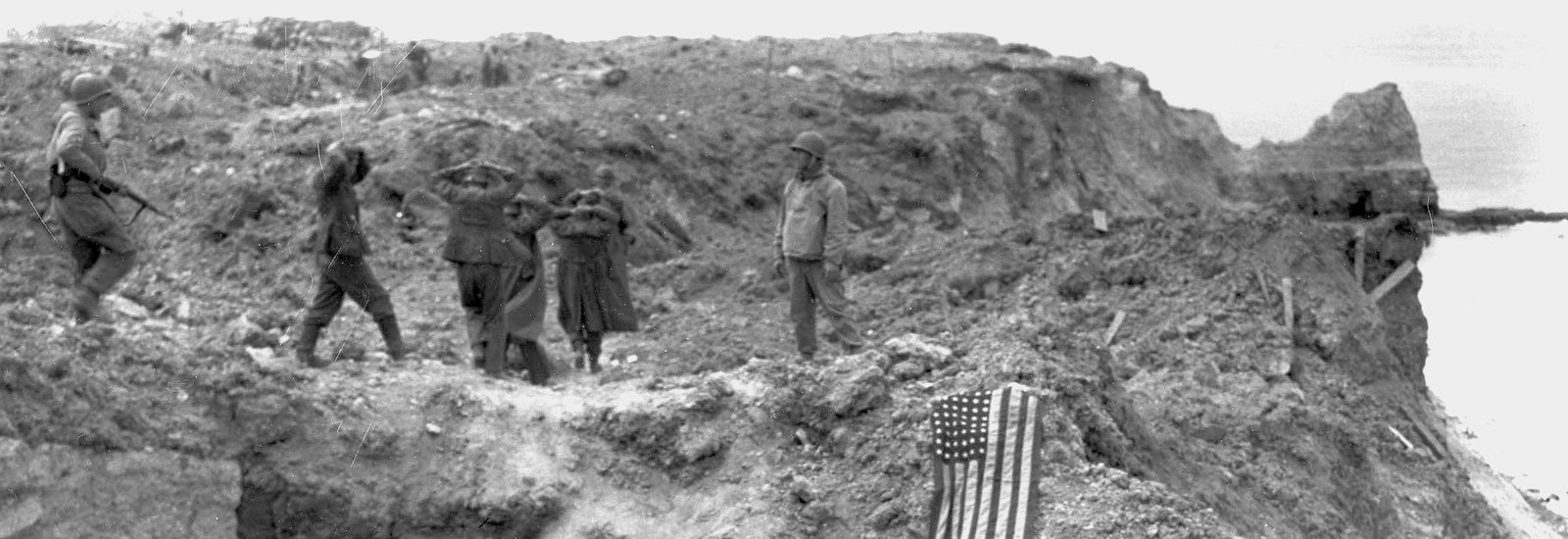
The cratered clifftop at Pointe du Hoc photographed after the assault, June 1944.
The cratered clifftop at Pointe du Hoc after the assault · US Army Signal Corps · NARA · Public domain · Source
Pointe du Hoc

Rehearsing on English cliffs

The 2nd Ranger Battalion trained on cliffs at Swanage and on the Isle of Wight with rocket-fired grapnels, rope ladders and extension ladders obtained from the London Fire Brigade and mounted on amphibious trucks. In rehearsal the ropes were dry. On the morning they were soaked, and the extra weight was enough to make several rockets fall short of the clifftop.

Continue in Pointe du Hoc →
Wounded German soldiers captured during the liberation of Sevastopol, photographed by Yevgeny Khaldei on 10 May 1944.
Wounded German soldiers captured during the liberation of Sevastopol, photographed by Yevgeny Khaldei on 10 May 1944. Yevgeny Khaldei / TASS · 10 May 1944 · public domain in Russia under the basis stated on Commons Source
Sevastopol and the Crimea

The Cape Khersones pocket contracts around the evacuation beaches

Soviet forces pressed the remaining German and Romanian troops west of the city while wounded men, headquarters staffs and combat formations competed for limited embarkation space. The evacuation remained under artillery and air attack. Contemporary photographs from 10 May show wounded German soldiers already entering Soviet captivity as the pocket contracted.

Continue in Sevastopol and the Crimea →