Skip to content
WW2 Theatres Theatres of the Second World War
Home

World War II calendar

WWII On This Day: March 7

What happened on March 7 during World War II? This date brings together 7 events from 1941, 1942 and 1945, with period photographs and links to the full operations documented across WW2 Theatres.

1941
German Type IXA submarine U-37 in dock at Lorient in 1940 after the French Atlantic ports became U-boat bases.
Mannewitz · Bundesarchiv Bild 101II-MW-1032-11A · CC BY-SA 3.0 DE
The Happy Time and the Wolfpacks

U-47 disappears after the OB 293 battle

U-47, U-99 and U-70 attacked outward convoy OB 293 on the night of 6–7 March. U-70 was sunk by the escorts, while U-47 was sighted during the battle and then failed to report again; Prien and his entire crew were lost. The precise cause of U-47's loss remains uncertain. Later accounts long credited HMS Wolverine, but the evidence does not permit a secure attribution. What can be established is that U-47 disappeared immediately after operating around OB 293 and that BdU's requests for a position report went unanswered.

A reconnaissance detachment of the German 5th Panzer Division entering Athens on 27 April 1941.
Bundesarchiv Bild 146-1979-123-32 · CC BY-SA 3.0 DE · Source
German Invasion of Greece, April 1941

British and Commonwealth formations begin landing in Greece

From 7 March, the headquarters and units of I Australian Corps, 6th Australian Division, 2nd New Zealand Division, the British 1st Armoured Brigade and supporting troops began disembarking through Piraeus and Volos. The movement continued through the end of the month. The force arrived with an awkward mission. It was too small to defend every approach into northern Greece and had to deploy while the Greek Army remained committed in Albania. Wilson placed the main Commonwealth formations on the shorter Vermion–Aliakmon position, preserving a connection with the Greek western armies…

Continue in German Invasion of Greece, April 1941 →
1942
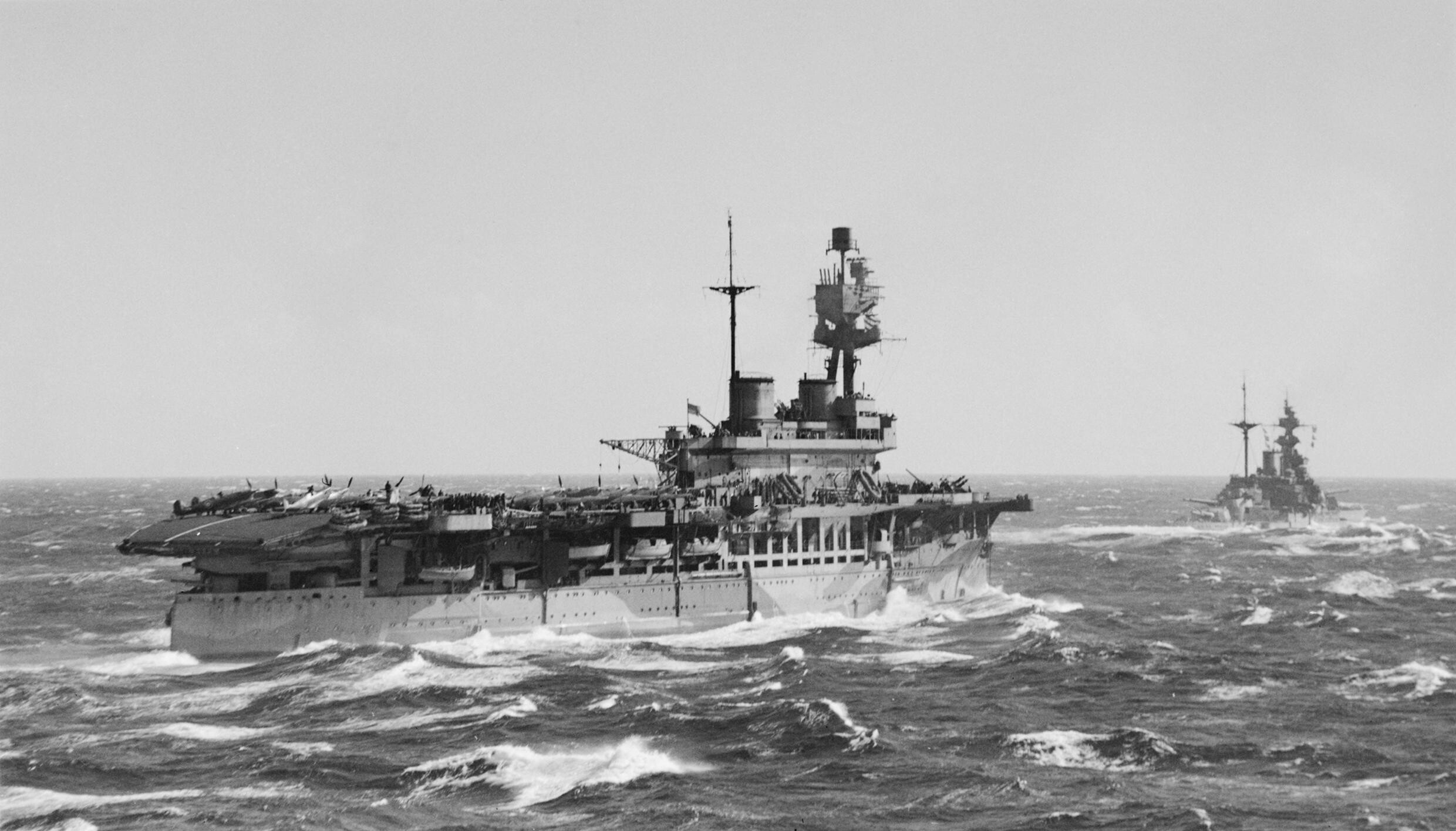
Spitfire Vs ranged on HMS Eagle during Operation Spotter; fifteen fighters were flown to Malta on 7 March 1942.
Spitfire Vs ranged on HMS Eagle during Operation Spotter; fifteen fighters were flown to Malta on 7 March 1942. Lt J. G. Marshall, Royal Navy official photographer / Imperial War Museums A 7840 · public domain (UK Government) Source

The first Spitfire reinforcement

HMS Eagle flew off fifteen Spitfire Vs during Operation Spotter, giving Malta a fighter with the speed and performance needed to meet the Bf 109 more evenly than the Hurricane. The aircraft still had to land on airfields under attack, enter dispersed service and survive bombing before their tactical value could be realised. March produced 4,927 Luftwaffe sorties, and fighter serviceability at times fell to a handful of aircraft. Spotter opened a sequence of carrier ferry missions in which Malta's fighter force survived by receiving replacements while the airfields remained…

Continue in Malta: Air Siege and Convoy War →
1945
Churchill tanks of 34th Tank Brigade at the start of the Reichswald battle, 9 February 1945.
Churchill tanks of 34th Tank Brigade at the start of the Reichswald battle, 9 February 1945 · Imperial War Museums B 14422 · IWM Non-Commercial Licence · Source
The Rhineland Battles

Lumberjack reaches a bridge

The southern arm of the same operation, driving for the Rhine between Cologne and Koblenz, came over a rise at Remagen and found the Ludendorff bridge still standing. That is where this page ends and the Rhine crossings begin. The reason the bridgehead could not be sealed off is on this page: there was nothing left west of the river to seal it with, and very little east of it either.

Continue in The Rhineland Battles →
Horsa gliders on the ground near Hamminkeln after the airborne landing east of the Rhine, March 1945.
Horsa gliders near Hamminkeln, 25 March 1945 · Imperial War Museums BU 2287 · IWM Non-Commercial Licence · Source
The Rhine Crossings

The bridge is still there

A task force of the 9th Armored Division came over a rise in the afternoon and found the railway bridge at Remagen standing. Every other bridge on the Rhine had been blown. The German commander needed authority to demolish it, the authority took time to obtain, and blowing a bridge early was a capital offence. The charges were fired at about ten past four. The main charge did not detonate properly, the bridge lifted and settled, and it was still standing.

Continue in The Rhine Crossings →
The Rhine Crossings

Across

Lieutenant Karl Timmermann was told to take his company over a bridge that was expected to blow underneath them. Sergeant Alexander Drabik ran across first, in a zigzag, and reached the far bank; Timmermann was the first American officer across the Rhine. Timmermann had been born in Germany, to a German mother and an American father who had served in the occupation after the previous war. Engineers followed him onto the bridge and cut the demolition cables by hand while it was still under fire.

Continue in The Rhine Crossings →
The Rhine Crossings

Bradley pushes everything at it

Bradley telephoned SHAEF and was told the bridgehead did not fit the plan, which allotted the main effort to the north. He argued and was given four divisions. Within twenty-four hours around 8,000 men were across. It is the clearest case in the campaign of an accident being exploited immediately rather than referred upwards. The bridgehead was never eliminated.

Continue in The Rhine Crossings →