Skip to content
WW2 Theatres Theatres of the Second World War
Home

World War II calendar

WWII On This Day: June 12

What happened on June 12 during World War II? This date brings together 5 events from 1940, 1942 and 1944, with period photographs and links to the full operations documented across WW2 Theatres.

1940
Japanese soldiers of the Ikeda Detachment south of Shayangzhen during the Zaoyang–Yichang campaign, 6 June 1940.
Japanese soldiers of the Ikeda Detachment south of Shayangzhen during the Zaoyang–Yichang campaign, 6 June 1940. Imperial Japanese Army photograph · public domain (Japan) Source
The Second Sino-Japanese War

Japan takes Yichang, at the edge of Sichuan

Japanese forces attacked in the Zaoyang–Yichang area from 1 May 1940, and Yichang fell on 12 June. The town lay at the edge of Sichuan and connected the Fifth and Ninth War Zones, and the Japanese navy had pressed for its capture as a forward base for air attacks on Chongqing. General Zhang Zizhong, who refused to retreat, was killed on the front line, and he was the most senior Chinese commander to die in combat during the war. Chinese casualties are put at more than 68,000 killed, wounded and…

Continue in The Second Sino-Japanese War →
German troops in northern France during the campaign of 1940.
Bundesarchiv Bild 101I-299-1808-10A · CC BY-SA 3.0 DE · Source
Battle of France 1940

French IX Corps and the British 51st Highland Division surrender

French IX Corps elements and the British 51st Highland Division were trapped against the Channel around Saint-Valery-en-Caux and entered captivity on 12 June after evacuation attempts failed. Fog, German artillery and control of surrounding high ground restricted the ships approaching the coast. Rommel's 7th Panzer Division and other German forces closed the land routes around the pocket. The surrender showed the shrinking value of coastal escape once German troops controlled the approaches to a port. Operations elsewhere continued to remove Allied personnel from western France, but isolated formations faced their…

Continue in Battle of France 1940 →
1942
IWM dates Free French legionnaires in a Bren carrier to 12 June 1942 and identifies the setting as Bir Hacheim. Since the main garrison had broken out the previous night, this photograph is not evidence that the box still held.
IWM dates Free French legionnaires in a Bren carrier to 12 June 1942 and identifies the setting as Bir Hacheim. Since the main garrison had broken out the previous night, this photograph is not evidence that the box still held. Len Chetwyn / IWM E 13304 · UK Government public domain Source

The Free French survivors regroup after the breakout

Free French troops who had escaped from Bir Hacheim gathered with Allied forces while the battle farther north entered a new phase. Their prolonged isolation had cost transport, guns, vehicles and casualties, and many men were exhausted or short of water. The IWM catalog dates this Bren-carrier photograph 12 June and identifies legionnaires on patrol from Bir Hacheim. Since the principal garrison had evacuated overnight 10–11 June, it is treated here as a dated aftermath image, not proof that the defended box was still in French hands.

Continue in Gazala and the Fall of Tobruk →
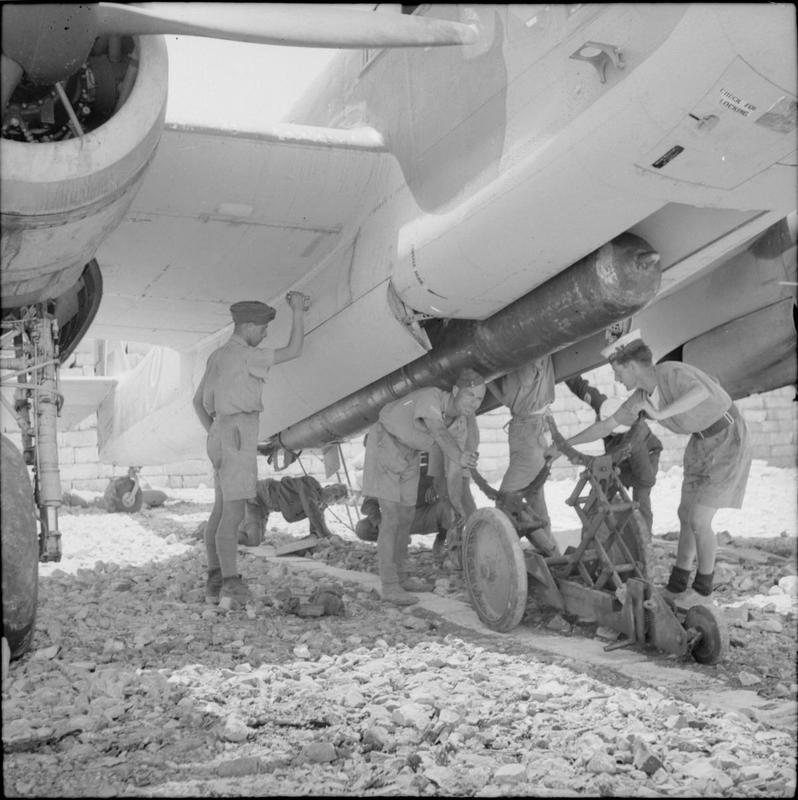
Ground crew at Luqa load a torpedo onto a Bristol Beaufort for a sortie against the Italian naval force threatening Operation Harpoon, June 1942.
Ground crew at Luqa load a torpedo onto a Bristol Beaufort for a sortie against the Italian naval force threatening Operation Harpoon, June 1942. Lt H. E. Cook, War Office official photographer / Imperial War Museums GM 1024 · public domain (UK Government) Source

Two convoys fail to solve the supply crisis

The Allies attempted to supply Malta simultaneously from Gibraltar and Alexandria. Operation Harpoon fought eastward through air, submarine and surface attack; only two of its six merchant ships reached Malta. Operation Vigorous approached from Egypt but faced repeated air attack, submarine danger and the prospect of interception by the Italian battle fleet and turned back before reaching the island. The June operations delivered too little to create a secure reserve. Food and fuel remained under pressure, while the island's aircraft and submarines still required aviation spirit, torpedoes and spare parts…

Continue in Malta: Air Siege and Convoy War →
1944
American howitzers shelling German forces in Normandy.
American howitzers shelling German forces in Normandy. US Army Signal Corps · NARA · Public domain Source
Operation Overlord

Carentan falls

The 101st Airborne Division took Carentan after four days of fighting along the exposed causeway approaches, joining the Utah and Omaha beachheads into a single line some fifty miles wide. Churchill, Brooke and Smuts crossed the Channel the same day to visit Montgomery's headquarters, a measure of how far the situation had stabilised in under a week.

Continue in Operation Overlord →