Skip to content
WW2 Theatres Theatres of the Second World War
Home

World War II calendar

WWII On This Day: February 1

What happened on February 1 during World War II? This date brings together 4 events from 1940, 1942 and 1945, with period photographs and links to the full operations documented across WW2 Theatres.

1940
Finnish ski troops moving through forest during the Winter War.
Imperial War Museums, HU 52936 · Public domain · Source
The Winter War

The second Soviet offensive opens with concentrated fire

The renewed Soviet offensive opened on the Karelian Isthmus with sustained artillery preparation and attacks focused on selected sectors. Fresh formations were fed into a battle whose objectives had been studied during the January pause. Artillery, tanks, engineers and infantry now worked on a more deliberate schedule. Fire smashed field positions and obstacles, engineers opened routes, and repeated assaults kept Finnish defenders under pressure across the same limited frontage. Finnish units still inflicted heavy losses, yet the balance of replacement had shifted decisively. The defence had finite infantry reserves and…

Continue in The Winter War →
1942
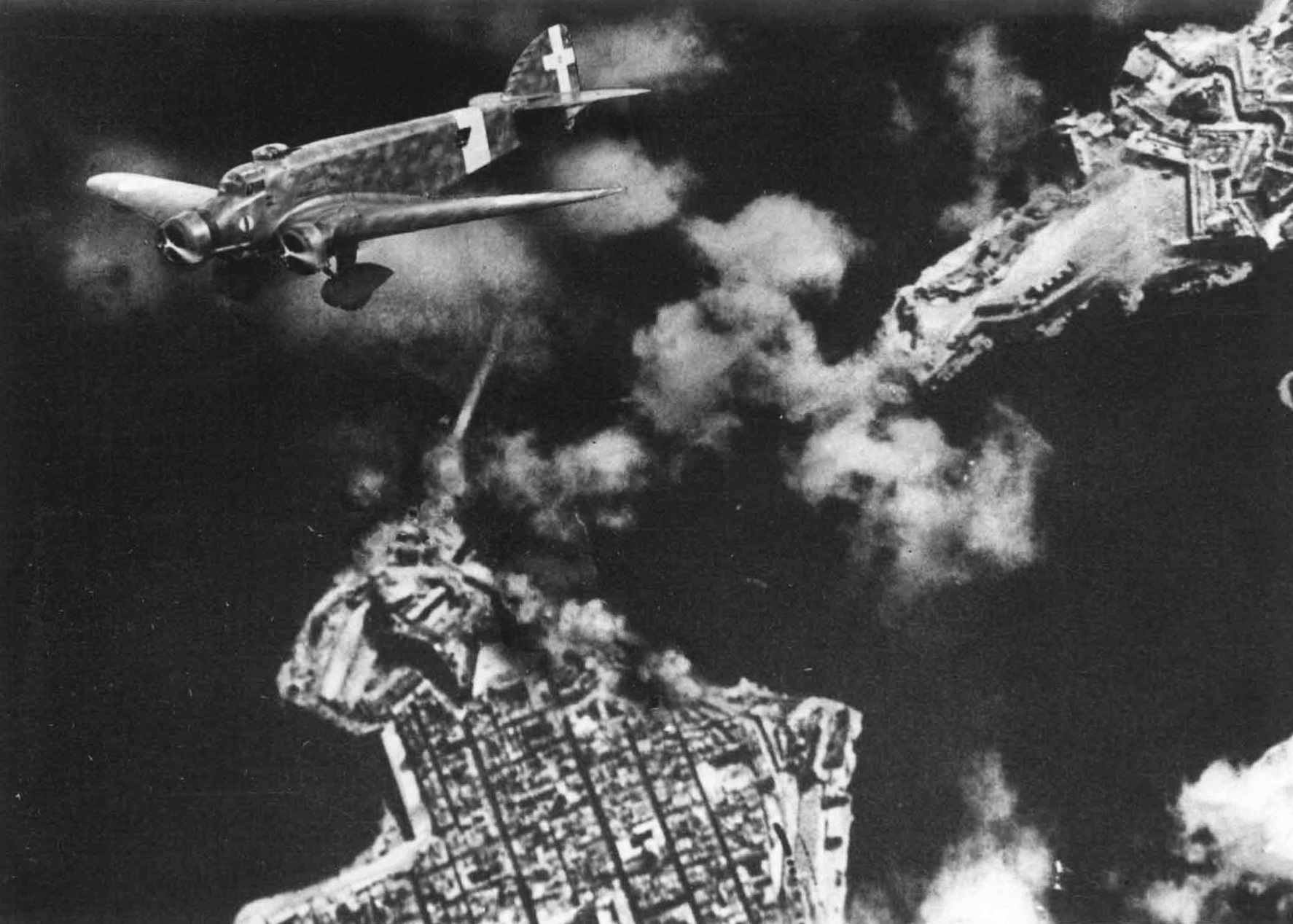
Bombs falling around Grand Harbour during an Italian air raid over Malta, 19 June 1941.
Central Archives of the State, Italy · photographer unknown · public domain in Italy
Malta: Air Siege and Convoy War

Kesselring concentrates on Malta

The Luftwaffe began a sustained neutralisation effort under Oberbefehlshaber Süd. German planning treated Malta as an operating system: anti-aircraft batteries, runways, dispersed aircraft, dockyard facilities and supply routes were attacked so that the island would lose both its defensive strength and its ability to strike Axis shipping. The Luftwaffe flew 2,447 sorties during February. Pressure increased again in March as serviceable RAF fighter strength fell and airfields were hit repeatedly. The immediate objective was to create periods in which Malta could neither protect incoming supplies nor interfere effectively with convoys…

Continue in Malta: Air Siege and Convoy War →
Civilians in Artemivsk, occupied Ukraine, wait to be examined before deportation to Germany for forced labour, May 1942.
Bundesarchiv Bild 183-B19880 / Knödler · CC BY-SA 3.0 DE
Nazi Forced Labour

Pohl takes over the SS economic empire

On 1 February 1942 Oswald Pohl became chief of the SS Economic-Administrative Main Office, which gave him charge of the concentration camps, their construction and their prisoners. The SS signed contracts with state and private firms to supply prisoners for armaments and related industries. Between 1942 and 1944 hundreds of subcamps were set up in or near factories and mines, and the policy of annihilation through work meant that prisoners laboured under conditions that deliberately led to illness, injury and death.

Continue in Nazi Forced Labour →
1945
Red Army combat engineers building a pontoon bridge across the Oder beside a destroyed bridge, photographed 22 January 1945.
Semyon Alperin / RIA Novosti RIAID 42325 · Public domain (per Commons file record)
The Vistula–Oder Offensive

The spearheads wait for the front

The leading Soviet formations held and enlarged their Oder lodgements as fuel, bridging and infantry units caught up and German units remained on the northern flank. Soviet formations expanded bridgeheads, brought artillery and supplies forward and reinforced the lengthening northern flank. German reinforcements were beginning to form a semi-coherent defence around the Oder and in Pomerania while the thaw reduced cross-country mobility.

Continue in The Vistula–Oder Offensive →