Skip to content
WW2 Theatres Theatres of the Second World War
Home

World War II calendar

WWII On This Day: August 15

What happened on August 15 during World War II? This date brings together 16 events from 1940, 1942, 1944 and 1945, with period photographs and links to the full operations documented across WW2 Theatres.

1940
A formation of Heinkel He 111s in the Battle of Britain
Imperial War Museums, MH6547 · Public domain · Source
The Battle of Britain

Luftflotte 5 discovers that the north is still defended

Luftflotte 5 attacked from Norway and Denmark against northern England on the assumption that Fighter Command had stripped the region to reinforce the south. British squadrons were still present and intercepted the raids. The German formations lacked the escort conditions available to raids crossing the narrower Channel approaches. Losses were severe enough that Luftflotte 5 did not repeat a comparable daylight effort over Britain. The raid exposed a persistent intelligence failure. Fighter Command's group system allowed Dowding to reinforce the south without leaving the rest of the country as empty…

Continue in The Battle of Britain →
1942
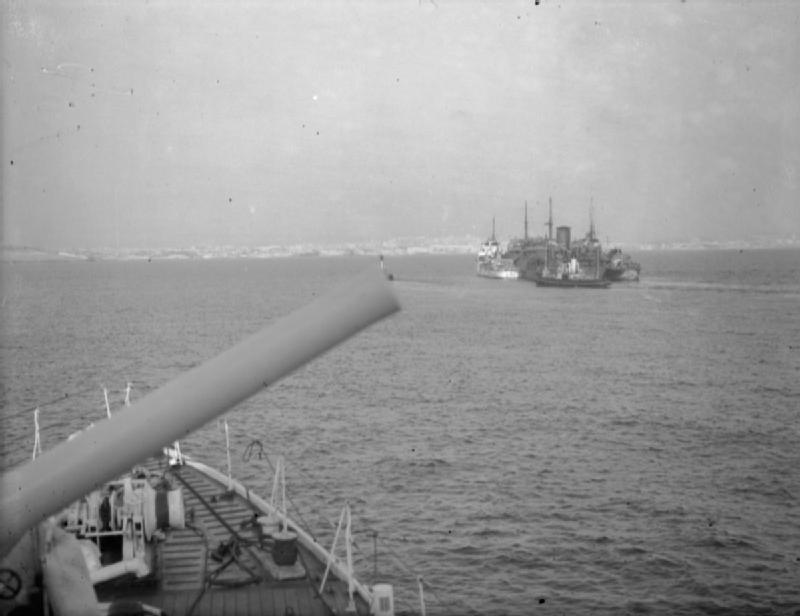
The damaged tanker Ohio, supported by destroyers, moves toward Grand Harbour on 15 August 1942.
The damaged tanker Ohio, supported by destroyers, moves toward Grand Harbour on 15 August 1942. John Alfred Hampton and Lt J. E. Russell, Royal Navy official photographers / Imperial War Museums A 11261 · public domain (UK Government) Source
Malta: Air Siege and Convoy War

Ohio reaches Grand Harbour

The crippled tanker Ohio reached Malta on 15 August supported by destroyers after torpedo and bomb damage had stopped her engines and weakened her hull. Four other merchant vessels from the fourteen-ship convoy also reached the island over the preceding days. Nine merchant vessels were lost. Pedestal delivered food, ammunition and fuel at the point when stocks were critically low. Ohio's aviation fuel was especially important because Malta's recovered fighter and anti-shipping forces depended on it. The convoy extended the island's endurance and allowed offensive operations to expand again. A…

Continue in Malta: Air Siege and Convoy War →
Cologne showing extensive bomb and fire damage after Operation Millennium in May 1942.
Cologne after the raid of 30–31 May 1942 · U.S. Department of Defense. Department of the Army.
Operation Millennium

What Millennium proved

Operation Millennium proved that Bomber Command could organise a mass stream and place a destructive concentration over a major German city. It strengthened Harris's position and influenced the later development of bomber-stream tactics. It did not prove that area bombing could quickly break German morale or production. Its political and organisational success was clearer than its strategic result.

Continue in Operation Millennium →
1944
Gliders on the landing ground at Le Muy, 15 August 1944, photographed from the German side.
Gliders on the landing ground at Le Muy, 15 August 1944, photographed from the German side. German wartime photograph · via Wikimedia Commons Source
Operation Dragoon

The First Airborne Task Force drops at Le Muy

Around 5,000 American and British parachutists dropped inland to block the roads by which reinforcements could reach the beaches. Fog scattered part of the drop, though far less badly than in Normandy, and the gliders came in through the morning. Le Muy itself was cleared during the day. The task force under Major General Robert Frederick held the road junctions behind the landing area throughout.

Continue in Operation Dragoon →
Allied landing craft off the Île d'Or at Le Dramont, Camel Beach, during the landing in Provence, August 1944.
Landing craft off the Île d'Or at Le Dramont, Camel sector, August 1944 · Public domain · Source
Operation Dragoon

The commandos take the flanks

French naval commandos of the Groupe naval d'assaut de Corse under Commandant Bouvet landed at Cap Nègre and climbed the cliffs to take the battery above and cut the coast road on the western flank. The First Special Service Force, an American and Canadian formation, landed on Port-Cros and the Île du Levant to silence the batteries covering the western approach. The guns on the Levant turned out to be wooden dummies.

Continue in Operation Dragoon →
Shipping off Le Dramont during the Provence landing.
Shipping off Le Dramont during the Provence landing. Public domain · via Wikimedia Commons Source
Operation Dragoon

The bombardment opens

Battleships, cruisers and destroyers opened on the coastal batteries and beach defences, joined by 1,300 aircraft from Corsica, Sardinia and Italy. The preparation lasted a little over two hours. Unlike Normandy the coast here had never been heavily fortified, and much of what existed had been stripped of guns and men through July to feed the fighting in the north.

Continue in Operation Dragoon →
The landing at Le Dramont, Camel Beach, 15 August 1944.
The landing at Le Dramont, Camel Beach, 15 August 1944. Public domain · via Wikimedia Commons Source
Operation Dragoon

H-Hour at Alpha

The US 3rd Infantry Division under Major General John O'Daniel landed in the bay of Cavalaire and on the Pampelonne beaches below Ramatuelle, with Combat Command 1 of the French 1st Armoured Division under General Sudre following. Resistance was light. Two landing craft were lost on mines. The division was several miles inland by midday.

Continue in Operation Dragoon →
Camel sector at Le Dramont during the landing.
Camel sector at Le Dramont during the landing. Public domain · via Wikimedia Commons Source
Operation Dragoon

H-Hour at Delta

The US 45th Infantry Division under Major General William Eagles came ashore at Sainte-Maxime on the Nartelle beaches, in the centre of the assault frontage. Saint-Tropez was taken the same day, in part by the Resistance and by scattered parachutists who had come down near the town, before the regular troops reached it.

Continue in Operation Dragoon →
Landing craft off the Île d'Or at Le Dramont, Camel sector, August 1944.
Landing craft off the Île d'Or at Le Dramont, Camel sector, August 1944. Public domain · via Wikimedia Commons Source
Operation Dragoon

H-Hour at Camel, and the beach that was refused

The US 36th Infantry Division under Major General John Dahlquist landed at Le Dramont below the Esterel. The eastern sector at Fréjus was the only one seriously defended, with mines, underwater obstacles and guns still in position. The naval commander of the assault group judged the fire too heavy and diverted the landing to Le Dramont rather than press it. The decision was taken on his own authority against the plan and it saved the division a costly frontal landing.

Continue in Operation Dragoon →
Operation Dragoon

Wiese has no reserve to send

General Friedrich Wiese commanded the Nineteenth Army along 300 miles of coast with divisions that had no transport, no armour except the 11th Panzer, and in several cases battalions of eastern European conscripts who surrendered readily. The 11th Panzer Division was west of the Rhône and could not cross quickly because the Allied air forces had destroyed the bridges. It took four days to reach the battle.

Continue in Operation Dragoon →
A train under attack by Hellcats of VOF-1 west of Carcassonne, August 1944.
A train under attack by Hellcats of VOF-1 west of Carcassonne, August 1944. US Navy 80-G-46497 · NARA · Public domain Source
Operation Dragoon

The roads and railways are cut

Carrier aircraft and fighter-bombers from Corsica ranged far inland attacking trains, road columns and river crossings across the whole south. Aircraft of VOF-1 caught trains as far west as Carcassonne. Combined with the Resistance campaign against the rail network, this left the Nineteenth Army trying to withdraw an army along roads it could not use by day.

Continue in Operation Dragoon →
Landing craft off the Île d'Or at Le Dramont, Camel sector, August 1944.
Landing craft off the Île d'Or at Le Dramont, Camel sector, August 1944. Public domain · via Wikimedia Commons Source
Operation Dragoon

End of the first day

Around 60,000 men and 6,000 vehicles were ashore, with casualties of a few hundred. Every objective for the day had been taken except at Fréjus, and the beachheads were joined within 48 hours. Set against Omaha ten weeks earlier, the comparison is stark. The difference was not the plan or the troops. It was that the Germans had moved almost everything they had to Normandy.

Continue in Operation Dragoon →
HMS Despatch off Arromanches, 6 to 8 June 1944.
HMS Despatch off Arromanches, 6 to 8 June 1944. IWM A 24073 · IWM Non-Commercial Licence Source
Operation Overlord

Operation Dragoon lands in the south

A second Allied invasion of France came ashore between Toulon and Cannes: US VI Corps and French Army B, against defences stripped to feed Normandy. Marseille and Toulon were captured within a fortnight and became the Allies' most productive ports in France. The French First Army driving north up the Rhône would meet the Normandy armies near Dijon in September, closing a continuous front from the North Sea to Switzerland.

Continue in Operation Overlord →
Tanks and half-tracks of the French 2e Division Blindée pass the Arc de Triomphe through crowds on the Champs-Élysées, 26 August 1944.
Jack Downey, US Office of War Information · Library of Congress · Public domain · Source
The Liberation of Paris

The police strike

Around 20,000 Paris policemen stopped work rather than be disarmed by the Germans, who had begun seizing weapons from precincts they no longer trusted. The Métro stopped the same day and the postal workers followed. A police force on strike is a police force with weapons and buildings and nothing to do. Four days later it would take the Préfecture.

Continue in The Liberation of Paris →
The Liberation of Paris

The last train leaves Pantin

Around 2,200 prisoners were taken from Fresnes, Romainville and the Cherche-Midi and loaded onto a train at Pantin bound for Buchenwald and Ravensbrück. It was the last mass deportation train to leave Paris. Between 1942 and August 1944 about 76,000 Jews were deported from France, most of them through the camp at Drancy on the northern edge of the city. Fewer than 3,000 returned.

Continue in The Liberation of Paris →
1945
The Scherl publishing building burning in Berlin after an air raid, July 1944.
Bundesarchiv Bild 183-J30142 · CC BY-SA 3.0 DE · Source
The Bombing of Cities

The city-bombing campaigns end with the war

American conventional bombing continued into the final days before Japan announced acceptance of surrender terms. By then the home islands had also been subjected to naval blockade, aerial mining, destruction of transport and industry, two atomic bombings and Soviet entry into the war. Post-war surveys tried to isolate how much each form of pressure contributed to the surrender decision. The surviving evidence instead shows a rapidly collapsing strategic situation in which several shocks arrived together and Japanese leaders weighed them within the same crisis. Across the wider war, city bombing…

Continue in The Bombing of Cities →