Skip to content
WW2 Theatres Theatres of the Second World War
Home

World War II calendar

WWII On This Day: October 14

What happened on October 14 during World War II? This date brings together 5 events from 1939, 1940, 1942 and 1943, with period photographs and links to the full operations documented across WW2 Theatres.

1939
A child survivor of SS Athenia is carried ashore from the Norwegian rescue ship Knute Nelson at Galway on 6 September 1939.
Press Agency photographer · Imperial War Museums HU 51014 · IWM Non-Commercial Licence
The Opening Convoy War

U-47 penetrates Scapa Flow

Günther Prien takes U-47 through the incomplete blockship defences of Scapa Flow and attacks HMS Royal Oak at anchor. After an initial torpedo causes limited damage, a second attack produces catastrophic explosions. The battleship capsizes and sinks with 835 men and boys dead. The Home Fleet's principal wartime anchorage has been penetrated by a single submarine. Royal Oak is not carrying Atlantic cargo, but the attack has immediate consequences for the wider maritime war. The Home Fleet is dispersed while Scapa's entrances and defences are strengthened, consuming ships, engineering work…

Continue in The Opening Convoy War →
1940
London, 7th September 1940 · London's dock area. Tower Bridge stands out against a background of smoke and fires. New York Times Paris Bureau Collection.
U.S. National Archives and Records Administration (NARA 541917) · Public domain
The Blitz

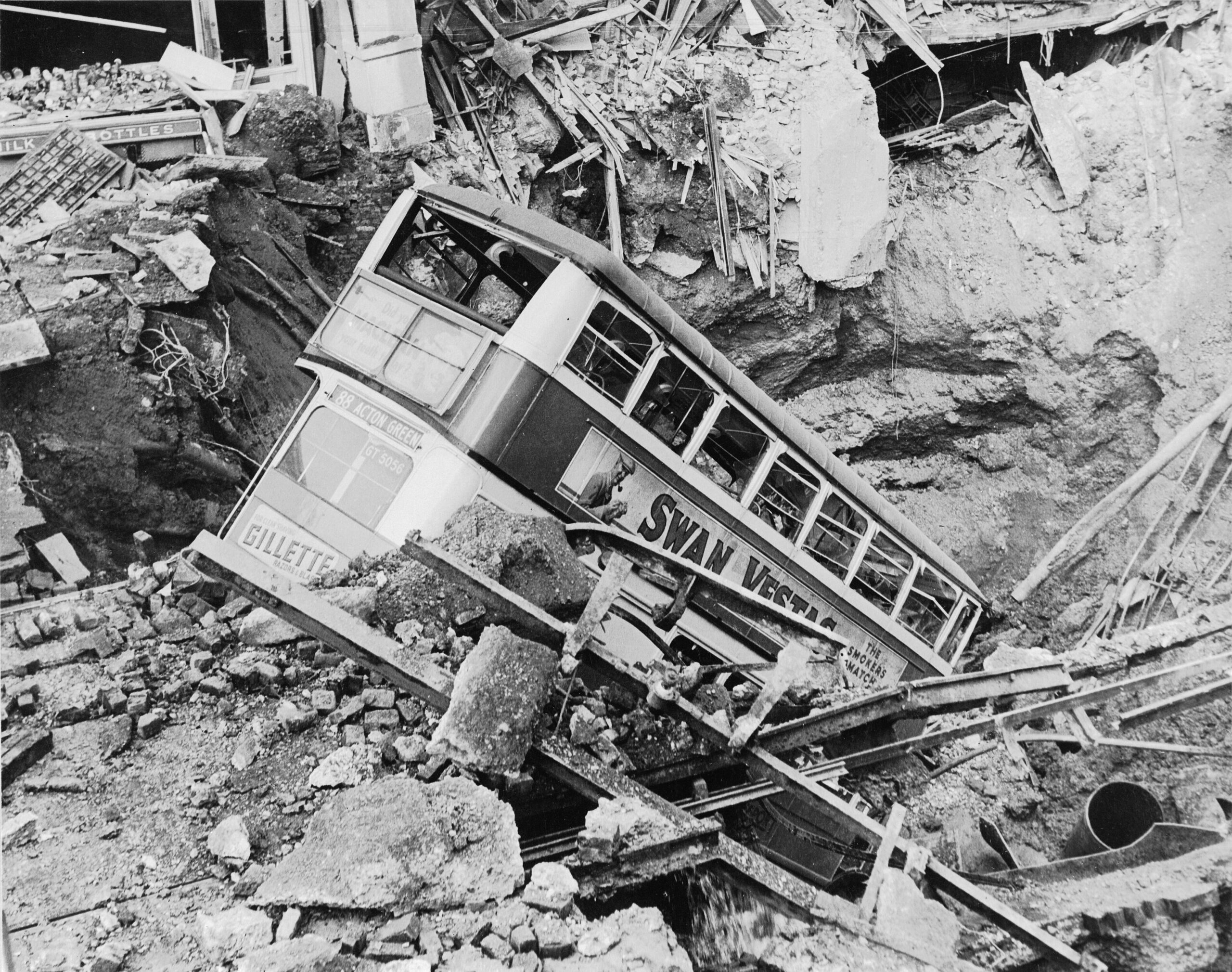
Balham

During the raid of 14–15 October a high-explosive bomb struck the roadway above Balham Underground station. The blast collapsed part of the tunnel and ruptured water and sewer mains, sending water, mud and debris into the station. Imperial War Museums records 64 people killed. A bus fell into the bomb crater above, producing one of the most familiar images associated with the disaster. Balham exposed the limits of the language of 'safe' shelter. Deep stations offered substantial protection against blast and fragments across a large city, but a direct structural…

Continue in The Blitz →
1942
German infantry haul a light infantry gun into a new position against Soviet strongpoints in Stalingrad, 12 October 1942.
German infantry haul a light infantry gun into a new position against Soviet strongpoints in Stalingrad, 12 October 1942. Bundesarchiv Bild 183-B22222 / Herber · CC BY-SA 3.0 DE Source
Battle of Stalingrad

Sixth Army launches the factory offensive

On 14 October Sixth Army concentrated 14th Panzer Division, 305th Infantry Division and supporting formations against the northern industrial sector. Tanks and panzer grenadiers moved at first light under heavy artillery and air support, while engineers attacked strongpoints around the tractor factory and workers’ settlements. German troops entered the tractor factory during the morning and reached the Volga east of it by the following day, cutting 62nd Army’s northern bridgehead again. The attack achieved a deeper penetration than the preceding weeks of local fighting, but Soviet units remained in the…

Continue in Battle of Stalingrad →
1943
Child survivors of Auschwitz, wearing adult-size prisoner jackets, stand behind a barbed wire fence.
USHMM

The Sobibór uprising opens a mass escape

Prisoners led by Alexander Pechersky and Leon Feldhendler organised an uprising on 14 October 1943. Members of the underground killed a number of SS personnel and guards before prisoners moved toward the camp perimeter in a mass breakout. Around three hundred prisoners escaped the camp area; many were later recaptured or killed, while several dozen survived the war. The revolt accelerated the German decision to dismantle Sobibór and erase visible traces of the killing centre.

Continue in The Holocaust: Timeline and Evidence →
Schweinfurt burns as a B-17 turns for home during the 14 October 1943 mission remembered as Black Thursday.
Schweinfurt burns as a B-17 turns for home during the 14 October 1943 mission remembered as Black Thursday. United States Army Air Forces / National Museum of the U.S. Air Force · Public domain in the United States Source
The Combined Bomber Offensive

Black Thursday

The Eighth Air Force dispatched 291 B-17s to Schweinfurt. Escort protection ended in western Germany, leaving the force exposed to repeated fighter attacks on the inward and outward routes. Sixty bombers were lost and seventeen more were written off after return. Deep unescorted operations were sharply restricted for the remainder of 1943.

Continue in The Combined Bomber Offensive →