Skip to content
WW2 Theatres Theatres of the Second World War
Home

World War II calendar

WWII On This Day: May 31

What happened on May 31 during World War II? This date brings together 11 events from 1940, 1941 and 1942, with period photographs and links to the full operations documented across WW2 Theatres.

1940
German troops at Lille
Dunkirk: Operation Dynamo

French First Army formations continue fighting at Lille

French troops encircled around Lille resisted several German divisions while the Dunkirk evacuation continued farther north. The pocket could not be relieved, but its defence delayed German formations that might otherwise have been available against the perimeter.

Continue in Dunkirk: Operation Dynamo →
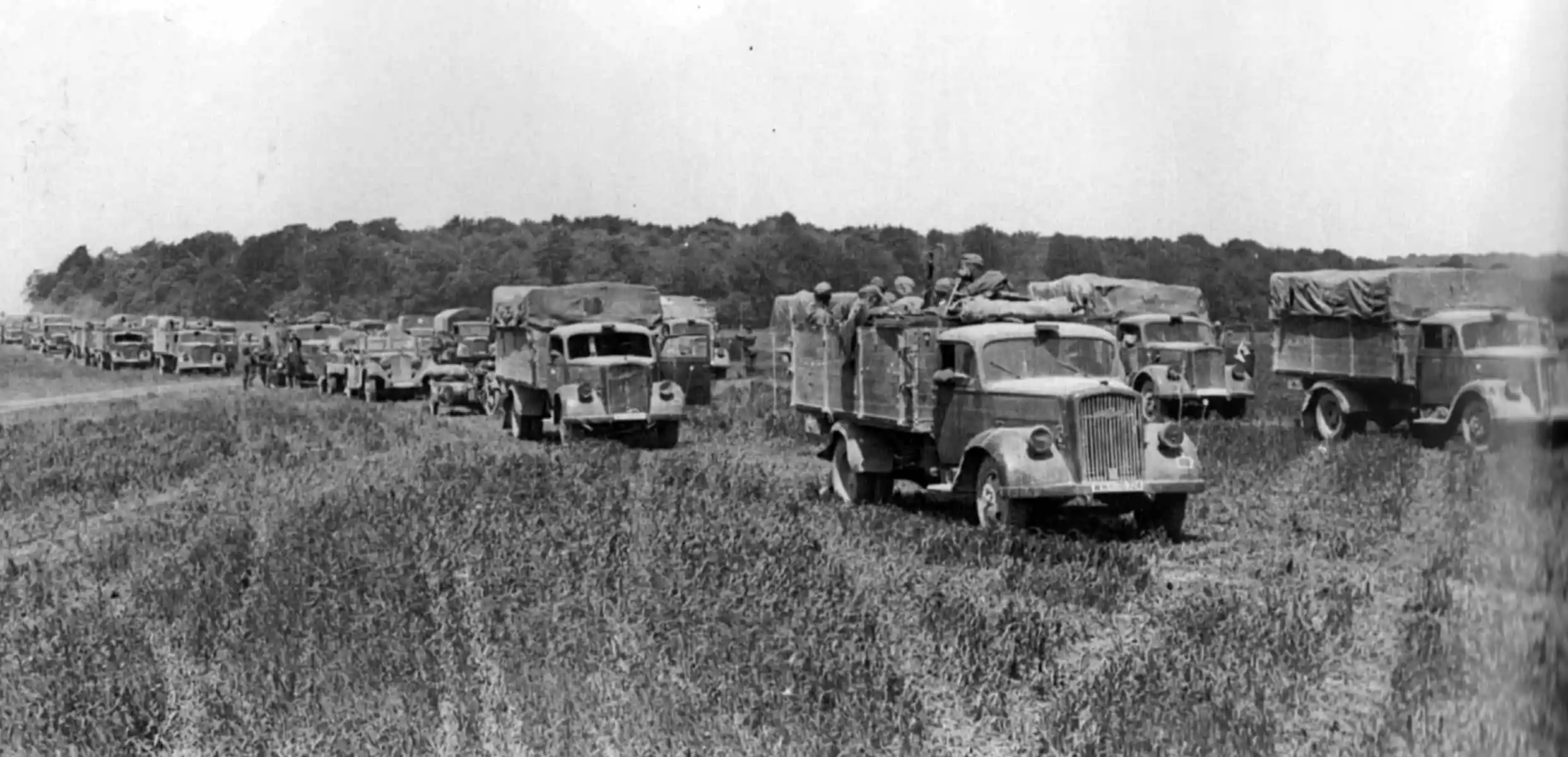
German troops in northern France during the campaign of 1940.
Bundesarchiv Bild 101I-299-1808-10A · CC BY-SA 3.0 DE · Source
Battle of France 1940

French formations hold an encircled position at Lille

Elements of the French First Army fought inside and around Lille from 28 to 31 May after German formations closed around them during the retreat toward Dunkirk. The encircled corps and divisions defended urban and suburban positions against several German divisions, consuming time and attention while other Allied troops moved north toward the evacuation perimeter. The surviving defenders entered captivity after ammunition and movement options narrowed. Their stand formed part of the land battle that protected Dynamo, connecting the evacuation directly to French resistance away from the beaches.

Continue in Battle of France 1940 →
British troops rescued in a ship at Dunkirk (France, 1940).
Divide and Conquer (Why We Fight #3) directed by Frank Capra
Dunkirk: Operation Dynamo

Gort leaves and Alexander takes command of the British rearguard

The British government ordered Lord Gort to return to England. Major-General Harold Alexander assumed command of the remaining British forces in the perimeter. Alexander was instructed to continue cooperating with the French defence and to evacuate the remaining British formations without abandoning Allied troops who still required shipping.

Continue in Dunkirk: Operation Dynamo →
1941
Walking wounded evacuated from Crete disembark at an Egyptian port on 31 May 1941; immediate aftermath of the evacuation lifts.
Walking wounded evacuated from Crete disembark at an Egyptian port on 31 May 1941; immediate aftermath of the evacuation lifts. Lt Leslie Buxton Davies / No. 1 Army Film & Photographic Unit / Imperial War Museums, E 3282 · Public domain (UK Government) Source
Battle of Crete

The final large evacuation takes men off Sfakia

The last large organised lift from Sfakia began on the night of 31 May. Nearly 4,000 men were embarked in the final operation recorded by the British official history, after several previous nights had carried thousands of troops away from the south coast. Naval capacity, the distance to Egypt and the danger of daylight air attack imposed a hard end to the evacuation. Several thousand British and Commonwealth troops remained on Crete when the ships departed, alongside Greek soldiers and men who had become separated from organised formations. Some soldiers…

Continue in Battle of Crete →
1942
Cologne showing extensive bomb and fire damage after Operation Millennium in May 1942.
Cologne after the raid of 30–31 May 1942 · U.S. Department of Defense. Department of the Army.
Operation Millennium

Flak and night fighters

Heavy anti-aircraft batteries around Cologne engaged the stream while night fighters attacked along the route. The concentration shortened exposure over the target but could not protect aircraft travelling to and from it. Many losses occurred away from Cologne, where fighters intercepted bombers crossing the Low Countries or returning individually to Britain.

Continue in Operation Millennium →
Operation Millennium

The final aircraft clear the city

The last scheduled waves passed over the target and turned west. Around 868 aircraft were credited by one official modern summary with reaching and bombing Cologne. Smoke and fire were visible over a large distance. Crews returned with radically different impressions depending on cloud, altitude and the part of the city they had crossed.

Continue in Operation Millennium →
Operation Millennium

Forty-one do not return

Forty-one bombers were lost, an overall loss rate of about 3.9 percent. Some were shot down by flak or night fighters, while others crashed or collided. The use of training crews had been controversial, yet the official history found that their loss rate was not dramatically worse than that of the operational groups.

Continue in Operation Millennium →
Flying Officer Leslie Manser, awarded the Victoria Cross after remaining with his damaged Manchester while his crew escaped.
Flying Officer Leslie Manser, awarded the Victoria Cross after remaining with his damaged Manchester while his crew escaped. Royal Air Force · RAF Museum Source
Operation Millennium

Leslie Manser holds the aircraft

Flying Officer Leslie Manser's Avro Manchester was badly damaged by anti-aircraft fire. He kept the aircraft under control while the rest of the crew escaped by parachute. Manser was killed when the aircraft crashed. He was awarded the Victoria Cross posthumously for giving his crew the chance to survive.

Continue in Operation Millennium →
Operation Millennium

The return becomes another hazard

Returning aircraft reached Britain over several hours, many short of fuel, damaged or unable to land at their home stations. Diversions and emergency landings crowded the airfield system. The Canadian official history noted that landing was among the most dangerous stages of the operation, with collisions and damaged aircraft adding to the night's cost.

Continue in Operation Millennium →
Operation Millennium

The Mosquito photographs the result

Four Mosquitoes of No. 105 Squadron carried out a combined bombing and reconnaissance mission over Cologne the next morning, the type's operational debut in Bomber Command. Photography confirmed extensive damage and thousands of fires, giving Harris the evidence needed to present the operation as a breakthrough.

Continue in Operation Millennium →
Operation Millennium

A city counts the damage

German records used by the British official history listed 486 people killed, 5,027 injured and 59,100 made homeless. Other summaries give slightly different totals, commonly around 469 to 474 dead. Thousands of homes, workshops and public buildings were destroyed or damaged. Industrial production was disrupted, but the city and its factories were not permanently disabled.

Continue in Operation Millennium →