Skip to content
WW2 Theatres Theatres of the Second World War
Home

World War II calendar

WWII On This Day: August 24

What happened on August 24 during World War II? This date brings together 9 events from 1940, 1942 and 1944, with period photographs and links to the full operations documented across WW2 Theatres.

1940
A formation of Heinkel He 111s in the Battle of Britain
Imperial War Museums, MH6547 · Public domain · Source
The Battle of Britain

Bombs fall on central London

During German night operations on 24–25 August, bombs fell on central London. British accounts long treated the episode as an accidental or navigationally mistaken attack during raids whose principal targets lay elsewhere. The event matters because the clean boundary between military targets and cities was already breaking down. London contained docks, railways, power, industry, government and dense residential districts; an attack on one category could not be separated physically from the others. Churchill authorised a retaliatory attack on Berlin for the following night. The raids on the two capitals became…

Continue in The Battle of Britain →
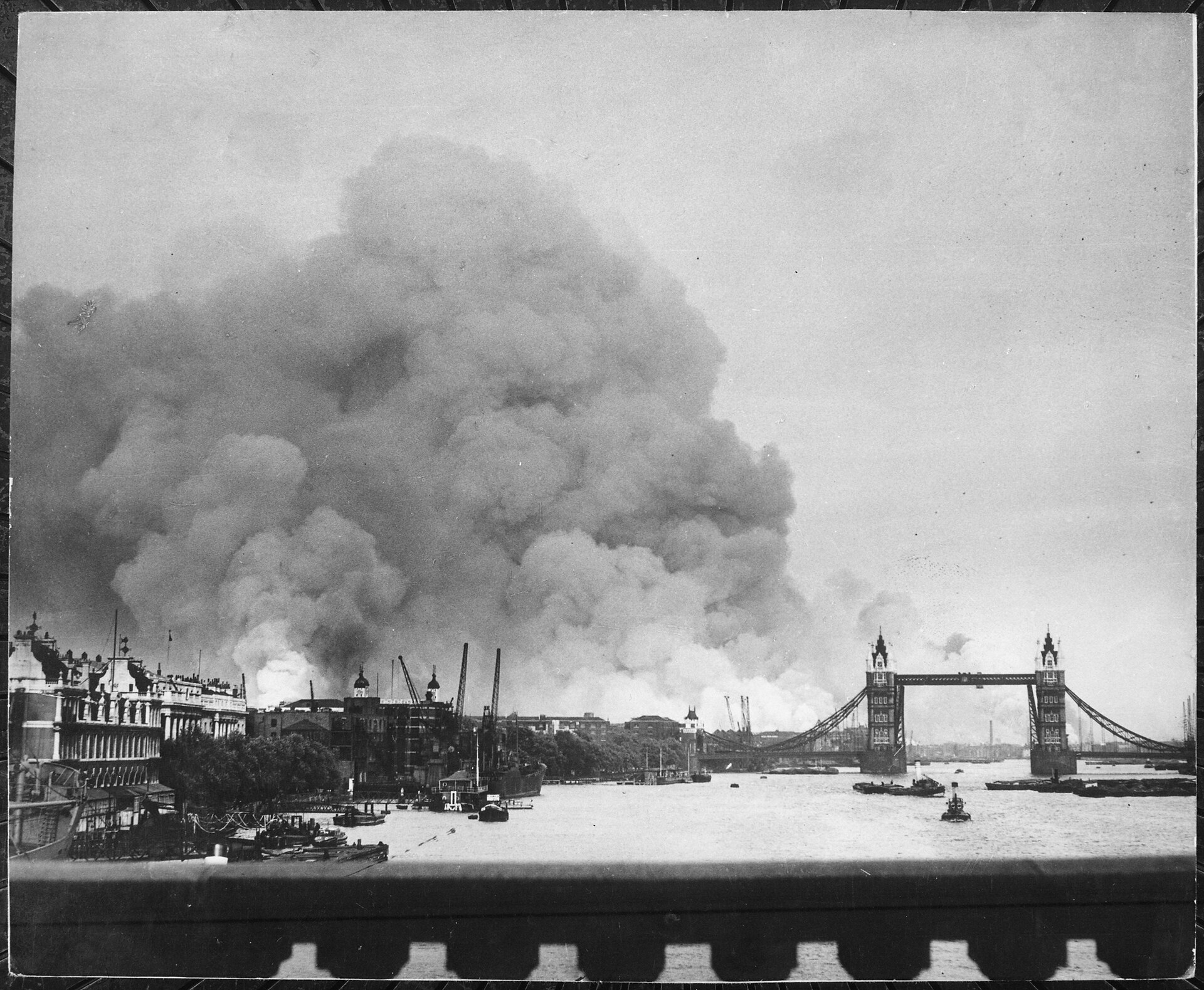
London, 7th September 1940 · London's dock area. Tower Bridge stands out against a background of smoke and fires. New York Times Paris Bureau Collection.
U.S. National Archives and Records Administration (NARA 541917) · Public domain
The Blitz

German bombs fall on London

During the night of 24–25 August German bombs fell in central and east London while Luftwaffe formations were attacking targets around the Thames Estuary and elsewhere. The familiar story reduces the incident to one lost crew; the surviving operational picture is less neat, but London had not yet been selected for the mass attack that began in September. Churchill authorised a retaliatory raid on Berlin for the following night. Eighty-one British bombers were dispatched, and only part of the force found the capital. Material damage was slight, but the raid…

Continue in The Blitz →
1942
A German tank commander in southern Soviet territory in June 1942, shortly before the opening of Case Blue.
Bundesarchiv Bild 101I-218-0528-30 · CC BY-SA 3.0 DE · Source
Case Blue and the Drive to the Caucasus

First Panzer Army reaches Mozdok

First Panzer Army reached Mozdok on the north bank of the Terek on 24 August. The river formed the last major natural barrier before the approaches toward Grozny, Makhachkala and the eastern military roads. Kleist's army arrived chronically short of motor fuel. More importantly, the strategic pursuit was ending. Soviet forces were being compressed onto shorter lines around crossings, ridges and approaches that could be defended more economically than the open steppe. Crossing the Terek therefore required a new kind of operation: bridgeheads had to be forced and expanded while…

Continue in Case Blue and the Drive to the Caucasus →
1944
Allied landing craft off the Île d'Or at Le Dramont, Camel Beach, during the landing in Provence, August 1944.
Landing craft off the Île d'Or at Le Dramont, Camel sector, August 1944 · Public domain · Source
Operation Dragoon

The 11th Panzer holds the gate open

Wietersheim's 11th Panzer Division, the only armour the Nineteenth Army had, fought a rearguard along the Rhône that kept the road open for most of the retreating force. American artillery could interdict the road but could not close it. It was the most professional German performance of the campaign, conducted by a division that had already crossed France once under air attack to reach the battle.

Continue in Operation Dragoon →
Leclerc and men of the 2e Division Blindée at Antony on 24 August 1944, during the fight through the southern approaches to Paris.
Leclerc and men of the 2e Division Blindée at Antony on 24 August 1944, during the fight through the southern approaches to Paris. Archives départementales des Hauts-de-Seine · Licence Ouverte 1.0 Source
The Liberation of Paris

The advance is held at the southern approaches

The 2e Division Blindée met determined German resistance on the roads through Antony, Fresnes and the southern approaches. Progress was slower than Leclerc wanted while columns searched for routes through roadblocks and defended junctions. The delay mattered because the uprising had already been under way for days. A dated photograph from Antony places Leclerc and his men on this approach on 24 August.

Continue in The Liberation of Paris →
Tanks and half-tracks of the French 2e Division Blindée pass the Arc de Triomphe through crowds on the Champs-Élysées, 26 August 1944.
Jack Downey, US Office of War Information · Library of Congress · Public domain · Source
The Liberation of Paris

Leclerc orders a detachment in by any route

With the main columns still delayed on the approaches, Leclerc ordered Captain Raymond Dronne to take a small detachment by back routes and reach the centre of Paris that night. Dronne's vanguard included the 9th Company of the Régiment de marche du Tchad, La Nueve, largely composed of Spanish Republicans, together with tanks and half-tracks from the division.

Continue in The Liberation of Paris →
The Liberation of Paris

La Nueve enters the city

Dronne's column came through the Porte d'Italie and drove north through streets held or screened by the Resistance, with civilians helping point out routes around German positions. Many of La Nueve's half-tracks carried names from the Spanish Civil War: Guadalajara, Teruel, Madrid, Ebro, Brunete and Guernica. The names made the company's earlier war visible as it entered Paris.

Continue in The Liberation of Paris →
The Liberation of Paris

The first troops reach the Hôtel de Ville

La Nueve halted on the square in front of the Hôtel de Ville. The first regular Allied soldiers to reach the centre of Paris were Spanish exiles in American vehicles wearing French uniforms. Dronne was taken inside to the Council of Resistance and to Georges Bidault. The rest of the division was still south of the city.

Continue in The Liberation of Paris →
The Liberation of Paris

The bells

The great bell of Notre-Dame began to ring and church bells across Paris followed. The sound carried through a city that was still divided by German strongpoints and Resistance-held streets. For Parisians who could not see the Hôtel de Ville, the bells announced that regular French troops had reached the centre.

Continue in The Liberation of Paris →