Skip to content
WW2 Theatres Theatres of the Second World War
Home / The Western Front / Operation Dragoon
U.S. Navy LCVPs on a Baie de Cavalaire invasion beach during Operation Dragoon, 15 August 1944, with German prisoners passing behind them.

Operation Dragoon

15 August to 14 September 1944 · Provence and the Rhône valley · Southern France campaign

Operation Dragoon put the U.S. Seventh Army and French Army B ashore in Provence on 15 August 1944. The assault secured a lodgement east of Toulon, accelerated the capture of Toulon and Marseille, and opened a pursuit up the Rhône valley while Army Group G withdrew from southern France. By mid-September the force from Provence had joined the Allied armies advancing from Normandy, while engineers were already restoring Marseille as a major supply port.

Baie de Cavalaire invasion beach, 15 August 1944 · U.S. Navy / Naval History and Heritage Command 80-G-59475 · Public domain · Source

CAMPAIGN
15 Aug–14 Sep 1944Official U.S. Army campaign dates for Southern France
ASSAULT FORCE
3 U.S. divisionsVI Corps landed the 3rd, 45th and 36th Infantry Divisions at Alpha, Delta and Camel
FRENCH ARMY B
About 250,000–260,000Five infantry and two armored divisions plus supporting formations; many soldiers came from North Africa and sub-Saharan Africa
PORTS
Toulon & MarseilleBoth German garrisons had surrendered by 28 August, weeks ahead of the original planning schedule
LOGISTICS
More than one-thirdShare of Allied supply needs in northern France soon provided through Toulon and Marseille
Marker affiliation Allied Axis Other / contested
Map layers

01 / 17

The Ground

The Riviera, the Rhône corridor and the Alpine flank

The coast between Toulon and Cannes offered beaches with deep water close inshore, a mild sea, and defences that had been stripped through the summer to feed Normandy. The Nineteenth Army held 300 miles of it with divisions that were static, under-equipped and in several cases made up of eastern European conscripts.

Inland the country does the work. North of the beaches the Maures and Esterel massifs rise straight off the shore, and behind them the whole of southern France funnels into one corridor: the Rhône valley, running north from Avignon to Lyon between the Alps and the Massif Central. An army retreating from Provence has to use it. An army that reaches Montélimar before the retreating army does can close it.

That geometry is the whole campaign. The landing was the easy part. What followed was a race for a valley, run by a force improvised out of reconnaissance troops on roads that the Resistance had already cleared.

Command & Decision

Allied and German, ranks as held in August 1944

Dragoon was the most argued-over Allied operation of the war. Churchill fought it from the Tehran conference until five days before the landings, wanting the troops sent into northern Italy and towards the Balkans instead. Marshall and Eisenhower wanted a working deep-water port, and the French wanted their own army back on French soil. The Americans won because they were paying for it.

The composition of that army is the fact most often left out. Around 250,000 of the men who landed in Provence belonged to French Army B, and more than half of them were African and North African: Algerian and Moroccan tirailleurs, Moroccan goumiers, Senegalese and West African troops, alongside pieds-noirs and men who had escaped occupied France. From October 1944 many of these units were withdrawn and replaced with white FFI volunteers in a process the French command called blanchiment, so the soldiers photographed entering Paris and Strasbourg were frequently not the ones who had come ashore.

Frederick B. Butler
Brigadier General, United States

Frederick B. Butler

Task Force Butler, VI Corps

Given a scratch force assembled from reconnaissance troops, a tank battalion and whatever else could be spared, and told to reach the Rhône before the Germans did. Covered 200 miles in three days and sat across the escape route of an entire army, out of fuel and unsupported.

US Army Signal Corps · NARA · Source
Jean de Lattre de Tassigny
Général d'armée, France

Jean de Lattre de Tassigny

Commanding, French Army B

Landed 250,000 men through beaches designed for far fewer, then attacked Toulon and Marseille simultaneously with forces the plan had not allocated to either. Took both 27 days ahead of schedule.

ECPAD · Service historique de la Défense · Source
Alexander Patch
Lieutenant General, United States

Alexander Patch

Commanding, US Seventh Army

Had commanded on Guadalcanal before taking Seventh Army for the landing. Ran a coalition operation in which the majority of his ground troops were French and the majority of those were African, and did it with very little friction.

US Army Signal Corps · NARA · Public domain · Source
Lucian Truscott
Major General, United States

Lucian Truscott

Commanding, US VI Corps

Recognised that he had no formation capable of exploitation and built one out of spare parts in three days. The decision to create and launch Task Force Butler is the reason the Nineteenth Army was nearly trapped rather than merely pushed.

US Army Signal Corps · NARA · Public domain · Source
Joseph de Goislard de Monsabert
Général de division, France

Joseph de Goislard de Monsabert

Commanding, 3e Division d'infanterie algérienne

Took Marseille with an Algerian division fighting alongside an insurrection already under way in the city. His division carried much of the French infantry effort in Provence and had come to it through Tunisia and Italy.

ECPAD · Service historique de la Défense · Source
Robert T. Frederick
Major General, United States

Robert T. Frederick

Commanding, First Airborne Task Force

Had raised and led the First Special Service Force, the American and Canadian formation that took the offshore islands on the first night. At 37 he commanded the improvised airborne division that dropped at Le Muy.

US Army Signal Corps · NARA · Public domain · Source
Winston Churchill
Prime Minister, United Kingdom

Winston Churchill

The opponent of the operation

Argued against the landing from Tehran until five days before it, wanting the troops used in northern Italy and towards the Ljubljana Gap with an eye on the postwar map. He lost, went to sea to watch the landing, and later described it as a strategic mistake.

Imperial War Museums · Public domain · Source
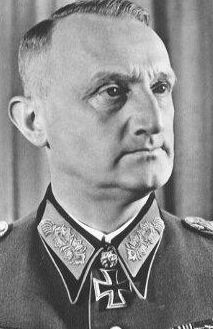
Johannes Blaskowitz
Generaloberst, Germany

Johannes Blaskowitz

Commanding, Army Group G

Ordered to extract two armies from southern and south-western France up a single valley under total air superiority. Got a substantial part of the Nineteenth Army out, which was more than the situation entitled him to.

Bundesarchiv Bild 146-2004-004-05 · CC BY-SA 3.0 DE · Source
Friedrich Wiese
General der Infanterie, Germany

Friedrich Wiese

Commanding, Nineteenth Army

Held 300 miles of coast with static divisions, no transport and one armoured division on the wrong side of a river whose bridges had been destroyed from the air. Lost most of his army's equipment on the Rhône road and most of its manpower to captivity.

Bundesarchiv · CC BY-SA 3.0 DE · Source
Wend von Wietersheim
Generalleutnant, Germany

Wend von Wietersheim

Commanding, 11th Panzer Division

Brought his division across France under constant air attack to reach the battle, then fought the rearguard along the Rhône that kept the retreat road open through the Montélimar week. The most effective German conduct of the campaign.

Bundesarchiv Bild 146-1972-031-42 · CC BY-SA 3.0 DE · Source

Ships, Guns & Machines

Materiel of the operation

Dragoon was mounted from the Mediterranean with equipment worn out by two years of campaigning in Africa, Sicily and Italy. It went in with fewer landing craft than Normandy and against a coast that had been thinned to reinforce it, which is why an assault of this size succeeded at a cost that reads more like a rehearsal than a battle.

Two items on this page decided more than the rest. One is the fleet, because the whole point of the operation was a port. The other is the road network of the interior, which the maquis had been cutting since June and which allowed a scratch American task force to travel two hundred miles in three days through country nobody had cleared for it.

M4 & M4A1 Sherman
Sherman tanks of the 4/7th Dragoon Guards, 8th Armoured Brigade, waiting to go into action near Rauray, Normandy, 28 June 1944.
Public domain · via Wikimedia Commons · Source

M4 & M4A1 Sherman

Amphibious fleet · about 880 ships · over 1,300 landing craft · 9 escort carriers

Sherman tanks of the 4/7th Dragoon Guards, 8th Armoured Brigade, waiting to go into action near Rauray, Normandy, 28 June 1944.

C-47 Skytrain and the Waco glider
C-47A Skytrains of the type that carried the airborne task force.
US Army Air Forces · Public domain · Source

C-47 Skytrain and the Waco glider

Air transport · about 5,000 parachutists · 400 gliders at Le Muy

The First Airborne Task Force was improvised from American and British battalions in the Mediterranean and dropped in poor visibility before dawn. The drop was more accurate than Normandy's, in part because the terrain around Le Muy gave clearer marks and the flak was thin.

The gliders at Le Muy
Gliders on the landing ground at Le Muy, photographed from the German side.
German wartime photograph · via Wikimedia Commons · Source

The gliders at Le Muy

Assault glider · Waco CG-4A and Horsa · landed through 15 August

Gliders came in through the day onto fields staked with anti-landing poles. The photograph here was taken from the German side, which is a useful corrective: most of the surviving imagery of this operation is Allied, and the view from the other end of the field looks different.

Battleship Lorraine
Bretagne-class battleship Lorraine firing at the Cépet shore battery, near Toulon, made up with the guns of her sister-ship Provence. Operation Dragoon, 1944.
Public domain · via Wikimedia Commons · Source

Battleship Lorraine

Battleships Nevada, Texas, Arkansas, Ramillies and Lorraine · with cruisers and destroyers

Dreadnought that featured ten 340 mm guns, a 20-knot top speed, and provided vital naval gunfire support during Operation Dragoon in August 1944.

Carrier and land-based air
A train under attack by Hellcats of VOF-1 west of Carcassonne.
US Navy 80-G-46497 · NARA · Public domain · Source

Carrier and land-based air

About 1,300 aircraft · from Corsica, Sardinia and Italy · VOF-1 Hellcats from escort carriers

Air power did more damage to the Nineteenth Army on the roads than the ground forces did in contact. Trains were caught as far west as Carcassonne, the Rhône bridges were destroyed before the 11th Panzer could use them, and daylight movement became impossible across the whole south.

The forts of Toulon
Fort Faron above Toulon, taken from the landward side in August 1944.
Wikimedia Commons · Creative Commons · Source

The forts of Toulon

Coastal fortress · Fort Faron, Six-Fours, the arsenal · guns facing seaward

Toulon had been fortified for three centuries against attack from the sea. De Lattre went round the back and took the forts from the landward side with North African infantry, which is why the city fell in a week rather than in the two months the planners had allowed.

Task Force Butler
A U.S. Sherman burns on the road toward Flassan in southern France, 17 August 1944.
BU 2396 · Imperial War Museums · Source

Task Force Butler

Improvised armour · recce squadron, tank battalion, armoured infantry, artillery · formed in 3 days

Assembled because VI Corps had no armoured division and needed one. It travelled two hundred miles of mountain road in three days on the strength of Resistance road intelligence, and arrived at Montélimar with almost no fuel and a fraction of its ammunition.

Henschel Hs 293
A captured Henschel Hs 293 photographed in Britain on 10 September 1944, used here as later equipment-identification imagery.
U.S. Army Air Forces / NARA NAID 204845023 · Public domain · Source

Henschel Hs 293

German radio-command guided glide bomb · rocket-assisted launch · anti-shipping weapon

The Hs 293 gave the limited German air effort a specialized anti-shipping capability. A guided bomb sank LST-282 off the Dragoon beaches on 15 August, demonstrating that ships offshore remained vulnerable even after Allied air superiority had sharply reduced conventional German attacks. The photograph is a captured weapon documented in Britain the following month, used here for equipment identification.

The Cost

Figures as proposed by the sources named

Dragoon was the cheapest major amphibious operation of the war in the west, and the disproportion between the two sides is the most striking thing in the record. The Nineteenth Army lost more men as prisoners in four weeks than the Allies lost in total.

The French figures below cover Army B from the landing to the link-up. They do not separate metropolitan from colonial casualties, which is one of the reasons the contribution of the North and West African units has been so hard to quantify since.

About 4,500

U.S. battle casualties

U.S. Army campaign history total for Southern France; slightly over 2,000 were killed, captured or missing.

About 2,700

French casualties at Toulon

Killed and wounded during the battle for Toulon in the U.S. Army official history. This figure covers the city battle; total French losses for Operation Dragoon require a wider accounting.

Up to about 7,000

Estimated German killed

An upper estimate in the U.S. Army campaign study; German killed and wounded totals are less certain and may include losses from air attack and Resistance action.

More than one-third

Allied supply needs

Share of requirements in northern France soon supplied through Toulon and Marseille after port clearance and repair.

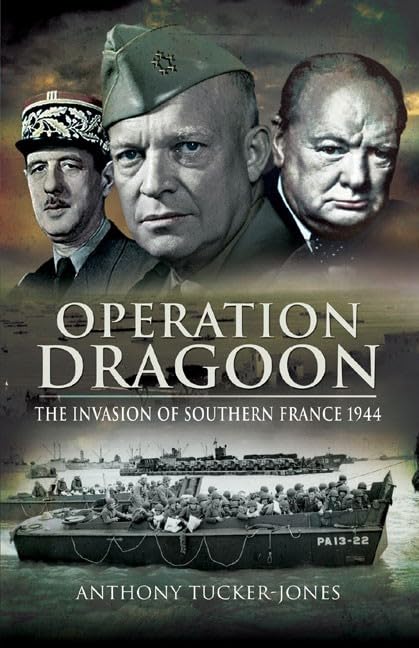
Books & Relics

The authenticity of the relics is not verified by WW2 Theatres.

This collection is curated by WW2 Theatres and not affiliated with our website, with all site photographs licensed to their respective owners.

Sources & Archives

US Army Center of Military History · ECPAD · Service historique de la Défense

This operation is documented more fully in French than in English. The ECPAD holds the Service cinématographique des armées film and photographic record, catalogued down to individual frames, and the Service historique de la Défense at Vincennes holds the Army B war diaries. The Musée de la Résistance en ligne carries the maquis side. The American official history covers the Seventh Army and the strategic argument that preceded the landing.

Front lines and force areas drawn on the map are approximate, generalised from the daily situation maps. Times on 15 August are from the naval and divisional after-action reports; from 16 August the record is daily.

  1. Riviera to the Rhine, Jeffrey J. Clarke and Robert Ross Smith, 1993U.S. Army Center of Military History
  2. Le débarquement de Provence dans les fonds de l'ECPADECPAD, Établissement de communication et de production audiovisuelle de la Défense
  3. War diaries and operational records of Army B and the First French ArmyService historique de la Défense, Vincennes
  4. Le débarquement de Provence, documentary material on the landing and the ResistanceMusée de la Résistance en ligne
  5. 15 août 1944. Le débarquement de ProvenceMinistère des Armées et des Anciens combattants
  6. Operation Dragoon: The Invasion of Southern FranceNaval History and Heritage Command, U.S. Navy
  7. Heeresgruppe G records and the withdrawal from southern FranceBundesarchiv, Militärarchiv Freiburg
  8. Southern France, U.S. Army Campaigns of World War IIU.S. Army Center of Military History
  9. Records of the First Airborne Task Force and the drop at Le MuyU.S. National Archives and Records Administration
  10. The port of Marseille under occupation, demolition and reconstruction, 1944Archives départementales des Bouches-du-Rhône
  11. The Supreme Command, Forrest C. PogueU.S. Army Center of Military History
  12. Foreign Relations of the United States, 1944, The Conference at QuebecU.S. Department of State, Office of the Historian
Operation chronologyDates, locations and sourced event summaries
DateEventLocationSummary
28 November to 1 December 1943 · ConferenceTehran Keeps a Southern France Landing in the 1944 PlanTehran

At the Tehran Conference, Allied leaders linked the 1944 cross-Channel invasion with a supporting operation from the Mediterranean against southern France. The concept later called ANVIL was intended to bring additional Allied forces onto the Continent and to support the main campaign in northern France.

Sources 11
2 July 1944 · DirectiveThe Combined Chiefs Set 15 August for ANVILCombined Chiefs of Staff

On 2 July the Combined Chiefs of Staff directed the Mediterranean command to prepare the southern France assault for 15 August. The initial landing was to use three U.S. divisions, followed by a larger build-up that included the French army assembling in the Mediterranean.

Sources 8, 11
9 to 10 August 1944 · Final orderThe Mediterranean Command Is Told to ProceedLondon

Winston Churchill made a final effort in early August to redirect the forces assigned to Dragoon toward other Mediterranean objectives. Dwight D. Eisenhower continued to support the southern France landing on military grounds, especially the need for additional port capacity and another Allied army advancing inside France.

Sources 11, 12
14 August 1944 · D−1The Invasion Fleet Turns Toward ProvenceWestern Mediterranean

Convoys assembled from ports in Italy, North Africa, Sicily, Sardinia and Corsica converged on the invasion area under Vice Admiral H. Kent Hewitt's Western Naval Task Force. On 14 August the assault groups turned toward the Var coast while air and naval deception continued elsewhere in the western Mediterranean.

Sources 4, 5, 6
15 August 1944 · Before dawnAirborne and Special Forces Isolate the BeachheadLe Muy and the Argens valley

Before dawn, more than 5,000 parachutists of the First Airborne Task Force were dropped around Le Muy and La Motte to control road junctions behind the beaches; glider-borne troops and support elements followed during the day. Scattered drops created local confusion, but the force secured the road network needed to obstruct German reinforcement of the coast.

Sources 5, 8, 9
15 August 1944 · 08:00VI Corps Lands on the Var CoastAlpha, Delta and Camel sectors

At 08:00 the U.S. VI Corps put the 3rd Infantry Division ashore in Alpha sector around Cavalaire and Pampelonne, the 45th Infantry Division in Delta sector near Sainte-Maxime, and the 36th Infantry Division in Camel sector around Le Dramont and the approaches to Saint-Raphaël. Naval gunfire, minesweeping and Allied air power supported the three landings.

Sources 5, 6, 8
16 August 1944 · D+1French Army B Begins LandingSaint-Tropez and the invasion beaches

The first major echelon of French Army B came ashore on 16 August, including the 1st Free French Division, 3rd Algerian Infantry Division and 1st Armored Division. Jean de Lattre de Tassigny's force would eventually number roughly 250,000 to 260,000 men, with a large share drawn from North African and other African units.

Sources 2, 3, 5
18 August 1944 · 11:00The Nineteenth Army Receives Its Withdrawal OrderArmy Group G headquarters

At 11:00 on 18 August, Army Group G commander Johannes Blaskowitz received the part of the German withdrawal directive ordering the Nineteenth Army north from southern France. Toulon and Marseille were to remain as fortress garrisons while the field army tried to escape through the Rhône corridor toward the Dijon area.

Sources 1, 7
18 to 20 August 1944 · ExploitationVI Corps Pushes Mobile Forces Into the InteriorHaute-Provence

Task Force Butler left its assembly area on 18 August as VI Corps exploited through Haute-Provence. The improvised mobile force under Brigadier General Frederick B. Butler included reconnaissance, armor, armored infantry, artillery and tank-destroyer elements and initially moved north toward the Grenoble approaches.

Sources 1, 8
20 August 1944 · MorningFrench Forces Open the Battle for ToulonToulon

French forces opened the main attack on Toulon on 20 August. De Lattre used formations advancing along the coast and around the landward approaches to compress a garrison of roughly 18,000 troops into the fortified port area, while commandos and local Resistance forces supported attacks on batteries, roads and strongpoints.

Sources 1, 3, 5
21 August 1944 · Late afternoonTask Force Butler Reaches the Montélimar Battle SquareCrest and the Montélimar battle area

After regrouping at Aspres, Task Force Butler reached Crest late on 21 August, about thirteen miles east of the Rhône. Truscott's orders called for the force to seize high ground north of Montélimar and block the German withdrawal routes, with elements of the 36th Infantry Division moving up to reinforce it.

Sources 1, 8
23 August 1944 · Urban battleThe 3rd Algerian Infantry Division Enters MarseilleMarseille

On 23 August troops of Joseph de Goislard de Monsabert's 3rd Algerian Infantry Division pushed into Marseille, where an insurrection and strike had already challenged German control. French units entered from the north and east while the garrison still held fortified positions, port installations and key heights.

Sources 1, 3, 5, 10
28 August 1944 · SurrenderThe Port Garrisons SurrenderToulon and Marseille

By 28 August the remaining organized German positions at Toulon and Marseille had surrendered. Toulon's last fortified elements, including Saint-Mandrier, capitulated after the main city fighting had ended; at Marseille General Hans Schaefer surrendered the garrison after five days of fighting inside and around the city.

Sources 1, 3, 5, 10
21 to 29 August 1944 · Battle endsGerman Columns Escape the Montélimar BottleneckMontélimar and the Rhône valley

By 29 August the German withdrawal had passed the most dangerous point around Montélimar. Allied artillery, aircraft and ground forces inflicted heavy losses on columns and equipment, while the 11th Panzer Division and other German units kept a corridor open long enough for much of the Nineteenth Army to continue north.

Sources 1, 7, 8
3 September 1944 · PursuitLyon is liberatedLyon

German forces withdrew from Lyon and Allied and French Resistance forces entered the city on 3 September. The capture marked another major step up the Rhône valley and removed the largest urban center on the route toward eastern France.

Sources 1, 4, 5, 8
11 to 12 September 1944 · JunctionThe Armies From Normandy and Provence JoinDijon, Autun and Nod-sur-Seine

Contacts between forces advancing from northern and southern France took place on 11 and 12 September around the Dijon-Autun area. On 12 September elements of the French army from Provence joined Leclerc's 2nd Armored Division at Nod-sur-Seine, while U.S. forces made their own junctions farther west.

Sources 1, 3, 5, 8
14 to 15 September 1944 · TransitionThe Southern France Campaign ClosesEastern France

The U.S. Army's Southern France campaign period ended on 14 September. By then Seventh Army had reached objectives that pre-invasion planning had expected much later, while Toulon and Marseille were being restored for sustained logistical use.

Sources 8, 11

Image rights and provenance are stated per record. U.S. federal military photographs are public domain where identified as federal works. Bundesarchiv photographs used here are credited under CC BY-SA 3.0 Germany. The ECPAD image of Jean de Lattre de Tassigny is used under Licence Ouverte 2.0. Chronology media is attached only where the source supports the dated event, a tightly bounded operational attribution, or an explicitly identified immediate aftermath.