Skip to content
WW2 Theatres Theatres of the Second World War
Home / The Eastern Front / The Battle of Berlin 1945
Yevgeny Khaldei's photograph of Soviet soldiers raising a Soviet flag over the Reichstag in Berlin on 2 May 1945.

The Battle of Berlin

16 April to 2 May 1945 · The Oder, Brandenburg and Berlin · Seventeen days

The Soviet Berlin operation was not one continuous rush from the Oder to the Reichstag. Zhukov's main force first had to break the Seelow position; Konev's advance from the Neisse then threatened Ninth Army and Berlin from the south, while Rokossovsky opened the lower-Oder front to the north. Once those movements closed around the capital, the campaign divided into two connected battles: Soviet armies reduced Berlin while Ninth Army fought through the Halbe pocket toward Wenck. The regime continued ordering relief operations after the forces required to execute them had ceased to exist in usable form. Berlin's organised resistance ended on 2 May when Helmuth Weidling ordered the garrison to stop fighting.

Yevgeny Khaldei / TASS · 2 May 1945 · CC BY 4.0 via the Russian Ministry of Defence · Source

SOVIET FORCE
About 2.5 millionThe three Soviet fronts assembled for the wider Berlin operation, with roughly 6,250 tanks and 41,600 guns and mortars
OFFENSIVE OPENS
16 April 19451st Belorussian Front attacks from the Küstrin bridgehead while 1st Ukrainian Front crosses the Neisse
BERLIN ENCIRCLED
25 AprilSoviet spearheads meet west of the city; Ninth Army is already trapped separately to the south-east
SOVIET IRRECOVERABLE LOSSES
81,116Killed and missing in the wider Berlin strategic operation through 8 May, not only the seventeen-day city campaign
CITY CAPITULATION
2 May 1945Weidling crosses the Soviet lines before dawn and issues a written order ending organised resistance
Marker affiliation Allied Axis Other / contested
Map layers

01 / 29

The Ground

The Oderbruch, Seelow ridge, lake chains and Berlin's waterways turned distance into a series of separate military problems.

The direct road to Berlin from Zhukov's Küstrin bridgehead crossed the Oderbruch, a reclaimed floodplain cut by drainage ditches, watercourses and soft ground, before climbing onto the Seelow Heights. German defence was arranged in depth. The forward positions could absorb reconnaissance and deception, while the main battle line on and behind the ridge covered the roads west. The ground therefore punished congestion: infantry, armour, artillery and supply columns all needed the same limited approaches.

Konev faced a different landscape south of Frankfurt. Once 1st Ukrainian Front broke the Neisse line and reached the Spree, its tank armies could turn north across relatively open country and approach Berlin from the south. The lake country around Königs Wusterhausen, Halbe, Beelitz and Potsdam then became decisive because water and forest narrowed the routes available both to the Soviet encirclement and to Ninth Army's attempt to escape west.

Berlin itself was not the continuous fortress imagined in late-war propaganda. Its defensive sectors were unevenly prepared. The Spree, Landwehr Canal, Teltow Canal, railway embankments, flak towers and large masonry buildings created strong local positions, while other districts initially had little organised defence. Soviet armies therefore advanced by crossings and converging sector attacks rather than by one linear push toward the centre.

Command & Decision

The decisive choices concerned where the Soviet fronts would turn, when Ninth Army could withdraw, and whether Berlin would be defended or escaped from.

Stavka concentrated the operation on Berlin and the territory east of the Elbe while preserving flexibility on the flanks. Konev's plan already contained the possibility of turning the northern tank armies toward Berlin if the situation allowed it; that movement became more important when Zhukov's first-day attack at Seelow failed to produce the expected breakthrough. Rokossovsky, arriving later on the lower Oder, protected the northern side of the operation and prevented Third Panzer Army from becoming a coherent relief force.

The central German command problem was Ninth Army. Busse and Heinrici understood that once Konev's tanks moved behind the army, the Oder position could become a trap. Hitler delayed withdrawal, then pulled LVI Panzer Corps into Berlin and repeatedly demanded relief attacks by Steiner, Wenck and Busse. Those orders treated units shown on situation maps as if headquarters, fuel, transport, artillery ammunition and open roads still existed in the strength required to execute them.

Inside the city Weidling inherited fragments of LVI Panzer Corps, Waffen-SS formations, police, Volkssturm, Hitler Youth and isolated heavy weapons rather than a purpose-built fortress garrison. He could organise sectors and local countermeasures, but he could not reconstruct a field army. His repeated consideration of a breakout reflected that reality. After Hitler's death and the failure of Krebs's attempt to obtain an armistice, Weidling chose capitulation rather than another uncoordinated destruction of the remaining garrison.

Joseph Stalin
Supreme Commander, Soviet Union

Joseph Stalin

Strategic direction of the Berlin operation

Made the rapid seizure of Berlin and the Soviet occupation zone a priority while telling Eisenhower that the city had lost much of its strategic importance. He approved an operational design that allowed Konev's northern tank armies to turn toward Berlin if circumstances required. The competition between fronts was real, but the more important fact was that Stavka preserved alternatives while the German command was losing them.

US National Archives and Records Administration · Public domain · Source
Georgy Zhukov
Marshal, Soviet Union

Georgy Zhukov

Commanding, 1st Belorussian Front

Commanded the 1st Belorussian Front on the direct Küstrin–Berlin axis. His opening attack at Seelow encountered the strongest prepared defence and severe congestion. Committing the Guards tank armies before a clean infantry breakthrough increased pressure but also traffic and losses. Once the Seelow system broke, his armies drove into the northern and eastern approaches and supplied much of the force that fought for the government district.

Grigory Vayl / Life · 12 February 1945 · Public domain in the United States · Source
Ivan Konev
Marshal, Soviet Union

Ivan Konev

Commanding, 1st Ukrainian Front

Broke the Neisse line on a broader and more weakly held sector, then exploited north and west with the 3rd and 4th Guards Tank Armies. The turn toward Berlin threatened Ninth Army from behind, closed the southern and western encirclement and brought Soviet forces to the Teltow Canal. His operational success changed the geometry of the battle before the city itself had been fully entered.

Russian Ministry of Defence · CC BY 4.0 · Source
Konstantin Rokossovsky
Marshal, Soviet Union

Konstantin Rokossovsky

Commanding, 2nd Belorussian Front

Opened the lower-Oder offensive four days after Zhukov and Konev because 2nd Belorussian Front was still redeploying from the Baltic. His armies broke Third Panzer Army, covered the northern flank of the Berlin operation and prevented the German formations north of the capital from becoming the coherent relief force imagined in bunker orders.

Russian Ministry of Defence · CC BY 4.0 · Source
Vasily Chuikov
Colonel General, Soviet Union

Vasily Chuikov

Commanding, 8th Guards Army

Led 8th Guards Army from the Seelow battle into Berlin's south-eastern districts. His command adapted from open-country breakthrough to canal crossings and combined urban assault groups. Chuikov then received Krebs's failed armistice approach on 1 May and Weidling's capitulation the following morning, giving his headquarters an unusual role in both the tactical assault and the formal end of the city battle.

Russian Ministry of Defence · CC BY 4.0 · Source
Adolf Hitler
Führer and Supreme Commander, Germany

Adolf Hitler

Final command from the Führerbunker

Continued exercising personal command from the Führerbunker after the eastern front had fragmented into separate pockets. He delayed Ninth Army's withdrawal, drew LVI Panzer Corps into Berlin and demanded relief attacks by Steiner, Wenck and Busse that did not possess the assembled forces or routes implied by the orders. He resisted surrender and a general breakout, then died by suicide on 30 April after receiving confirmation that no relief force was reaching the city.

Heinrich Hoffmann / Bundesarchiv Bild 183-1983-0331-500 · CC BY-SA 3.0 DE · Source
Gotthard Heinrici
Generaloberst, Germany

Gotthard Heinrici

Commanding, Army Group Vistula

Prepared Army Group Vistula's defence in depth and anticipated the opening Soviet assault closely enough to reduce the effect of part of the first bombardment. His more important late decision was to stop treating Hitler's relief orders as executable strategy. He tried to withdraw shattered formations and preserve Ninth Army; Keitel removed him after midnight on 29 April when those decisions conflicted with orders to stand and counterattack.

Bundesarchiv Bild 146-1977-120-09 · Johannes Bergmann · CC BY-SA 3.0 DE · Source
Theodor Busse
General der Infanterie, Germany

Theodor Busse

Commanding, Ninth Army

Commanded Ninth Army on the Oder and recognised that Konev's advance was turning the position into a pocket. Withdrawal came too late to preserve an organised route toward Berlin. Once encircled, Busse rejected the practical effect of orders to attack north and drove west through Halbe toward Wenck. Only part of the army and the civilians moving with it reached the western corridor.

Bundesarchiv Bild 146-1971-033-33 · CC BY-SA 3.0 DE · Source
Helmuth Weidling
General der Artillerie, Germany

Helmuth Weidling

Commanding, Berlin Defence Area

Entered Berlin with LVI Panzer Corps and was appointed commandant on 23 April. He inherited a defence composed of regular remnants, Waffen-SS, police, Volkssturm, Hitler Youth and fixed strongpoints rather than a coherent fortress army. He proposed an organised breakout, later judged a mass breakout impracticable, and on 2 May crossed the Soviet lines to issue the written order ending resistance.

Gleb Samsonov / Izvestia · Russian Ministry of Defence · CC BY 4.0 · Source
Walther Wenck
General der Panzertruppe, Germany

Walther Wenck

Commanding, Twelfth Army

Was ordered to turn Twelfth Army away from the Western Allies and attack toward Berlin. His command could not reach the capital. The useful mission became opening a corridor far enough east to meet survivors of Ninth Army and then moving soldiers, wounded personnel and civilians toward the Elbe. Wenck's actual operation therefore diverged sharply from the relief role still assigned to it in bunker directives.

Bundesarchiv Bild 101I-237-1051-15A · Schneider / Kunath · CC BY-SA 3.0 DE · Source

Ships, Guns & Machines

Massed artillery opened the operation; combined assault detachments, not tanks alone, carried it through the city.

The Soviet offensive was built around extraordinary artillery density and large armoured forces. T-34-85s formed the numerical core of the tank armies, while IS-2 heavy tanks, ISU-152 assault guns, B-4 howitzers and rocket launchers supplied direct and indirect fire against positions that lighter weapons could not quickly reduce. The famous searchlights at Seelow belonged to this system of fire and control, but smoke, haze and reflected light prevented them from producing the simple battlefield advantage later legend sometimes assigns to them.

Urban fighting required a different organisation. Soviet rifle units worked with engineers, tanks, self-propelled guns and artillery in assault groups designed to cross canals, open walls, clear cellars and upper floors, and bring direct fire onto a defended building. Tanks without infantry remained vulnerable to Panzerfaust teams at very short range, so armour was most useful when integrated into the street-clearing system rather than sent ahead of it.

German heavy equipment existed in pockets, not as a coherent armoured reserve. Panthers and a small number of Tiger IIs could dominate a street or road when fuel and mechanical condition allowed, and the 12.8 cm guns of the flak towers remained formidable fixed weapons. The ubiquitous Panzerfaust was more important to the local anti-tank battle. None of these weapons could restore the continuous operational front that had already been destroyed outside the city.

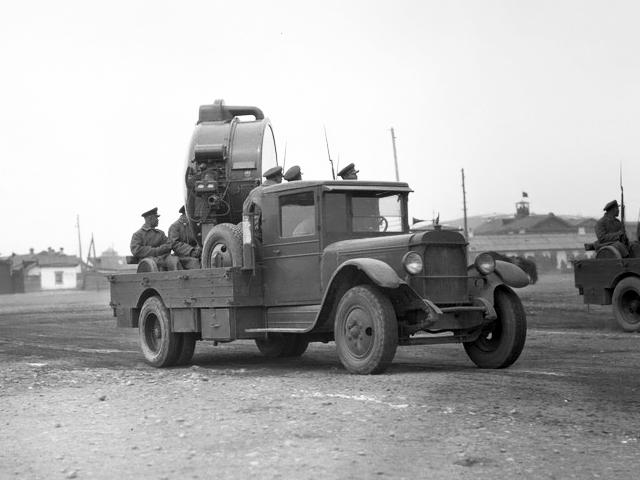
Z-15-4 / Z-15-4B searchlight
A Z-15-4 searchlight station carried on a ZiS-12 chassis; an exact equipment-type museum record, not a Seelow event photograph.
Museum of Russian Military History (Музей отечественной военной истории) · Source

Z-15-4 / Z-15-4B searchlight

Soviet · 150 cm anti-aircraft searchlight family · about 140 lights massed for the opening Seelow assault

About 140 Soviet searchlights were massed behind 1st Belorussian Front for the opening attack at Seelow. The Z-15-4 family used a 1.5-metre reflector and could be transported on a ZiS-12 truck. At Seelow the beams were directed across the battlefield rather than into the sky. Smoke, haze, dust and reflected light reduced the intended effect, making the searchlights part of the opening experiment rather than a weapon that simply blinded the German defence.

T-34-85
T-34-85 tanks of the 56th Guards Tank Brigade, 7th Guards Tank Corps, on the outskirts of Berlin in April 1945.
Georgy Ugrinovich / TASS · Public domain (Russia) · Source

T-34-85

Soviet · medium tank · 85 mm ZiS-S-53 gun · principal tank type

The T-34-85 formed the numerical core of the Soviet tank force and was suited to both exploitation and urban movement. Its 85 mm gun was adequate for most battlefield targets, but street fighting exposed every tank to short-range Panzerfaust attack. Soviet doctrine increasingly paired tanks with infantry and engineers because armour alone could not clear the cellars, upper floors and courtyards from which those weapons were fired.

IS-2 Model 1944
IS-2 heavy tanks beside the Reichstag on 2 May 1945; tank 434 ‘Boevaya Podruga’ is in the foreground.
Viktor Temin / TASS · Public domain (Russia) · Source

IS-2 Model 1944

Soviet · heavy tank · 122 mm D-25T gun

IS-2 heavy tank regiments supplied armour and a 122 mm gun capable of damaging both heavy German armour and masonry strongpoints. The two-part ammunition limited rate of fire, and the vehicle's size did not make it immune to close-range attack. In Berlin its value came from protected direct fire inside a combined assault system, not from operating independently.

ISU-152
Armour and artillery of 1st Belorussian Front on Frankfurter Allee in April 1945; an ISU-152 stands beside the car at right.
Arkady Shaikhet · Russian Ministry of Defence · CC BY 4.0 · Source

ISU-152

Soviet · heavy self-propelled gun · 152 mm ML-20S

The ISU-152 carried a 152 mm gun-howitzer on a heavily armoured chassis and was useful against fortified buildings, barricades and concrete positions. Limited traverse and slow loading made surprise attacks from the flank dangerous, so vehicles normally worked with infantry and other armour. Its destructive effect was greatest when a target had already been located and isolated by the assault group.

SU-76M
A Soviet SU-76M column near Königsberg in early 1945. This is a period type photograph, rather than a Berlin-specific image.
Yefim Kopyt · Public domain (Russia) · Source

SU-76M

Soviet · light self-propelled gun · 76.2 mm ZiS-3 gun

The light SU-76M gave rifle formations mobile 76.2 mm direct fire where heavier vehicles were unnecessary or difficult to move. Its open fighting compartment and thin armour were liabilities in a city, but its small size and mechanical simplicity made it useful on restricted routes. The surviving card photograph is a 1945 type image from Königsberg, not a Berlin event photograph.

BM-31-12
A BM-31-12 rocket launcher crew prepares its vehicle on a Berlin street in May 1945; a second launcher is visible behind it.
Georgy Ugrinovich / TASS · Public domain (Russia) · Source

BM-31-12

Soviet · twelve-rail 300 mm rocket launcher

The BM-31-12 fired heavy 300 mm rockets that could saturate an area or strike urban strongpoints with a large explosive charge. Rocket artillery remained an area weapon rather than a precise street-fighting instrument. Soviet troops also improvised short-range launch arrangements for individual heavy rockets when they wanted destructive effect against a specific building.

203 mm howitzer M1931 B-4
A 203 mm B-4 of the 100th High-Power Howitzer Artillery Brigade firing on the outskirts of Berlin in April 1945.
Mark Redkin · Russian Ministry of Defence · CC BY 4.0 · Source

203 mm howitzer M1931 B-4

Soviet · tracked heavy howitzer · 100 kg-class shell

The tracked B-4 was a siege weapon brought forward when ordinary field artillery or tank guns could not quickly reduce a concrete or massive masonry position. Its heavy shell and low mobility made direct fire a deliberate operation, requiring engineers, ammunition handling and protection. In Berlin the weapon represents the Red Army's ability to bring front-level artillery resources into an urban assault.

Panzerfaust 60
Volkssturm men with Panzerfausts beside a Berlin roadblock under construction on 10 March 1945.
Bundesarchiv Bild 183-J31320 · CC BY-SA 3.0 DE · Source

Panzerfaust 60

German · disposable anti-tank launcher · effective range about 60 metres

The Panzerfaust 60 was one of the few weapons available in quantity that could make a Soviet tank vulnerable regardless of the collapse of the wider German armoured force. Regular soldiers, Waffen-SS, Volkssturm and some Hitler Youth received it. Its very short range forced the firer to use cellars, doorways, rubble or upper floors for concealment, making Soviet infantry protection around tanks essential.

Tiger II
Tiger II heavy tanks photographed in Germany in 1944. This is a period type image; it is not presented as a Berlin photograph.
Bundesarchiv Bild 146-1975-102-14A · Hamann · CC BY-SA 3.0 DE · Source

Tiger II

German · heavy tank · 8.8 cm KwK 43 · SS Heavy Panzer Battalion 503

A small number of Tiger IIs associated with SS heavy tank units fought on the approaches to and inside Berlin. Their frontal armour and 8.8 cm gun could dominate a local engagement, but the operational conditions of April 1945—fuel shortage, mechanical wear, blocked routes and disappearing supporting units—prevented a handful of heavy tanks from functioning as a mobile reserve.

12.8 cm FlaK 40 Zwilling
Flakturm IV in Hamburg in April 1945, showing four twin 12.8 cm FlaK 40 mountings. The photograph documents the exact mounting type used on Berlin's flak towers, rather than the Berlin towers themselves.
Australian armed forces / Australian War Memorial, SUK14320 · Public domain · Source

12.8 cm FlaK 40 Zwilling

German · twin heavy anti-aircraft mounting · Berlin flak towers

Berlin's flak towers mounted twin 12.8 cm FlaK 40 guns designed for high-altitude air defence. They could also fire at ground targets over long urban sight lines and remained formidable local strongpoints. Their limitation was positional: a concrete tower could deny an approach or shelter defenders, but it could not move to close the gaps through which Soviet armies were already passing.

The Cost

City deaths and the wider Berlin strategic operation are different accounting problems and are not combined.

Krivosheev's 81,116 Soviet killed and missing and 280,251 wounded or sick cover the Berlin strategic operation from 16 April through 8 May. They therefore include fighting outside Berlin after the capital surrendered. The same operational accounting records 1,997 tanks and self-propelled guns as irrecoverable losses. None of those totals can be assigned mainly to the Seelow Heights or to street fighting inside the city.

German losses are harder to reconstruct because commands disintegrated, units were mixed into the city garrison, and Ninth Army was destroyed or dispersed through the Halbe breakout. Museum Berlin-Karlshorst gives an approximate city-battle figure of 20,000 German military dead and 30,000 civilian dead. Those are useful scale estimates, not a complete accounting of all losses in Brandenburg or the wider operation.

Sexual violence by Soviet soldiers during and after the conquest is extensively documented in hospital records, diaries, testimonies and Soviet disciplinary material. The number of victims cannot be reduced to one secure Berlin total: published estimates use different populations, periods and methods. The page therefore records the crime and the uncertainty together rather than turning a disputed estimate into a false exact fact.

81,116

Soviet killed and missing

Krivosheev's figure for the Berlin strategic operation from 16 April through 8 May; it is wider than the city battle ending on 2 May.

280,251

Soviet wounded and sick

The corresponding three-front strategic-operation total in the same accounting.

1,997

Soviet tanks and self-propelled guns irrecoverably lost

Across the wider Berlin strategic operation; the total cannot be assigned mainly to Seelow, Panzerfausts or urban fighting.

About 20,000

German military dead in the Berlin city battle

Museum Berlin-Karlshorst's approximate city-battle figure; German losses across the wider operation were substantially larger and less cleanly reconstructed.

About 30,000

Berlin civilians killed

Museum Berlin-Karlshorst's approximate figure for the city battle; published counts vary with period and definition.

Documented on a mass scale

Sexual violence against civilians

The crime is established by multiple types of evidence, but estimates use different populations and periods; no single Berlin total is treated here as settled.

Sources & Archives

U.S. Army operational history · German command records · Soviet archival material · Berlin institutions and photographic file records.

Earl F. Ziemke's U.S. Army official history remains the backbone for the operational sequence because it reconstructs the Soviet plan alongside captured German command records. It is especially valuable for the changing orders to Ninth Army, the practical weakness of the Steiner and Wenck relief schemes, and the distinction between taking Berlin and continuing the wider strategic operation.

German defensive records are checked against the Bundesarchiv and the surviving Berlin defence map, while Soviet front documents are referenced through the Russian Ministry of Defence's Pamyat Naroda system rather than an unrelated state-archive site. Museum Berlin-Karlshorst and Berlin institutions support the surrender and city history. Photographs are checked on their individual holding or Commons pages because several of the most famous images of Berlin were made after the fighting they later came to symbolise.

  1. Stalingrad to Berlin: The German Defeat in the East, Chapter XXI, Earl F. Ziemke, 1968United States Army in World War II
  2. The City Becomes a Symbol: The U.S. Army in the Occupation of Berlin, 1945–1949, William Stivers and Donald A. CarterUS Army Center of Military History
  3. Soviet Casualties and Combat Losses in the Twentieth Century, G. F. Krivosheev, 1997Greenhill Books
  4. Army Group Vistula, Ninth Army and Berlin Defence Area recordsBundesarchiv, Militärarchiv Freiburg
  5. Operational records of the 1st and 2nd Belorussian and 1st Ukrainian FrontsCentral Archive of the Ministry of Defence of the Russian Federation, via Pamyat Naroda
  6. The battle on the Seelow HeightsGedenkstätte Seelower Höhen
  7. Berlin 1945: city administration, deaths and destructionLandesarchiv Berlin
  8. War's end, occupation and sexual violence in BerlinDeutsches Historisches Museum
  9. Raising a Flag over the Reichstag, file and licensing recordWikimedia Commons / Russian Ministry of Defence source record
  10. The German surrender in May 1945Museum Berlin-Karlshorst
  11. German Defense of BerlinU.S. Naval History and Heritage Command, Online Reading Room
  12. Lagekarte zur Schlacht um Berlin: map and historical commentary from the Berlin Defence Area recordsBundesarchiv
  13. The end of the war in Berlin and the German surrenderMuseum Berlin-Karlshorst
  14. Conduct of the Red Army toward the German civilian population and the problem of estimating sexual violenceBundeszentrale für politische Bildung
Operation chronologyDates, locations and sourced event summaries
DateEventLocationSummary
Sunday 1 April 1945 · PlanningBerlin becomes the primary Soviet objectiveMoscow

On 1 April Stalin replied to Eisenhower that Berlin had lost much of its former strategic importance and that Soviet main operations would resume later. The message did not describe what Soviet headquarters was actually doing.

Sources 1, 2, 5
Sunday 15 April 1945 · NightThe forward screen is withdrawnSeelow sector

During the night of 15–16 April German troops in parts of the Oderbruch were pulled back from exposed forward positions toward the prepared main battle zone. Heinrici and Busse expected the Soviet offensive and wanted the opening bombardment to fall on ground that contained as little of Ninth Army's main strength as possible.

Sources 1, 4, 6, 12
Monday 16 April 1945 · Before dawn, local time1st Belorussian Front attacksOderbruch and Seelow Heights

Before dawn on 16 April, 1st Belorussian Front opened its attack from the Küstrin bridgehead with a massive artillery preparation. Searchlights were directed horizontally across the battlefield in an attempt to illuminate the route and disorient the defenders.

Sources 1, 5, 6, 12
Monday 16 April 1945 · Before dawn1st Ukrainian Front crosses the NeisseThe Neisse between Forst and Muskau

Konev's 1st Ukrainian Front attacked across the Neisse between Forst and Muskau under artillery fire and smoke. The German sector was less strongly held than the direct approaches at Seelow, and Soviet bridgeheads expanded during the first day.

Sources 1, 5
Monday 16 April 1945 · AfternoonThe tank armies enter before the breakthrough1st Belorussian Front

With the infantry still short of a clean break through the Seelow system, the 1st and 2nd Guards Tank Armies were ordered forward. Their columns entered roads and passages already carrying infantry, artillery, engineers and supply traffic.

Sources 1, 5
Tuesday 17 April 1945 · Second dayThe defence still holdsSeelow sector

On the second day Soviet attacks narrowed onto the sectors around Seelow and south-east of Wriezen. German armoured reserves arrived late but helped prevent an immediate rupture of the principal line.

Sources 1, 4, 5, 6
Wednesday 18 April 1945 · Third dayThe final defensive belt is breachedWest of Wriezen and Seelow

By 18 April 1st Belorussian Front had broken ten to twelve miles into the German system in several sectors. Ninth Army still held fragments of a connected front, but the defensive belts were losing the depth that had made the opening resistance effective.

Sources 1, 4, 5, 6
Thursday 19 April 1945 · Fourth dayThe Oder defence breaksSeelow to Müncheberg

On 19 April the organised defence west of Seelow gave way. Soviet formations pushed toward Müncheberg and Fürstenwalde while Konev's armour continued north and west beyond the Spree.

Sources 1, 6, 12
Friday 20 April 1945 · AfternoonBerlin comes under Soviet artillery fireEastern and northern Berlin approaches

From 20 April Soviet artillery began striking Berlin as 1st Belorussian Front approached from the east and north-east. The shelling marked the moment when the capital moved from the rear of the Oder battle into the ground campaign itself.

Sources 1, 2, 7, 12
Friday 20 April 1945 · Evening2nd Belorussian Front opens the northern battleLower Oder, north of Berlin

Rokossovsky's 2nd Belorussian Front attacked across the lower Oder after completing a rapid redeployment from the Baltic. Its start came later than the attacks by Zhukov and Konev because the front had farther to move and assemble.

Sources 1, 5
Saturday 21 April 1945 · EveningSoviet troops reach the cityBerlin outer defence ring

On 21 April Soviet formations reached Berlin's outer defence belt and entered eastern and north-eastern districts. 2nd Guards Tank Army approached from the north while 3rd Shock, 5th Shock and 8th Guards Army formations pressed in from the east and south-east.

Sources 1, 5, 12
Sunday 22 April 1945 · Afternoon conferenceThe Steiner order collapsesFührerbunker

Hitler ordered Felix Steiner to attack south from the Finow Canal area and restore a front north of Berlin. The headquarters assigned to Steiner did not possess the divisions in the usable condition implied by the order: some units were tied down, others incomplete, and others still moving.

Sources 1, 4
Monday 23 April 1945 · AfternoonWeidling is appointedBerlin

On 23 April Hitler ordered LVI Panzer Corps into Berlin and placed its commander, Helmuth Weidling, over the eastern and south-eastern defence. He was subsequently made commandant of the entire Berlin Defence Area.

Sources 1, 4, 11, 12
Tuesday 24 April 1945 · MiddayThe south-eastern ring closesBohnsdorf and the Teltow Canal

On 24 April forces of 1st Belorussian and 1st Ukrainian Fronts met around Bohnsdorf, closing the south-eastern side of the Berlin encirclement and isolating Ninth Army beyond the lake chain.

Sources 1, 5
Wednesday 25 April 1945 · MiddayBerlin is fully encircledWest of Berlin and Torgau

On 25 April Soviet spearheads met west of Berlin and completed the ring around the capital. The same day American and Soviet troops made contact on the Elbe near Torgau, physically dividing the remaining German-controlled territory.

Sources 1, 2, 5
Thursday 26 April 1945 · MorningNinth Army starts westHalbe pocket

On 26 April Busse's Ninth Army began its breakout toward the Baruth–Zossen road and the routes leading toward Wenck's Twelfth Army. Artillery ammunition was close to exhaustion, and much of the promised air supply had been redirected to Berlin.

Sources 1, 4
Thursday 26 April 1945 · City battleAssault detachments move inwardTempelhof and the inner districts

From 26 April several Soviet armies pushed through the S-Bahn ring and into the built-up districts. 8th Guards Army advanced from the south, while 5th Shock and 3rd Shock Armies drove from the east and north toward the centre.

Sources 1, 5, 11
Thursday 26 April 1945 · EveningWeidling proposes an organised breakoutBerlin Defence Area headquarters

As the defended area contracted, Weidling presented Hitler with a plan for the garrison to break west in organised groups rather than be destroyed in place. The proposal assumed that the remaining armour would lead the movement and that the troops would try to reach German forces outside the city.

Sources 1, 4, 11
Friday 27 April 1945 · EveningThe defended area contractsCentral Berlin

By the evening of 27 April Soviet armies had compressed the German-held area into a narrow east–west strip through the centre and western districts. Communications between sectors were increasingly unreliable and local ammunition shortages were becoming decisive.

Sources 1, 4, 5, 7, 12
Saturday 28 April 1945 · Late nightHeinrici is removed as the relief front collapsesArmy Group Vistula

By 28 April the northern German front was disintegrating and the relief schemes around Berlin had lost nearly all operational substance. Heinrici and Manteuffel were withdrawing forces to prevent their commands from being overrun while Keitel and Jodl continued demanding counterattacks.

Sources 1, 4
Sunday 29 April 1945 · Before dawnThe Spree crossingMoltke Bridge and the government district

Before dawn on 29 April assault units of 3rd Shock Army forced the Moltke Bridge area and fought through the Interior Ministry toward Königsplatz and the Reichstag. The Spree crossing brought the government district into the immediate ground battle.

Sources 1, 5
Sunday 29 April 1945 · Outside BerlinPart of Ninth Army reaches WenckBeelitz and the Elbe approaches

By 29 April groups from Ninth Army had forced passages through the Halbe pocket and reached elements of Twelfth Army around Beelitz. The movement was fragmented and costly; much of Ninth Army had already been killed, captured or broken into smaller groups.

Sources 1, 4
Monday 30 April 1945 · Around middayThe last relief report leaves no army coming to BerlinFührerbunker

By 30 April the answer to Hitler's repeated questions about Wenck, Ninth Army and the northern relief forces was unambiguous. Wenck's spearhead had stopped south of Schwielow Lake, Ninth Army was encircled and fragmenting, and the other proposed thrusts had made no progress toward Berlin.

Sources 1, 11
Monday 30 April 1945 · AfternoonThe Reichstag assaultThe Reichstag

On 30 April the 150th and 171st Rifle Divisions attacked the Reichstag after fighting through the government district. Soviet troops entered the building during the evening, but German defenders remained in parts of the structure and surrounding positions overnight.

Sources 1, 5, 9
Monday 30 April 1945 · About 15:30Hitler diesFührerbunker

Between about 15:00 and 15:30 on 30 April Adolf Hitler and Eva Braun died by suicide in the Führerbunker while Soviet troops fought in the government district. Their bodies were carried into the Chancellery garden and burned as far as the available fuel allowed.

Sources 1, 4, 11
Tuesday 1 May 1945 · 01:00Krebs asks for an armistice8th Guards Army command post

At about 01:00 on 1 May General Hans Krebs crossed the lines to Chuikov's 8th Guards Army command post with news of Hitler's death and a proposal for an armistice. The bunker leadership wanted negotiations that might allow the successor government to continue functioning.

Sources 1, 4, 5, 11
Tuesday 1 May 1945 · NightThe breakouts beginTiergarten, Spandau and northern Berlin

During the night of 1–2 May groups from the government district, Waffen-SS sectors and other isolated commands attempted to move west through the Tiergarten, across the Spree and toward Spandau.

Sources 1, 4, 11
Wednesday 2 May 1945 · Before dawnWeidling crosses the linesTempelhof

At about 05:00 on 2 May Weidling crossed the Soviet lines and surrendered the city. He signed an order stating that further resistance was senseless and instructing the remaining German soldiers in Berlin to cease fighting.

Sources 1, 4, 10, 11, 13
Wednesday 2 May 1945 · AfternoonThe city battle endsBerlin

By the afternoon of 2 May organised resistance in Berlin had ended as the remaining command posts, flak towers and isolated groups surrendered, dispersed or attempted to escape.

Sources 1, 4, 7, 9, 10, 13

Image rights and editorial standard. Bundesarchiv material is credited under the licence stated on its individual file page. Russian Ministry of Defence and Soviet wartime photographs are used only where the individual Wikimedia Commons record supplies a reusable licence or public-domain basis. US federal photographs are public domain. The Yevgeny Khaldei Reichstag photograph was made on 2 May 1945 after the principal fighting for the building and is treated as a staged symbolic photograph, not as the first Soviet flag raising. Event-marker photographs are used only when their date or operational attribution is defensible. Front lines are generalised reconstructions rather than survey-accurate unit boundaries.