
The Air War over Europe
September 1940 to April 1945 · Britain, Germany and occupied Europe · Six operations
Two air forces set out to break a nation by bombing its cities. Neither did. The campaign that finally worked was aimed at oil refineries and railway junctions, and by then around 600,000 German and 60,000 British civilians were dead.
CH 1561 · Imperial War Museums ·
- BOMBER COMMAND DEAD
- 55,573About 125,000 aircrew served; roughly 44 per cent were killed on operations or in training.
- GERMAN CIVILIAN DEAD
- ≈350,000 to 600,000Published estimates vary with territorial scope, missing records and the treatment of late-war losses.
- EIGHTH AIR FORCE DEAD
- More than 26,000The Eighth Air Force suffered more than 47,000 casualties in the European war.
- SYNTHETIC FUEL
- 316,000 → 17,000 t/monthAverage output when the 1944 oil offensive opened, compared with September after repeated attacks.
- GERMAN FLAK ARM
- About 900,000 personnelAround 1943, before counting the additional labour used for bomb repair and industrial dispersal.
What Strategic Bombing Actually Achieved
City bombing did not force surrender. Air superiority, transport disruption and the oil offensive produced clearer military effects.The air war over western Europe was not one campaign with one test of success. The Luftwaffe attacked British ports, factories, transport and cities in 1940–41; RAF Bomber Command developed a night area offensive against German industrial cities; the United States Eighth Air Force pursued daylight attacks on selected industrial systems; and by 1944 the strategic air forces were also being used to prepare the invasion of France and to destroy German fuel production. The results have to be judged against those different objectives.
The clearest failures were claims that bombing a population would make a state stop fighting. The Blitz killed tens of thousands and destroyed or damaged huge numbers of homes without forcing Britain out of the war. Bomber Command's area offensive devastated German cities but did not produce the collapse of civilian morale or armaments production its strongest advocates expected. German production continued rising in many sectors into 1944, although that does not mean bombing had no effect: factories were dispersed, repairs absorbed labour and material, and Germany committed fighters, guns and hundreds of thousands of personnel to home air defence.
The campaign became more directly connected to battlefield outcomes in 1944. Long-range escorts and a more aggressive American fighter doctrine made it possible to contest the Luftwaffe over Germany and build the air superiority required for Overlord. The Transportation Plan then attacked the French and Belgian rail system to delay German reinforcement of Normandy. From May, repeated attacks on synthetic-fuel plants and refineries drove German fuel production into crisis. Those effects were measurable in movement, training and operations rather than in assumptions about civilian morale.
Even the successful target systems did not operate in isolation. Soviet advances removed Romanian oil, Allied armies overran territory and transport networks, and German fighter losses combined with fuel shortages and reduced pilot training. The bombing campaign mattered, but its effects are strongest where the evidence connects attacks to a specific military system and weakest where success was inferred from the amount of urban destruction alone.
Why Cities Became Targets
Night navigation, industrial geography and deliberate attacks on morale produced different bombing policiesAir forces entered the war with theories that bombing could strike an enemy's war economy far behind the front. In practice, docks, railways and factories were embedded in cities, bombing accuracy was poor, weather and darkness often obscured aiming points, and political and military leaders also hoped that attacks on urban populations would weaken the enemy's willingness to continue.
The policies were not identical. During the Blitz, German raids struck ports, factories, railways and urban areas while German leaders also expected the attacks to damage morale. In Britain, the Butt Report of August 1941 confirmed how rarely Bomber Command was placing bombs close to its assigned targets at night. The Area Bombing Directive of 14 February 1942 then made the morale of the enemy civil population, particularly industrial workers, an explicit objective, and the Air Staff clarified that built-up areas rather than individual factories were to be the general aiming points.
The American daylight force retained a different doctrine. The Eighth Air Force aimed at industrial systems such as aircraft plants, ball-bearing works and oil facilities, expecting tight formations and precision bombsights to permit selective attack. Combat, cloud and the lack of long-range escort repeatedly defeated those assumptions in 1943, and radar bombing through weather often scattered bombs across much wider areas than doctrine implied.
The civilian experience therefore cannot be reduced to a claim that every raid had the same purpose. Some policies deliberately made urban populations part of the target system; others aimed at military or industrial objectives inside cities and killed civilians because the weapons, navigation and scale of attack could not confine destruction to those objectives. The historical record has to preserve those distinctions while still counting the people killed by the result.
Six Campaigns That Changed the Air War
From the Blitz to the destruction of Germany's fuel systemThese six operations mark changes in method and purpose rather than six versions of the same bombing campaign. The Blitz tested whether sustained bombing could force Britain to yield. Area bombing formalised a British night strategy built around urban industrial areas. The Combined Bomber Offensive brought the American daylight campaign into the same strategic programme, while Big Week and the spring fighter battle shifted the contest toward destruction of the Luftwaffe.
The final two operations tied strategic air power directly to the invasion and the German war economy. The Transportation Plan attacked rail movement before and after D-Day. The oil campaign attacked the fuel supply required by aircraft, vehicles and training. The map follows the opening state of each operation, showing how the geographic focus moved from Britain to Germany, France and the fuel system.
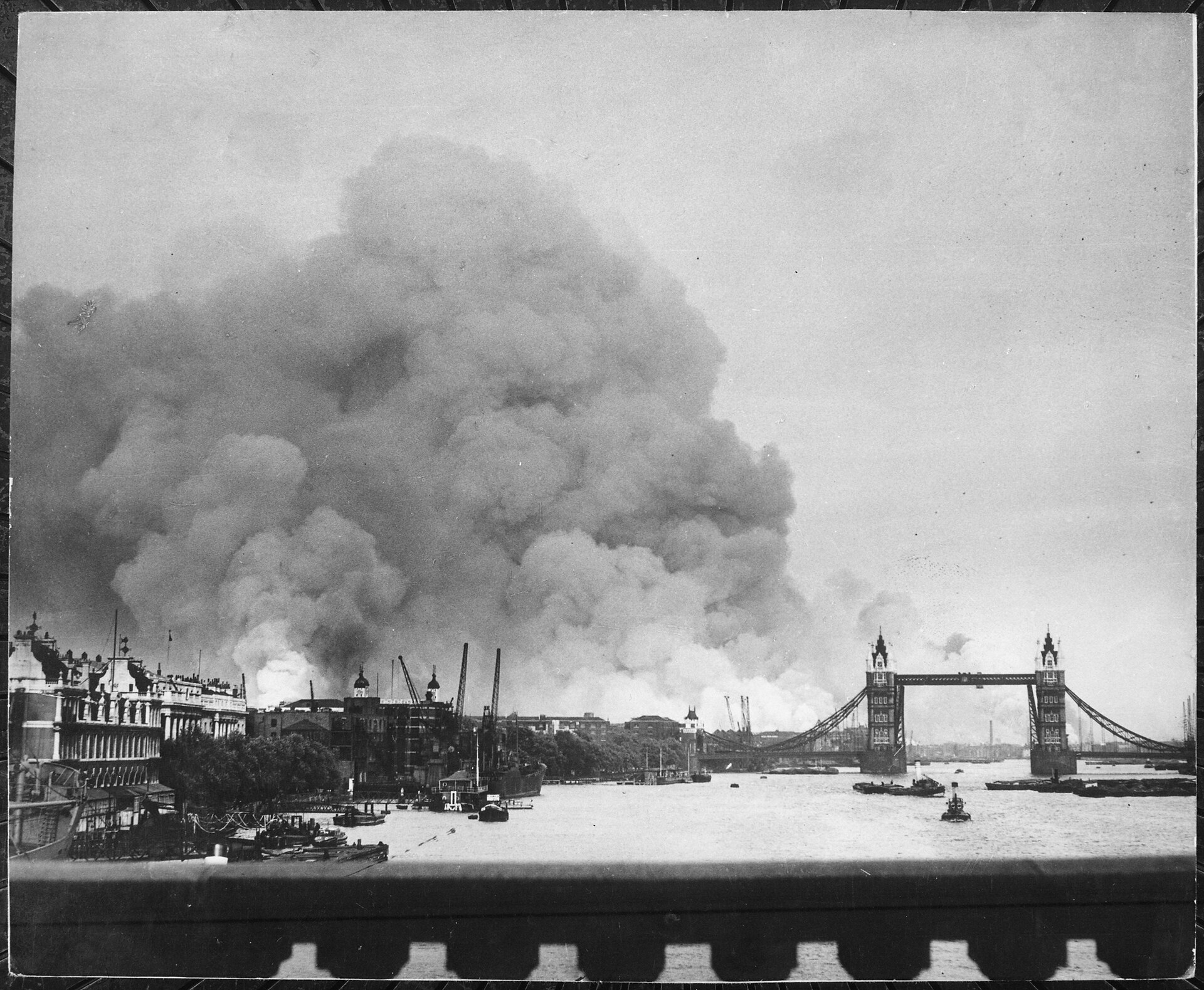
The Blitz
The Luftwaffe shifted its main bombing effort onto London on 7 September 1940 and then carried sustained night attacks to ports and industrial cities across Britain. Roughly 43,000 to 43,500 civilians were killed during the Blitz and around two million homes were destroyed or damaged. The attacks caused severe local disruption but did not force Britain out of the war or produce the collapse in morale German leaders had hoped to achieve.
As daylight losses mounted, German bombing moved increasingly into darkness, where navigation and target identification were poor. British night defences improved during the winter, while German air units were drawn toward the Balkans and the coming invasion of the Soviet Union. The campaign ended without a strategic decision, leaving both sides with evidence that destroying cities was easier than forcing a government to surrender.

Area Bombing Begins
The Butt Report, circulated on 18 August 1941, found that only about one aircraft in three recorded as attacking had come within five miles of its assigned target, with results in the Ruhr worse still. The Air Ministry's directive of 14 February 1942 then focused Bomber Command on the morale of the enemy civil population, particularly industrial workers, and built-up areas became the general aiming points for the night offensive.
Lübeck, Rostock and the thousand-bomber raid on Cologne showed how concentration, incendiaries and improved navigation could destroy large urban areas even when individual factories could not be identified reliably at night. Gee and later Pathfinder methods improved concentration, but the policy remained an area campaign. That British method would continue alongside a very different American daylight doctrine.

The Combined Bomber Offensive
The Casablanca directive of 21 January 1943 placed British night bombing and American daylight bombing inside one strategic programme while leaving the two forces with different methods and chains of command. The formal Pointblank directive followed on 10 June and made the German fighter force and the industries supporting it an immediate priority before the invasion of France. Bomber Command attacked the Ruhr, Hamburg and Berlin while the Eighth Air Force struck aircraft plants, ball-bearing works and other industrial systems by day.
The American crisis came from deep penetration before long-range escort was available: sixty of 376 heavy bombers dispatched on the Schweinfurt–Regensburg mission were lost on 17 August, and another sixty of 291 on the second Schweinfurt mission on 14 October. Bomber Command inflicted catastrophic urban destruction, especially at Hamburg, but its Berlin offensive also cost heavily without breaking German resistance. By early 1944, longer-range escort was beginning to change the balance.

Big Week and Air Superiority
Big Week concentrated American daylight and RAF night attacks against the German aircraft industry while long-range escorts increasingly sought the Luftwaffe in combat. P-51 Mustangs extended the escort radius, but P-47s and P-38s also carried substantial parts of the fighter battle. Under James Doolittle the Eighth Air Force's fighters gained greater freedom to range ahead, pursue German aircraft and attack them around their bases rather than remain tied closely to the bomber formations.
German fighter production continued to rise, so Allied air superiority was not produced simply by destroying factories. The more serious German problem was the loss of experienced pilots, compounded by fuel shortages and reduced training time. The pressure continued through attacks on Berlin and the spring campaign. By D-Day, Allied air forces could operate over Normandy on a scale the Luftwaffe could no longer match.

The Transportation Plan
The Transportation Plan directed Allied bombers against marshalling yards, repair facilities, bridges and rail links in France and Belgium before Operation Overlord. Eisenhower made the programme part of the invasion preparation despite objections from strategic-bomber commanders who preferred targets in Germany and repeated concern from Churchill about the number of French and Belgian civilians likely to be killed.
The bombing did not stop all rail movement. German trains used detours, night movement and local repair, but damaged junctions and rolling stock made rapid reinforcement of Normandy increasingly difficult. Target restrictions were revised as the civilian-risk estimates were debated. By D-Day, the rail system in northern France had been disrupted enough to delay the movement of German formations toward the invasion area.

The Oil Campaign
The major American oil offensive opened on 12 May 1944 with attacks on synthetic-fuel plants in Germany and occupied Europe, followed by repeated raids from the Eighth and Fifteenth Air Forces and later sustained RAF participation. The United States Strategic Bombing Survey found that synthetic-fuel output averaged about 316,000 tons a month when the attacks began, fell to 107,000 tons in June and reached about 17,000 tons in September.
The plants were repaired repeatedly and then attacked again. At the same time Romanian oil supplies were bombed and eventually lost as Soviet forces advanced. Fuel shortages reduced operational flying, pilot training and the mobility of German ground forces. Oil was not the sole cause of Germany's defeat, but it was one of the strategic target systems whose effects can be traced directly from bombing to a worsening military constraint.
Sources & Archives
British and American official histories · wartime records · postwar surveys and German recordsWebster and Frankland's official history remains central for Bomber Command because it reconstructs policy, operations and results from Air Ministry and command records and is often critical of the decisions it records. Craven and Cate perform the same function for the United States Army Air Forces. Operational record books at Kew and American mission records provide the contemporary record behind individual raids and losses.
The United States Strategic Bombing Survey is essential for industrial effects because its teams entered Germany after the war and examined production records, plants and officials. It still has to be read as a postwar assessment rather than as a final verdict. Aggregate German civilian death totals vary with territorial boundaries, missing records, foreign workers and the treatment of late-war estimates, so this page gives a range rather than presenting one total as exact.
- The Strategic Air Offensive Against Germany 1939 to 1945, four volumes, Charles Webster and Noble Frankland, 1961HMSO
- The Army Air Forces in World War II, seven volumes, Craven and CateUS Air Force Historical Support Division
- The United States Strategic Bombing Survey, European report, 1945US Air Force Historical Support Division
- Air Ministry records, Bomber Command operational record books, series AIRThe National Archives, Kew
- Luftwaffe records and the defence of the ReichBundesarchiv, Militärarchiv Freiburg
- German civilian deaths from Allied air attack, statistical and historical estimatesStatistisches Bundesamt and German historical scholarship
- The International Bomber Command Centre and the roll of the deadLincoln
- The Blitz and the British civilian record, contemporary observationMass Observation Archive, University of Sussex
- Photographic and film record of the air warImperial War Museums
- Openly licensed photographic material of the air warWikimedia Commons
- Bomber Command personnel and casualty overviewRoyal Air Force Museum
- Civilian deaths from enemy action in the United KingdomThe National Archives, Kew
- The Butt Report, bombing accuracy and the development of area bombingRoyal Air Force Museum
- The Allied Oil Plan and German petroleum productionAir University
- The Transportation Plan before Operation OverlordAir University
- The Crucible of War 1939–1945, Official History of the Royal Canadian Air Force, Volume IIIDirectorate of History and Heritage, Department of National Defence, Canada
Operation chronologyDates, locations and sourced event summaries
| Date | Event | Location | Summary |
|---|---|---|---|
| 7 September 1940 to 11 May 1941 · 01 | The Blitz | Britain | The Luftwaffe shifted its main bombing effort onto London on 7 September 1940 and then carried sustained night attacks to ports and industrial cities across Britain. Roughly 43,000 to 43,500 civilians were killed during the Blitz and around two million homes were destroyed or damaged. The attacks caused severe local disruption but did not force Britain out of the war or produce the collapse in morale German leaders had hoped to achieve. Sources 1, 8, 12 |
| 18 August 1941 to 26 June 1942 · 02 | Area Bombing Begins | Britain and western Germany | The Butt Report, circulated on 18 August 1941, found that only about one aircraft in three recorded as attacking had come within five miles of its assigned target, with results in the Ruhr worse still. The Air Ministry's directive of 14 February 1942 then focused Bomber Command on the morale of the enemy civil population, particularly industrial workers, and built-up areas became the general aiming points for the night offensive. Sources 1, 4, 13 |
| 21 January 1943 to 31 March 1944 · 03 | The Combined Bomber Offensive | Britain, Germany and occupied Europe | The Casablanca directive of 21 January 1943 placed British night bombing and American daylight bombing inside one strategic programme while leaving the two forces with different methods and chains of command. The formal Pointblank directive followed on 10 June and made the German fighter force and the industries supporting it an immediate priority before the invasion of France. Bomber Command attacked the Ruhr, Hamburg and Berlin while the Eighth Air Force struck aircraft plants, ball-bearing works and other industrial systems by day. Sources 1, 2, 3, 5 |
| 19 to 25 February 1944, and the road to air superiority · 04 | Big Week and Air Superiority | Germany and occupied Europe | Big Week concentrated American daylight and RAF night attacks against the German aircraft industry while long-range escorts increasingly sought the Luftwaffe in combat. P-51 Mustangs extended the escort radius, but P-47s and P-38s also carried substantial parts of the fighter battle. Under James Doolittle the Eighth Air Force's fighters gained greater freedom to range ahead, pursue German aircraft and attack them around their bases rather than remain tied closely to the bomber formations. Sources 2, 3, 5 |
| 6 March to June 1944 · 05 | The Transportation Plan | France and Belgium | The Transportation Plan directed Allied bombers against marshalling yards, repair facilities, bridges and rail links in France and Belgium before Operation Overlord. Eisenhower made the programme part of the invasion preparation despite objections from strategic-bomber commanders who preferred targets in Germany and repeated concern from Churchill about the number of French and Belgian civilians likely to be killed. Sources 1, 2, 15 |
| 12 May 1944 to April 1945 · 06 | The Oil Campaign | Germany, occupied Europe and Romania | The major American oil offensive opened on 12 May 1944 with attacks on synthetic-fuel plants in Germany and occupied Europe, followed by repeated raids from the Eighth and Fifteenth Air Forces and later sustained RAF participation. The United States Strategic Bombing Survey found that synthetic-fuel output averaged about 316,000 tons a month when the attacks began, fell to 107,000 tons in June and reached about 17,000 tons in September. Sources 2, 3, 14, 16 |
Image rights. Material credited to the Imperial War Museums is used under the IWM Non-Commercial Licence. Material credited to the US Army Air Forces and NARA is in the public domain. Material credited to the Bundesarchiv is licensed CC BY-SA 3.0 DE. Civilian death figures for the bombing of Germany are contested and are given as ranges with the authority named.